Plaud NotePin is for the person who leaves a good conversation with a bad page of notes. The consultant who spent the meeting typing instead of reading the room. The student who underlined everything and retained the highlighter. The field engineer whose useful detail arrived while both hands were occupied. Clip this pill-shaped recorder to a shirt, ask everyone if recording is all right, press it, and get back to listening. Later, the Plaud service turns the audio into a transcript, speaker labels, a summary, action items, and a mind map. The appeal is less science fiction than sensible choreography: the recorder is already where your hand can find it.
The case for one more object
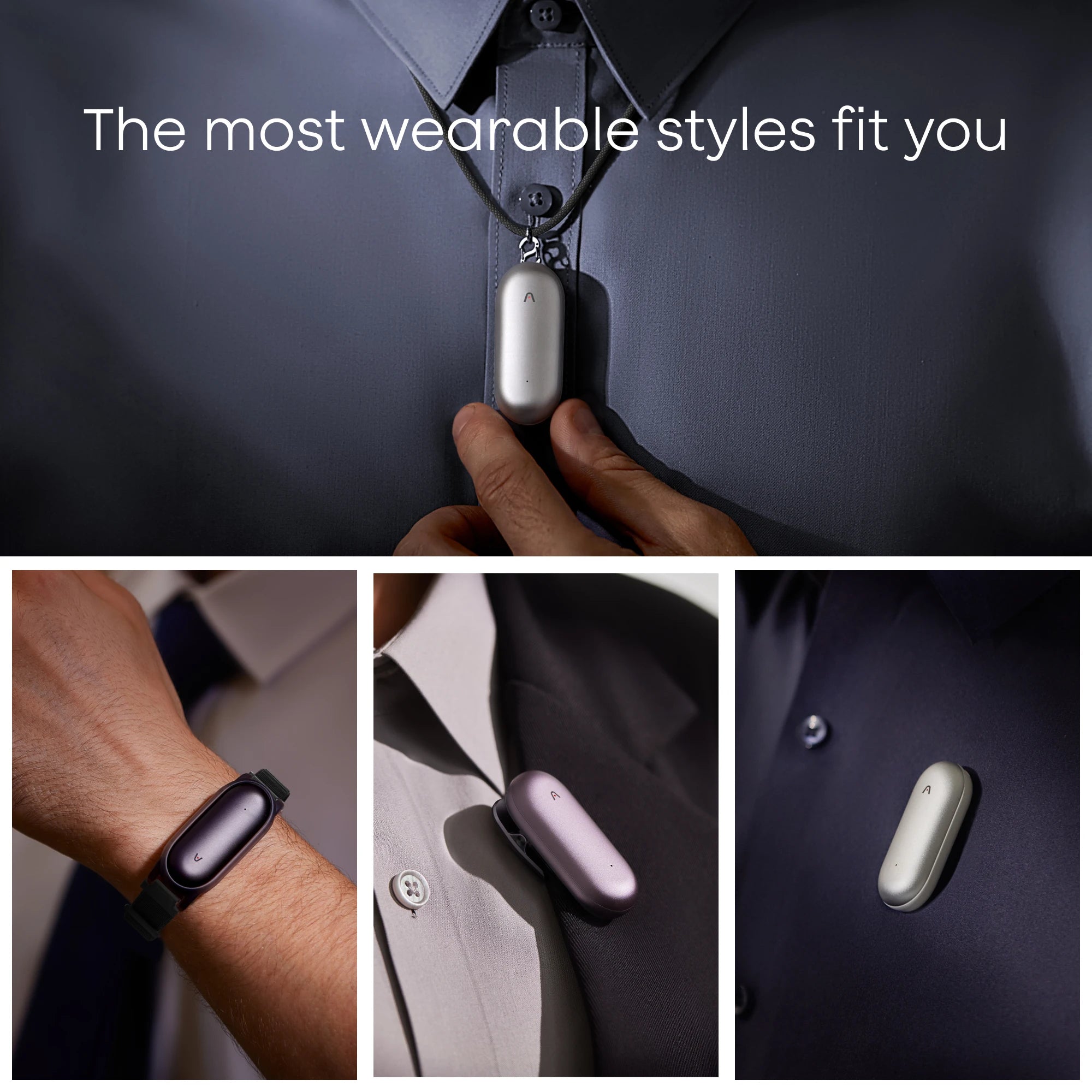
Your phone already has microphones, storage, and apps that can transcribe. A dedicated recorder must therefore win on habit. NotePin weighs 16.6 grams and can live on a collar, pocket, lanyard, or optional wristband. It has no feed to check and no glass rectangle asking for attention. In a face-to-face interview, a site walk, or a lecture, that narrow purpose is the point.
A likely buyer records in-person speech often and needs the result in a useful shape. Reporters can preserve quotes while watching an interviewee. Clinicians can focus on a patient, assuming their organization approves the workflow. Salespeople can leave with objections and follow-ups sorted. Teachers and students can revisit dense explanations. Creators can collect a walking monologue before it evaporates. If nearly all your meetings happen in Zoom or Teams, software such as Granola, Otter, or Fireflies may be the shorter route. Plaud Desktop now covers online meetings too, but the pin itself earns its keep away from the laptop.
What happens after the press
The hardware records audio to 64GB of local storage, so an internet connection is not required in the room. When the NotePin reconnects to the Plaud mobile app, a standard transfer begins over Bluetooth; a Wi-Fi fast-transfer option handles larger files. The cloud step comes next. Plaud Intelligence transcribes the recording, separates speakers, and generates the selected form of notes. The company says cloud storage is regional, using AWS infrastructure in Oregon for the Americas, Frankfurt for EU and EEA accounts, Singapore for much of Asia-Pacific, and Japan for Japanese accounts.
Capture
Press, feel the vibration, and record locally. No phone needs to sit on the table.
Transfer
Reconnect to the app. Bluetooth starts the move; Wi-Fi can hurry a large file along.
Use
Generate a transcript, choose a summary, ask questions, then export the useful parts.
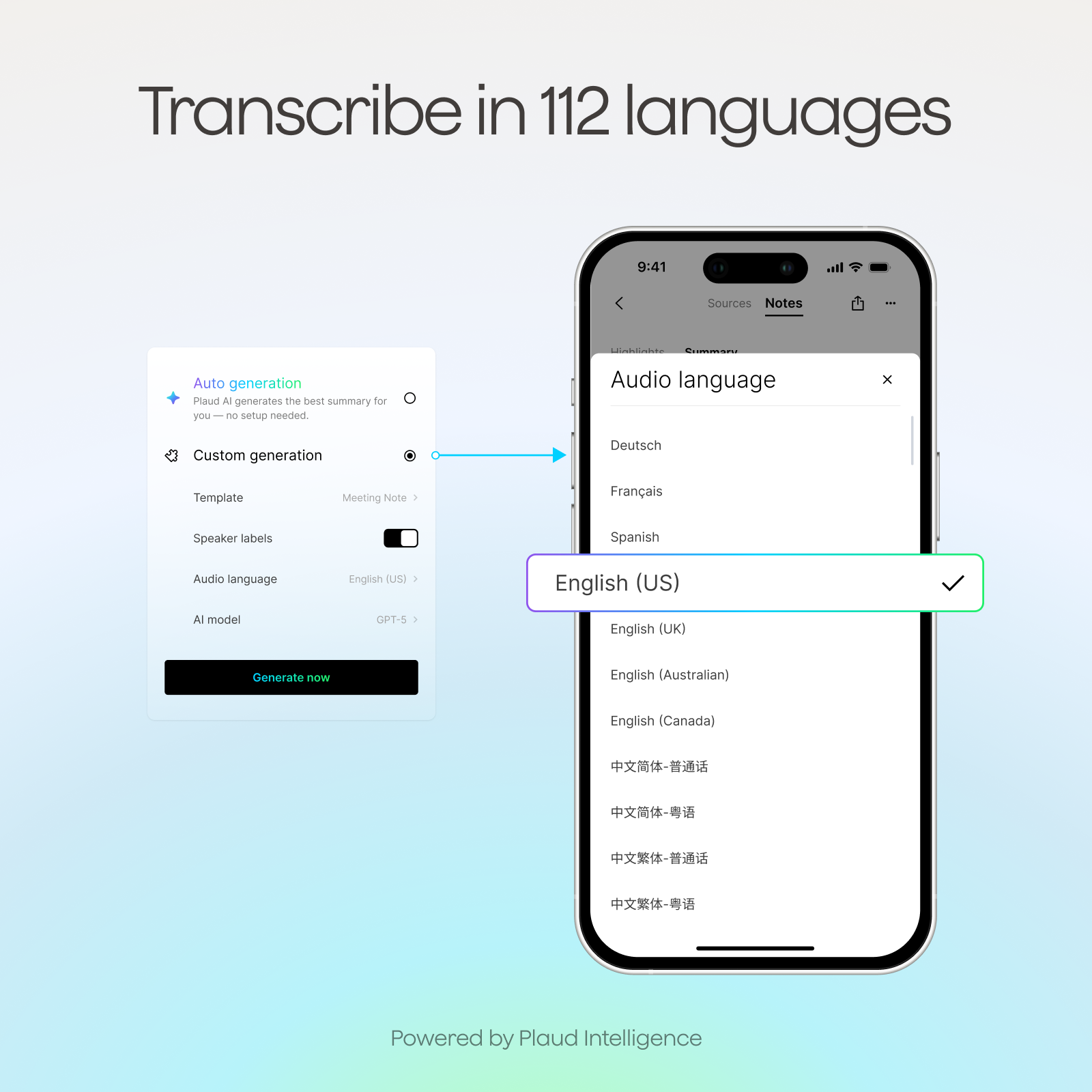
Plaud has pushed the software beyond a block of text. There are more than 10,000 summary templates, plus custom vocabulary for names and specialist terms. Ask Plaud answers questions against a recording and links back to its source. Plaud Intelligence 3.0 added text and image context, multidimensional summaries, and highlights that tell the system which moment mattered. Exports are refreshingly ordinary: transcripts can leave as TXT, SRT, DOCX, or PDF; summaries as text, Markdown, DOCX, or PDF; audio as MP3 or WAV depending on platform; mind maps as PNG or Markdown. Your notes are not trapped in a novelty file format.
“Plaud nailed the NotePin's design and form factor.”Brady Snyder, Android Central, after wearing it for a week
The free plan has a stopwatch
The $159 purchase includes 300 transcription minutes each month. That sounds roomy until work supplies five hour-long meetings. Light users can stay on the Starter plan indefinitely, and the recorder remains useful as a recorder. People who want every meeting processed should budget for software. Plaud currently lists Pro at $99.99 a year for 1,200 minutes per month, with a $17.99 monthly option. Unlimited is $19.99 per month when billed annually or $29.99 month to month. Prices and features can vary by country, so check the checkout page rather than treating those figures as permanent.
Monday to Friday, one long meeting a day, free allowance gone. Count your real calendar before buying.
That arithmetic creates the product's central tension. The dedicated hardware is useful because it makes recording effortless; effortless recording consumes minutes. A buyer who only needs two interviews and a few memos each month gets a better deal than a manager who wants every conversation summarized. The latter may still save enough administrative time to justify Pro or Unlimited, but the subscription belongs in the purchase decision, not in the surprise column.
How it sits beside the alternatives
NotePin earns its place where meeting bots cannot go: a workshop, classroom, conference corridor, home visit, or table for two. Its closest competition includes other wearable recorders and phone apps, but many buyers are really choosing among three different habits. Wear a dedicated device, place a phone in the room, or invite software into a call.
| Choice | Setting | Useful edge | Watch for |
|---|---|---|---|
| Plaud NotePin | In-person, mobile work | Small, offline capture, structured outputs | Cloud processing and minute limits |
| Plaud Note / Note Pro | Desk meetings and phone calls | Phone-call recording mode; Pro adds a status display | Less natural to wear |
| Otter / Fireflies | Online meetings | Calendar and conferencing workflows | Bots, platform dependence, subscriptions |
| Phone recorder | Occasional capture | Already owned, sometimes free transcription | Friction, distraction, placement |
What reviewers found in the room
Independent testing lands in a believable middle. TechRadar praised the compact wearable approach, searchable transcripts, and summary tools, while noting that the free minutes vanish quickly and integrations were limited in its test. Tom's Guide gave the NotePin four stars and highlighted its ability to organize messy brainstorming. Android Central liked the form factor but found transcription merely adequate and encountered a slow cloud-processing episode despite a fast internet connection. Wired Italia reported that it handled multiple speakers well during a live panel.
Owners have also documented rougher edges. An early Reddit review described a fussy pressure-sensitive start gesture and a failed phone connection, then later added that firmware updates made the NotePin more reliable. Other threads complain about transfers, accidental long recordings, and customer support. These are anecdotes, not failure-rate data, but they point toward the practical test every new owner should run: make several short recordings, confirm the vibration and LED, transfer them, and learn the reset procedure before trusting the pin with a crucial hour.
A wearable recorder is useful only after two habits form: confirm that it started, and tell the room that it did.
The awkward part is human, not technical
A discreet recorder can easily become a socially loud object. Plaud advises users to obtain consent, and that is the right default. Recording law varies by jurisdiction; workplaces, schools, clinics, and client contracts may add stricter rules. A simple explanation usually works: you would like to use an AI note-taker so you can stay present, and you can share the notes afterward. If someone hesitates, put it away.
Sensitive work deserves another check. Plaud lists ISO 27001 and 27701 certifications, SOC 2 Type II, and alignment or compliance claims for GDPR, HIPAA, and EN 18031. Those credentials help a procurement review; they do not automatically approve a particular use. A clinician still needs the right agreement and organizational policy. A lawyer still has client duties. Everyone should understand that audio is local during capture but must reach Plaud's cloud for transcription and AI output.
Original NotePin or the newer S?
Plaud launched NotePin S at CES 2026 for $179. It is the current successor, with a physical Highlight button designed to mark important moments during recording and all four wear options in the box. The original $159 NotePin uses a pressure-sensitive surface and includes the magnetic pin and clip, while the wristband and lanyard cost extra. Both feed the same Plaud software ecosystem. If the $20 gap holds at checkout, buyers who want tactile certainty or the extra mounts should lean toward S. A discounted original remains sensible for someone who mainly clips it to a collar and does not need hardware highlights.
Pin it on
- You conduct regular in-person interviews or meetings.
- Your notes need action items, quotes, or searchable recall.
- A phone on the table breaks your attention.
- You have a clear consent and data policy.
Leave it off
- You mostly meet online and already like your meeting app.
- You record fewer than a handful of times each month.
- You cannot upload audio to a cloud service.
- You expect flawless distant-room transcription.
The verdict
Plaud NotePin solves a modest problem with unusual discipline. It stays close, starts quickly, records for a working day, and turns speech into material you can search and share. The summaries are the payoff, but availability is the feature that changes behavior. You can listen because your note-taking hand has been reassigned.
Buy it after two calculations. First, count the in-person hours you genuinely need transcribed; that reveals the likely subscription. Second, count the rooms where recording is welcome and permitted. If both numbers are healthy, the NotePin can recover time and attention without demanding another screen. If they are small, test the recorder already in your pocket. The clever purchase is the one that fits the conversation habits you already have.