In a trucking company, a gallon of diesel is both ordinary and oddly anonymous. The driver stops, the pump clicks, the receipt arrives. Somewhere later, an accountant tries to decide whether that purchase belonged to that driver, in that vehicle, on that route. By then, the fuel is gone. Vikram Sekhon knew the rhythm from running a fleet that dispatched 120 to 250 trucks a day. Fuel was his second-largest expense after payroll. It was also, in his telling, the most chaotic one to manage.
He and fellow fleet operator Shivam Shah tried the available cards. Their complaint was specific: fraud kept appearing, fees were hard to predict, and each month ended in a reconciliation exercise. A card might know its account number; the business needed to know the truck. That mismatch became Piston, the Cupertino company they founded in 2024.
- Piston lets commercial drivers buy fuel through an app, with no physical fuel card.
- Before authorization, its system checks the driver, device, vehicle, pump, location and fleet rules.
- Fleets get live spending records; participating stations get access to fleet demand and can negotiate rebates.
- Piston says its network reached more than 2,000 stations in 48 U.S. states by September 2026.
The expensive little rectangle
A conventional fuel card solves a real problem: it lets a company issue purchasing power to drivers, set limits and collect data. Large providers such as WEX also offer detailed controls. Piston's objection is more pointed. A physical card can be lost, skimmed, shared or used apart from the vehicle it was meant to serve. An exception report can flag a purchase, but the strongest moment to make a decision is before the pump starts.
Sekhon has offered a remarkably plain measure of the old arrangement. His fleet spent roughly $3 million a year on fuel, he said, while receiving the same price as a single motorist in a Honda Civic. He also estimated that fraud had consumed more than 5% of fuel spending in his former operation. Those are his operating claims, not a promise that every fleet will save the same amount. They do explain why a company would attempt the unglamorous job of building a new payment network.
“Fuel was our second-largest expense after payroll, and the most chaotic to manage.”Vikram Sekhon, co-founder and CEO

Make the truck part of the transaction
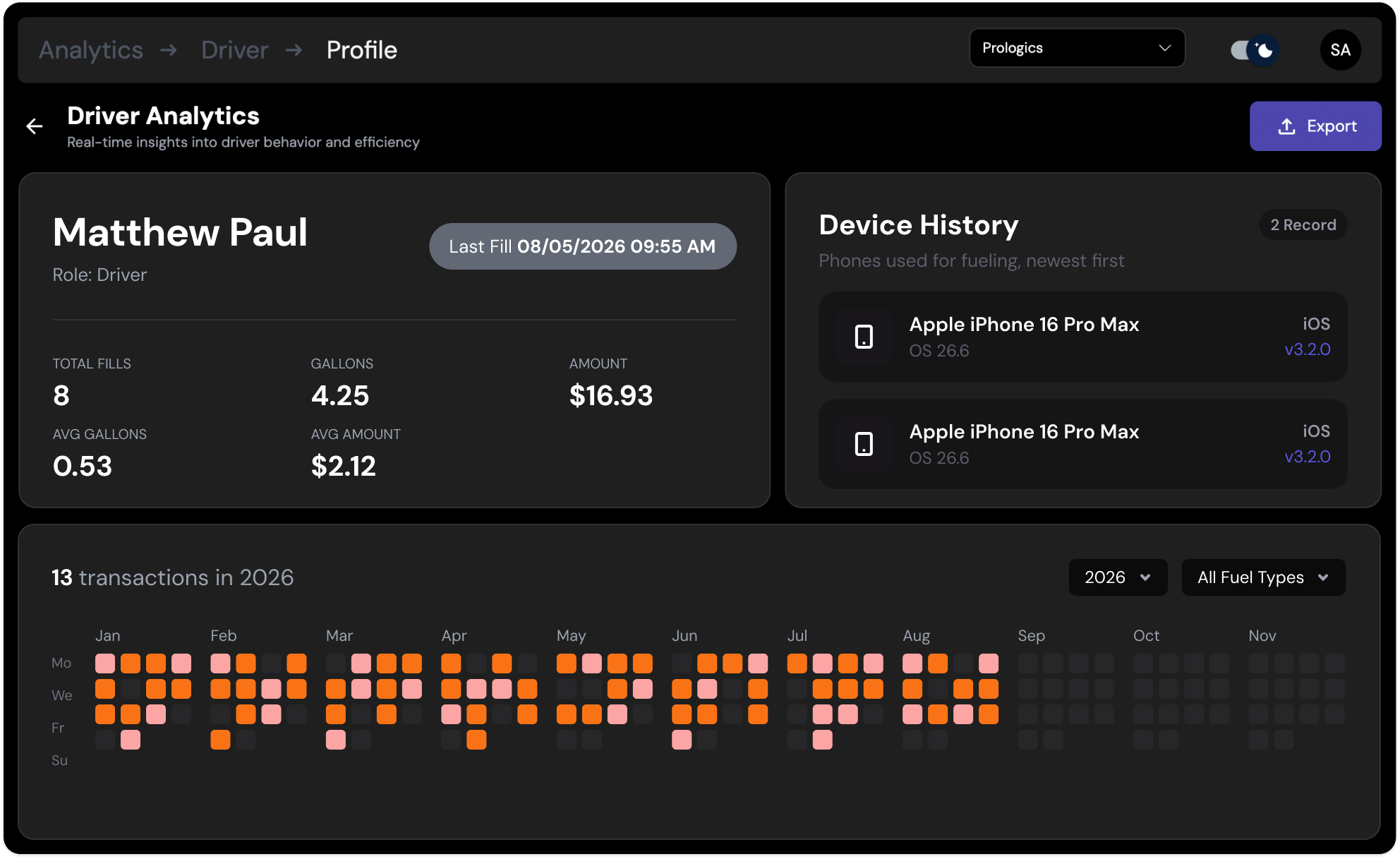
The driver's visible task is short. Open Piston's app, choose a station and pump, and request fuel. At most enabled sites the pump unlocks directly; QR codes and authorization codes remain options at other participating locations. Behind the screen, Piston checks identity, device, vehicle assignment, location, fuel type, tank capacity, telematics signals and the fleet's own rules. The purchase is tied to a specific driver and vehicle before authorization, then appears in the fleet dashboard.
A purchase becomes a decision about the whole trip, not merely the account number.
Consider a last-mile delivery route with drivers swapping vans. The fleet manager can revoke one driver and assign another without waiting for a replacement card. For a plumbing contractor, a technician can be permitted to buy the right fuel within the work area and shift window. An over-the-road carrier can set rules around lanes and preferred stations. Piston sells the same underlying platform to each, then changes the policy around the way that fleet actually works.
There are two businesses at every pump
Piston must persuade the fleet and the station owner. The fleet wants fewer questionable gallons, less card administration and a better price. The merchant wants repeat commercial traffic and a way to offer terms without surrendering the customer relationship to a chain of intermediaries. Piston says it connects both sides through its own cardless rails, pays the station and invoices the fleet. It negotiates discounts at individual sites and returns them as monthly rebates.
This makes the map as important as the app. A network of 2,000 stations sounds broad; a fleet cares about the three stops on Tuesday's route. Piston says it studies a customer's markets, preferred stations and lanes during onboarding, then works to add missing locations. That is a useful warning for anyone copying the model: distribution must fit the customer's real journey. A pump on the wrong highway might as well be on the moon.
A card and its controls authorize a purchase; managers review the resulting data and exceptions.
The driver, vehicle, station and fleet policy are checked as the fuel purchase is requested.
Its announced acceptance at more than 800 Maverik locations in late 2025 was a practical step toward that density. By September 2026, Piston said it was live at more than 2,000 stations across 48 states. It also said its point-of-sale integrations were certified and live on systems that represent more than 95% of U.S. merchant fuel sites. That last figure describes the systems Piston can connect to, rather than stations already accepting it. The distinction matters when a driver is standing at a particular pump.
A network has to earn its numbers
In June 2025, Piston reported more than 120 fleet customers, 800 stations and over $20 million in annualized transaction volume. A September 2026 announcement said payment volume had grown eightfold year over year and the merchant network 40-fold, while customer retention stood at 98%. Those are company-reported figures. They describe fast expansion, but the more revealing test is operational: can the network approve the legitimate fill quickly, decline the wrong one, and put a useful record in front of the manager?
September 2026
reported coverage
after Series A
The $15 million Series A, led by FPV Ventures with Spark Capital and Pear VC participating, gives Piston money to extend that network and develop the product. Its two newer tools are Piston Guard, which looks for anomalous transactions and can flag or block suspected fraud, and Piston Analytics Agent, which answers questions about spending in plain language. The artificial intelligence is an assistant to the underlying transaction design; a clever explanation of a bad purchase cannot refund the gallon.
There is a revealing detail in how the company works. Sekhon says his own fleet, now more than 100 trucks across seven states, pays through Piston every day. That makes him a live customer of his own infrastructure. The company also says its engineering team is based in Kolkata, where its office has grown to more than 25 people. The pumps are American; much of the machinery behind them is built halfway around the world.
The lesson in the nozzle
Piston is not a universal answer to fuel spending. A fleet needs participating stations on its actual routes, drivers able to use the mobile flow, and accurate vehicle and policy data. Those are substantial conditions. They also clarify what the company has built: a payment method whose usefulness depends on the quality of the network and the truth of the context it checks.
The copyable idea is smaller and more interesting than a cardless app. Find the moment a bad decision becomes expensive, then move the check to just before it. Piston found that moment at the pump. The accountant may still have a receipt to inspect, but the truck now gets a vote before it fills.
Continue the route