A truck can be available and a construction job can still go begging. In a review of unclaimed work on its own marketplace, Trux found the largest primary cause was the quality of the job posting. Haulers wanted notice, a competitive rate and enough detail to decide whether the day would pay. The company advises customers to post 24 to 48 hours ahead. Even the hour matters: jobs posted before 1 p.m. local time are more likely to fill, it says, because drivers often hunt for tomorrow’s work at lunch.
This is a fine way to puncture the usual romance of marketplaces. A map full of pins is useless if each pin hides the wrong truck type, an uncertain day length or a rate that does not cover the haul. Trux, founded in 2015, began with the appealing idea of connecting idle dump trucks to contractors and material producers. The business it built is about making the work legible to everyone who touches it.
- Trux offers a dump truck marketplace plus dispatch, tracking, ticketing and payment tools.
- Its customers include aggregate and asphalt producers, contractors, fleet owners, brokers and independent haulers.
- The practical lesson: better information can unlock capacity already in the market.
A phone call has a long tail
The founders, cousins Richard and Michael Saccone, knew an industry where dispatchers spent hours calling truck owners while drivers sometimes sat idle. Finding a match was the obvious first act. The less obvious second act was keeping a plant, a dispatcher, a driver and a job site in agreement after the match. A late load of gravel is inconvenient; a mistimed asphalt delivery can set off delays across a paving day.
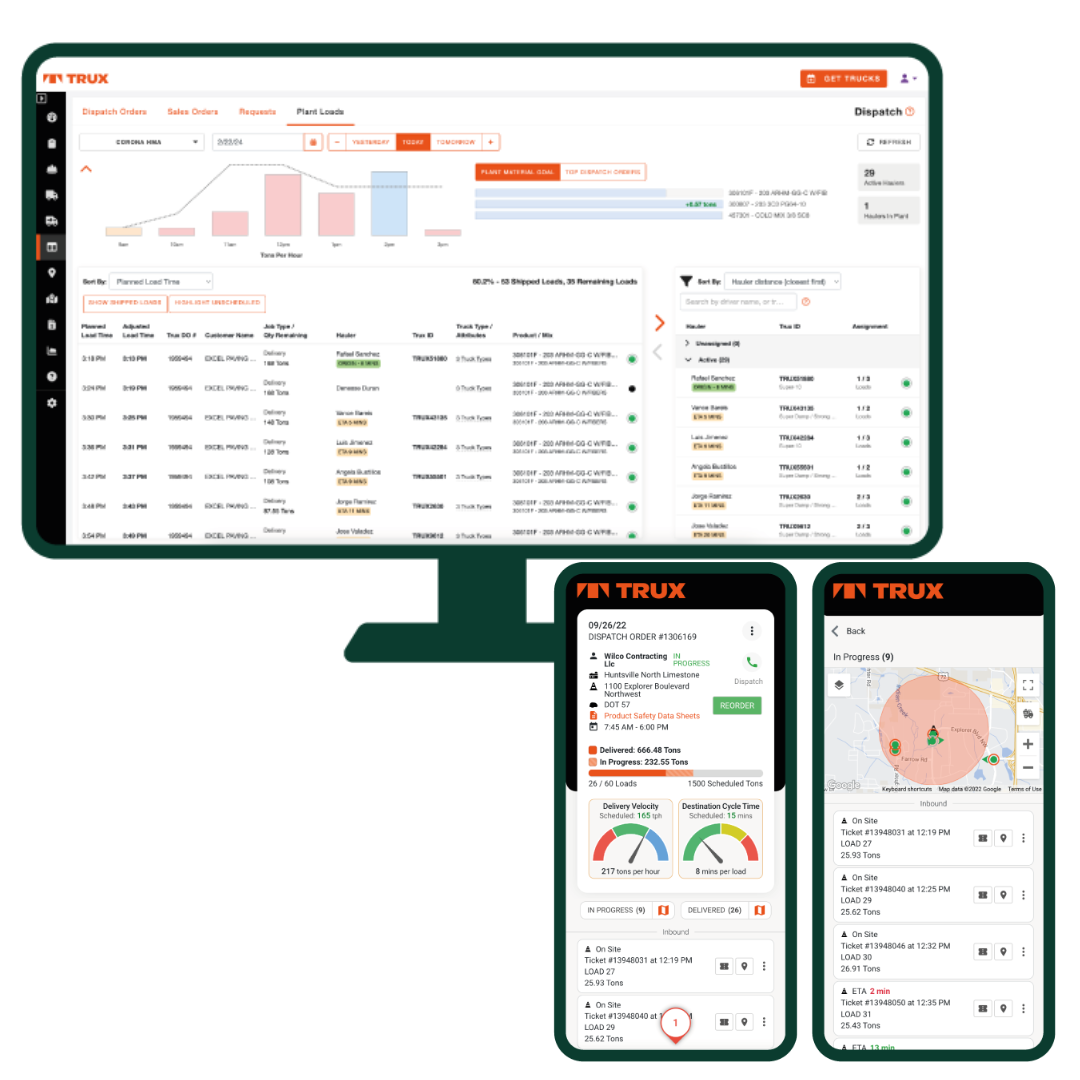
Trux’s first Digital Dispatch installation went live at a plant in November 2018. It joined sales orders to dispatch orders, assigned haulers, tracked shifts and managed weekly payment to third-party drivers. In its first full year, the company added visual alerts for over-assigned orders, truck filters, time-stamped route histories and staggered start times. Those are small, unglamorous features. They are also the features a dispatcher needs at 6 a.m. when several trucks threaten to arrive at the plant together.

The product later called Trux Deliver expanded beyond dispatch. Delivery Tracker, introduced in 2019, let customers see the trucks and loads attached to an order. Ticket data, ETAs, arrival times and delivery velocity followed. In other words, the company moved from asking “Who will take this job?” to “What is happening to this order?” That change explains its present menu better than any list of features.
“We can speak to the customer knowing they see what we see.”Vulcan Materials dispatcher, in a Trux case study
The software follows the material
A material producer can use Trux Materials to assign owned trucks, regular contractors and haulers from the marketplace. The dispatcher can stack loads, move assignments as the day changes and watch trucks at the plant and on the road. The customer can use Delivery Tracker to see what is inbound and what has arrived. A digital ticket records the scale and delivery details. For a contractor, Trux Construction supplies dispatch and fleet management. For a hauler, the Drive app presents available work, instructions, schedules, completed loads and earnings.
This combination is Trux’s distinction in the market. Conventional fleet software can locate a truck; a load board can advertise a job. Trux links the marketplace to the plant’s daily operating desk and the customer’s delivery view. Its public terms describe it as a technology provider and limited broker, with third-party operators doing the hauling. The company charges for software access and marketplace services under customer agreements. Its terms say the marketplace service fee is generally a percentage of the billable haul amount; there is no public flat price to quote.
The price of a missing detail
Trux’s marketplace study reads almost like a field guide to human incentives. Post a full day of work. State the material and truck requirements. Give the pickup and drop-off points so the hauler can estimate fuel and travel time. If notice is short, consider a higher rate. Hourly jobs tend to fill more readily than per-ton or per-load jobs, the company says, because traffic and queues can otherwise eat into the driver’s pay. Customers can offer work to favorite haulers first, then widen the invitation to approved marketplace drivers.
None of this can conjure a qualified truck from nowhere. It can, however, reduce the number of qualified drivers who decline a job because it reads like a mystery. For a business that began as a matching service, the lesson is pleasingly severe: the match is only as good as the instructions.
Those are Trux’s reported 2024 platform figures, not a measure of savings for every customer. Its February 2024 announcement said the delivery platform was live in more than 500 aggregate and asphalt plants and had handled more than 11.5 million loads cumulatively. A Vulcan Materials case study reports 2.5 more loads per truck, though it does not publish enough detail to treat that as a general benchmark. The useful point is narrower: when a producer can see plant flow and customer demand at the same time, it can make better decisions about the next truck.
A marketplace grows up
The company’s path from spare capacity to operating software is visible in its chronology. The 2018 product had a utilitarian name, Digital Dispatch. It became Trux Deliver because the work had spread to plant operations, job site productivity, electronic ticketing and customer communication. In 2021, Trux announced a broader SaaS platform and rebrand. The market it serves is still stubbornly physical: rock must be crushed, asphalt must stay workable, and a truck must show up. The software wins only when it makes those physical constraints easier to manage.
For a small contractor, the immediate value may be a vetted extra truck without a week of onboarding paperwork. For a producer, it may be an order dashboard that exposes a slow plant turn before the paving crew runs short. For a driver, it may be a clear shift and a reliable record of earnings. These are different buyers with one shared frustration: each used to learn too late what someone else already knew.
What to borrow
Before adding capacity, improve the information attached to each job. Publish earlier, specify the equipment and route, say how the driver will be paid, then track what happened from assignment to ticket. The cheapest new truck may be the one already waiting for a job it can understand.
Trux has no monopoly on the construction site’s future. It does have a pointed theory of the present: a load is not complete when the truck accepts it, or even when it reaches the gate. It is complete when the material, the record and the payment all arrive together. A surprisingly large business can fit inside that interval.