The useful thing about a fuel pump is that it does not care about your pitch deck. A driver needs diesel; a fleet manager wants a clean receipt; a business owner wants to know whether the purchase belongs to a real truck. In 2020, AtoB’s founders went to trucking hubs and listened. The answer they carried back to San Francisco was less glamorous than their original idea, an “Uber for buses.” It was also a better business: make the money around a truck move as sensibly as the truck itself.
- AtoB sells fleet cards, fuel discounts, spend controls, payments and credit tools to US transportation businesses.
- Its distinctive move is to connect card transactions with vehicle data, so location and tank capacity can inform fraud checks.
- The current site says more than 35,000 fleets use its fuel card; the 2024 Series C combined $130 million in equity and debt.
- Its cards have published setup and monthly fees. The test is net savings on a fleet’s actual routes.
The bus was the wrong vehicle
Vignan Velivela had worked on robotics at Cruise. Tushar Misra came from Uber. Harshita Arora had built a cryptocurrency price-tracking app. Together they tried a bus service concept. Then the pandemic arrived, and the founders found a more stubborn problem in trucking. Velivela told Forbes that visits to places such as Stockton, California, introduced them to fuel cards and to the frustrations surrounding them: opaque charges, old software, and cards that knew too little about the vehicles they served.
That change of mind is the hinge of the story. The founders had looked for a transport network to build. Truckers pointed them toward the financial network already in place, with its gaps and delays. AtoB, founded in 2019, set about replacing parts of that experience with a card, a driver app and a management dashboard. It is a case of paying attention to a dull complaint until it becomes an interesting company.



At the pump, a purchase is a decision
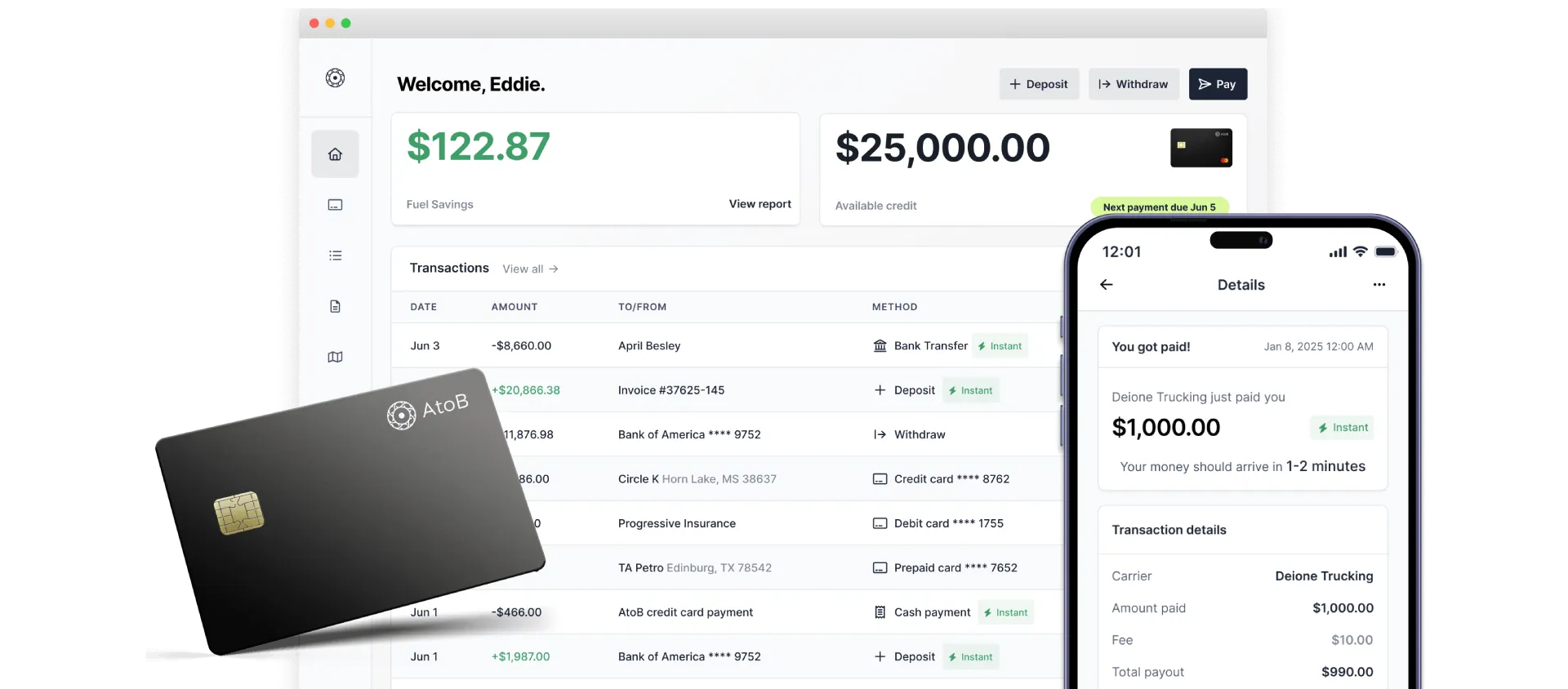
AtoB’s flagship fleet card buys fuel and other eligible vehicle expenses wherever its card network is accepted. Participating stations offer discounts; the driver app helps locate them. Managers can set transaction limits, restrict merchants, define operating hours, deactivate cards and inspect purchases as they happen. Credit and prepaid versions serve different cash-flow situations. The dashboard puts transactions in a place where someone can act on them before a month-end statement arrives.
The cleverer question is whether a purchase makes sense. AtoB describes telematics checks that compare a card transaction with the associated vehicle’s location and fuel capacity. If a card is used miles from its truck, or asks for more fuel than the tank can hold, the transaction can be flagged or blocked. Its advertised $250,000 fraud guarantee is conditional on connecting vehicle telematics. This matters more than another colorful chart: a manager can write a policy that follows the physical business.
AtoB’s own published average is 42 cents per gallon for truck diesel bought by its customers at merchant partner truck stops during the second half of 2025. It is a precise claim with a precise boundary, not a promise for every pump in America. The current site also advertises more than 35,000 fleets. An owner-operator, a local service company with vans, and a long-haul carrier may all use the same card, but their economics will differ sharply with route, fuel type, station choice and usage.
The price of a cheaper gallon
AtoB’s early coverage described a zero-fee card. Its current published pricing is more specific: the fuel-card page lists a $35 account setup charge and monthly active-card fees. The prepaid Unlimited plan lists $3 per month for one to five cards, with additional cards priced separately. The credit Flex plan lists a $15 monthly minimum for one to five cards, then additional per-card charges. Premium features and financing have their own terms. “No transaction fee” is a useful distinction; “free” would be the wrong word.
For a fleet comparing cards, the arithmetic is portable. Start with gallons bought at stations the trucks already pass. Apply the discounts actually available on those routes. Subtract the card charges, any financing cost, and the cost of a detour. Then count the less visible gains: fewer unauthorized transactions, less time matching receipts, and faster access to cash. The best advertised discount can lose to a smaller one if getting it sends a driver out of the way.
When a card becomes a desk
Fuel was the entrance, not the entire building. AtoB now offers Driver Pay to eligible fuel-card customers, with instant transfers and tools for 1099 reporting. It does not process W-2 payroll. Its broader instant-payments product lets fleets and their partners send money around the clock through supported bank, card and wallet methods. Credit tools aim to cover fuel and selected operating costs such as repairs and towing. Each addition addresses a familiar trucking problem: the truck works on Saturday, the bill arrives on Saturday, but conventional money can still be waiting for Monday.
AtoB also sells through the companies that already touch fleets. Uber Freight launched a co-branded carrier card with AtoB in 2023, combining fuel purchasing with spend tools inside its carrier experience. A 2024 agreement with Mastercard broadened the card network relationship. The company markets payment tools to freight brokers and factoring companies as well. Distribution through a trusted industry partner can put a card in front of a carrier at precisely the moment a load, invoice or fuel bill makes it useful.
“We want payments to be as reliable as the internet.”Vignan Velivela, speaking to Forbes in 2022
The financing follows the same split as the product. In 2022, AtoB reported a $155 million round, made up of $75 million in equity and $80 million in debt, at a reported $800 million valuation. The 2024 Series C added $130 million in combined equity and debt, led by General Catalyst and Bloomberg Beta, with Mastercard participating. Equity helps build the system; debt can help support the working capital a payments and credit business needs. Treating the two as one pile of venture cash would miss the mechanics.
2019 - An early mobility concept gives way to AtoB.
2022 - A $155 million equity-and-debt round accompanies wider fuel-card adoption.
2023 - Uber Freight brings AtoB’s card and tools into its carrier offering.
2024 - Mastercard partnership and $130 million Series C.
A small lesson from a large tank
AtoB sits between older fleet-card providers such as WEX and Comdata, and newer open-network rivals such as Coast and RoadFlex. It does not own the truck or the fuel station. Its position is the seam between a physical journey and a financial record. If a fleet can see the price before buying, approve the purchase while it happens and pay a driver when the work is done, the card becomes an operating tool rather than a piece of plastic.
The idea is worth copying in other industries with moving crews: watch where the work takes place, learn which payment delay actually hurts, and attach a control to the transaction itself. It requires trustworthy operational data, enough participating merchants to make discounts real, and economics that still work after fees. A vehicle without connected telematics gets fewer fraud checks; a route with few participating stops captures less of the advertised saving. The lesson from AtoB’s pivot is admirably unromantic. Ask the person holding the fuel nozzle what is broken. Then build around the answer.