There is a moment in the life of a growing company when “the hiring process” becomes a charming fiction. The warehouse recruits by the hundred. Head office insists on panel interviews. Graduates arrive in cohorts. One country needs a consent step that another does not. A newly acquired brand still speaks in its own voice. Somewhere, a spreadsheet named FINAL_v7 is making decisions it was never designed to make. Pinpoint is built for this moment.
Pinpoint is a web-based applicant tracking system for in-house recruiting teams. Its pitch is unusually specific: one platform for “multi-stream hiring.” In ordinary language, that means a company can run different workflows for shop-floor staff, executives, apprentices and seasonal workers without buying four systems or forcing every vacancy through the same bureaucratic sausage machine.
That makes it most relevant to mid-sized and large organizations with several locations, brands or types of role. A five-person startup making three hires this year can find simpler tools. A retailer hiring Christmas staff, cyber specialists and a finance director at the same time should keep reading.
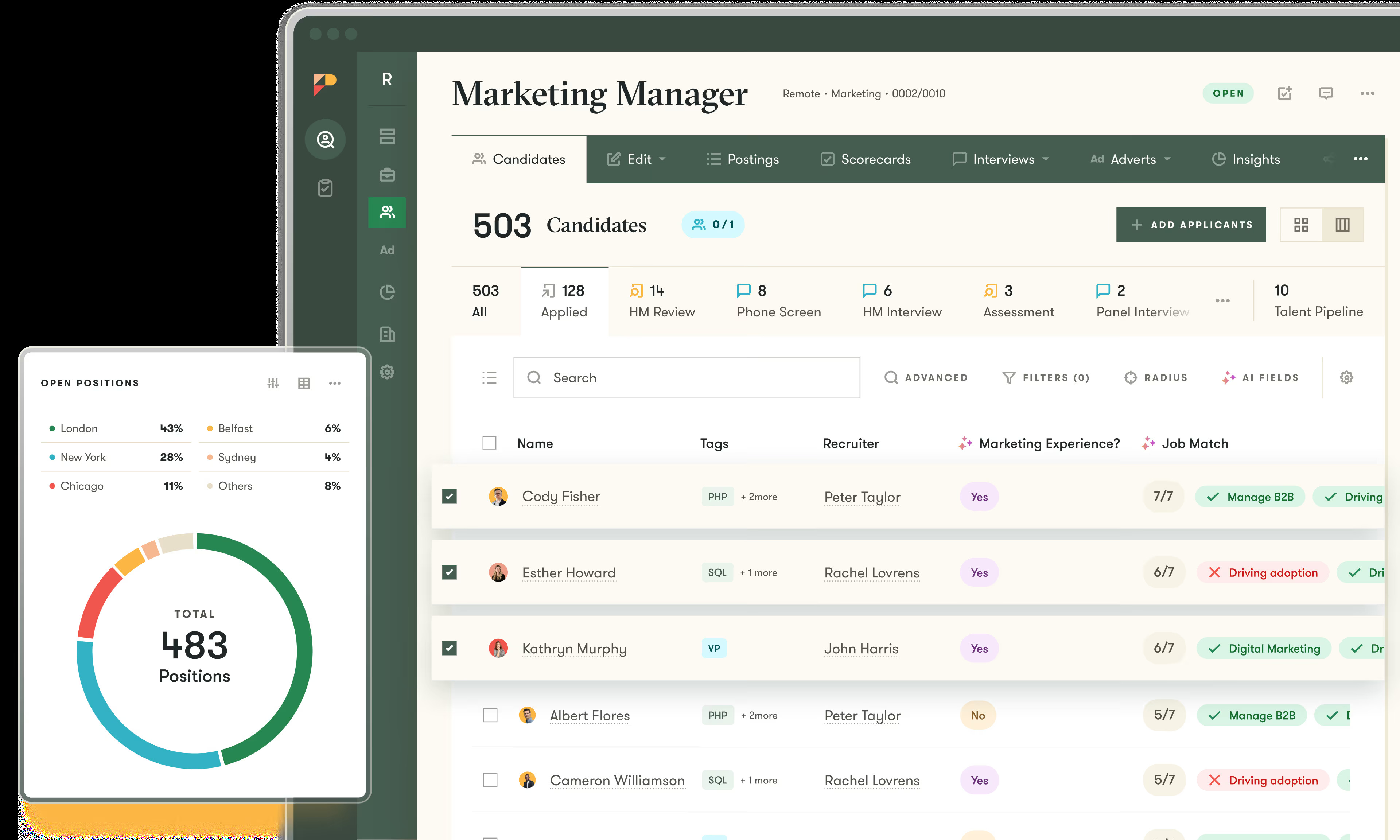
01 / The useful bitOne system, several ways to hire
The platform covers the whole recruiting trip: requisition planning, approvals, job advertising, branded career pages, referrals, agency submissions, candidate communication, interview scheduling, scorecards, offers and onboarding. Recruiters work in the main console; hiring managers can review and collaborate; applicants meet the company through its career site and messages. Reporting sits across the process instead of being rebuilt after the fact.
The distinction is configurability with guardrails. A local hiring team can have stages and permissions suited to its work, while the central talent function keeps consistent reporting and compliance. Pinpoint also does not charge per hiring-manager seat. That commercial choice matters: when inviting another manager creates another bill, hiring conversations migrate back to email. Unlimited users remove one excuse for bad data.
The five-room hiring house
requisitions
applicants
people
fairly
the hire
On the attraction side, teams can publish branded sites, distribute roles to job boards, run employee referrals and give agencies a controlled portal. Talent pools and automated communication help with candidates who are not ready today. During selection, there are flexible stages, anonymized screening, structured scorecards, one-way video interviews and offer management. Background and reference checks, documents and onboarding activities carry the successful candidate over the line.
“Tasks that once took days now happen in minutes.”Jed Shaw, talent acquisition manager at CDL, in a Pinpoint case study
CDL provides a tidy example of what that plumbing can do. The UK software company says Pinpoint’s automations cut time to hire by 30 percent and helped it reach a 100 percent acceptance-to-start rate. Shaw said activity kept moving so reliably that managers asked whether he had been working weekends. It is a better automation anecdote than a dashboard full of theoretical hours saved.
02 / The new layerAI with a clipboard, not a judge’s wig
Pinpoint spent 2026 adding AI at a brisk pace. The Candidate Companion answers questions and helps visitors find roles. Candidate Filters and Match Scores compare applications with stated criteria. An interview Notetaker produces records, while Hiring Copilot can search candidates, draft job content and remember working context. The company’s published direction is to let recruiters work from assistants such as Microsoft Copilot, Claude, Gemini and ChatGPT as well as inside Pinpoint.
The more interesting technical move is its hosted Model Context Protocol server. Compatible AI clients can search Pinpoint’s API documentation and, when the correct authentication is supplied, execute requests against an account. A conventional REST API, webhooks and a public-beta integration framework are available too. This will appeal to teams that want hiring data to travel, though every buyer should test permissions, audit trails and data residency with their own security people.
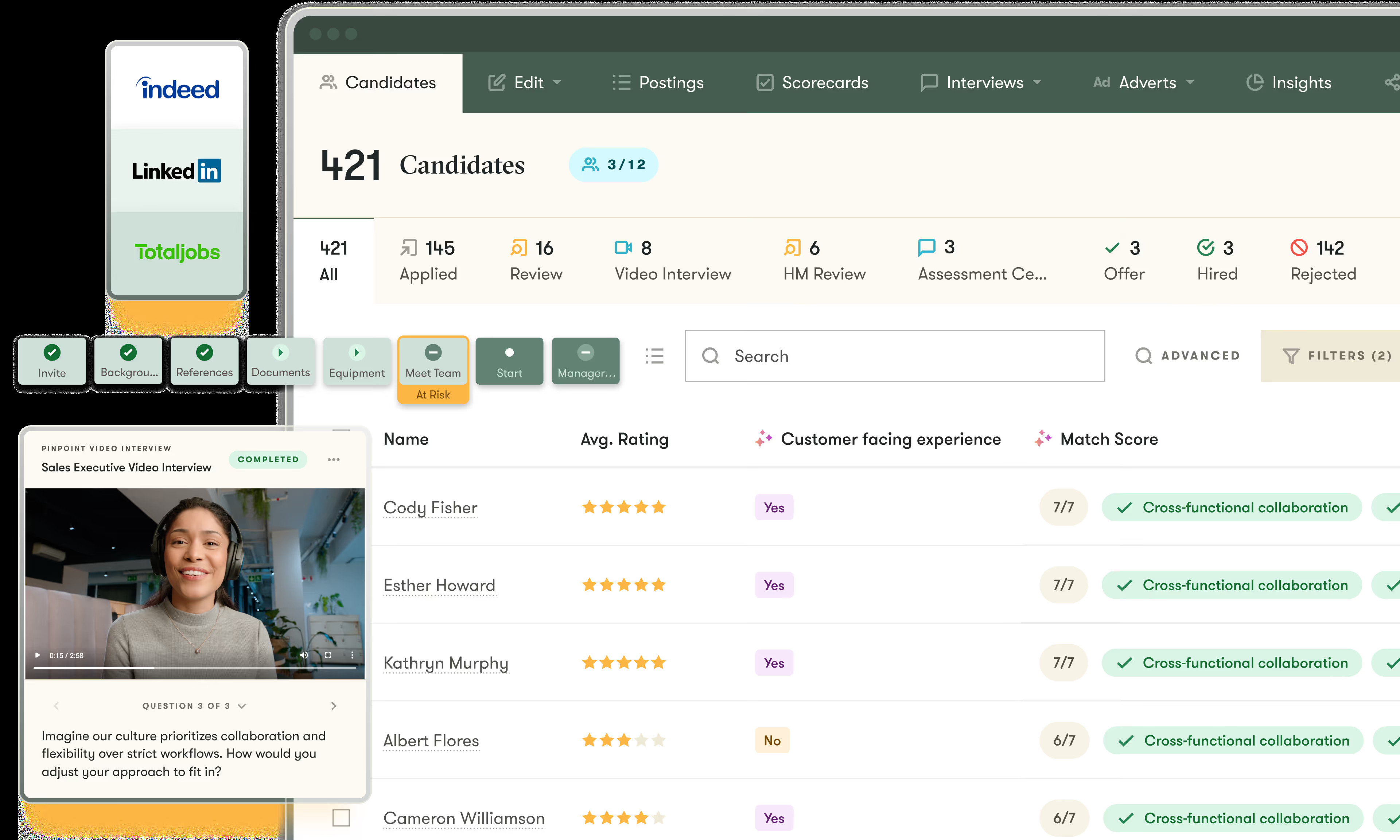
Pinpoint says decisions remain human. That is the correct promise, but buyers should ask how match criteria are created, who can change them, how candidates are told about AI use and how outputs can be challenged. The August 2026 release added AI usage limits and candidate-consent controls for the Notetaker, evidence that governance is becoming product work rather than policy wallpaper.
03 / Buyer’s notebookWhere Pinpoint earns its chair
User reviews repeatedly praise ease of use, configuration and support. G2’s 2026 listing showed 4.7 out of 5 from 129 reviews, while Pinpoint’s site displayed 4.8 ratings from G2, Capterra and SelectSoftware Reviews. On Capterra, customers mention single-source reporting and candidate experience; a Trustpilot reviewer called it one of the most user-friendly systems they had used. Reddit comments are anecdotal but unusually direct: recruiters comparing familiar ATS products have named Pinpoint as a favorite.
There are caveats. Reviews can be solicited, and at least one Capterra listing discloses a nominal incentive, so star counts deserve context. Some buyers report that advanced integrations take extra effort. The breadth of Pinpoint also means configuration matters: flexible software can reproduce a muddled process with impressive fidelity. The dedicated implementation manager is therefore part of the product, not a ceremonial handoff.
| Buying situation | What to inspect in Pinpoint | Also compare |
|---|---|---|
| Several hiring streams | Workflow templates, permissions, shared reporting and exceptions by brand or region | iCIMS, Greenhouse |
| High-volume frontline roles | Automations, mobile application flow, job-board feeds, checks and onboarding | Workable, Teamtailor |
| Structured professional hiring | Scorecards, interview plans, scheduling, talent pools and hiring-manager adoption | Greenhouse, Lever, Ashby |
| Connected HR stack | Native integrations, API coverage, webhooks, implementation ownership and data export | Recruitee, Lever |
Competitor choice should follow the organization rather than a league table. Greenhouse is a natural comparison for structured professional recruiting. Lever combines ATS and CRM ideas. Workable often suits smaller or quicker deployments. iCIMS competes for large, complex enterprises, while Ashby attracts analytics-minded technology teams. Pinpoint’s lane is the organization where different populations need different journeys but leadership still wants one record.
04 / The awkward questionHow much, and how long?
Pinpoint does not publish fixed prices. Subscriptions are quoted according to organizational size and hiring needs, with no charge per hiring-manager seat and no stated user cap. The missing public number makes a clean shortlist harder. Ask for a three-year total that includes setup, integrations, career-site work, data migration, support, AI allowances, checks and any future expansion into new brands or countries.
Implementation ranges from a few weeks for simpler organizations to three-to-six months for complex enterprise rollouts. Every customer gets a dedicated implementation manager and an onboarding portal. That timeline is sensible for a system touching applicant data, approvals and public career pages. It also means this is not software to buy on Friday because the old contract expires on Monday.
- Bring three genuinely different vacancies to the demo and make the team build each workflow.
- Ask a real hiring manager to review candidates without coaching from the project team.
- Trace one candidate from mobile application through checks, signed offer and first-day tasks.
- Export a report across regions, then request the underlying data through the API.
- Price the next acquisition or country now, while switching costs are still theoretical.
05 / VerdictBuy the complexity you actually have
Pinpoint’s best idea is not a button. It is the recognition that a company can need consistency without making every hire identical. The product gives central teams oversight while letting recruiters shape workflows around the people and rules in front of them. Its interface looks approachable, its automation reaches beyond interview scheduling, and recent releases show serious investment in AI and integration.
The strongest buyers will arrive with complexity already visible: several brands, countries, worker types or compliance paths; too much agency spend; disconnected onboarding; reporting assembled by hand. They should value configuration, candidate experience and support more than the cheapest monthly sticker. Tiny teams, or businesses with one repeatable hiring motion, may be paying for rooms they never enter.
The verdict is straightforward. Put Pinpoint on the shortlist when your organization needs one hiring system without pretending it has one hiring process. Make the vendor prove your hardest workflow, obtain a complete commercial quote, and give implementation the time it deserves. If the hiring managers voluntarily stay in the system after launch, the spreadsheet may finally stop recruiting on your behalf.