A trade that looks instantaneous on a screen is, underneath, a relay race. An exchange publishes a price. A feed handler decodes it. A strategy decides. A risk check approves. An order crosses a network and joins a queue. Every handoff is measured in microseconds, sometimes nanoseconds, and every handoff offers a fresh way to be late. Pico makes a business out of owning as much of that relay as a customer wants to hand over.
The New York company does not run an exchange or place trades. It supplies the connective tissue: colocation racks near matching engines, low-latency routes, direct market data, public and private cloud, execution software, packet capture, analytics and people awake at three in the morning. Its customers are the institutions for which a short network wobble can become a long investigation - banks, exchanges, broker-dealers, quantitative funds, market makers, asset managers and fintech providers.
The ugly problem is the useful one
Pico was founded in 2009, when the electronification of more asset classes was creating an excellent problem for infrastructure specialists. Trading firms wanted access to more markets, in more countries, at lower latency. Building that access internally meant negotiating data licenses, procuring links, installing servers, watching clocks, maintaining feed handlers and coordinating a small parade of vendors whenever something went wrong.
Pico's first answer was infrastructure as a service. Its PicoNet network now spans three regional meshes - the Americas, Europe and the Middle East, and Asia-Pacific - and reaches more than 900 exchange and venue products. Customers can rent dedicated or shared colocation, take raw feeds, connect to major public clouds and ask Pico to manage the devices. The advertised menu stretches from 5-nanosecond Layer 1 multicast access inside a venue to hosted Layer 3 connections that trade a little speed for broader reach and simpler operations.
The product is not merely a faster cable. It is one neck to call. A managed setup can include exchange onboarding, daily checks, patching, security, on-site hands and follow-the-sun support. That changes the buying calculation: a client compares Pico's contract not with one telecom invoice, but with the cost and distraction of assembling the whole system.

“As the trading environment becomes more globalized and continues to produce increasing amounts of data, clients are seeking greater efficiency.”Jarrod Yuster, founder and CEO
The pipes learned to talk
Connectivity alone can become a contest over routes, price and footprint. Pico's more interesting move was to turn the traffic crossing its network into an independent record of how the trading system behaved. In 2019 it acquired Dublin-born Corvil, whose appliances capture network packets, decode financial protocols and reconstruct events with precise timestamps. A customer can ask whether a market-data tick arrived late, whether an application stalled or whether congestion appeared between two locations - without depending on the application that may itself be misbehaving.
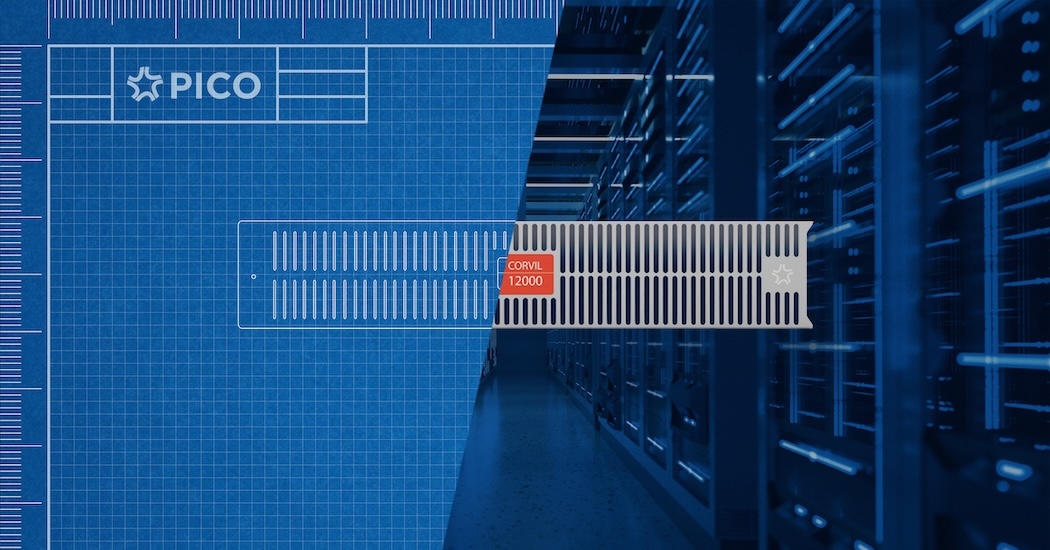
This is where the network becomes both service and sensor. Corvil says it understands more than 600 protocols and can stream its measurements into tools such as Splunk, Elastic and Kafka. The 2025 Corvil 12000 appliance sustains capture and real-time analytics at 200Gbps, with enough raw storage options to reach 737 terabytes in a 2U box. One Corvil Center can manage as many as 600 appliances while leaving bulky packet data at the point of capture.
Then came action. Pico acquired Redline Trading Solutions in January 2022. Redline's InRush ticker plant normalizes market data; RedlineFeed distributes it through a common API; its Execution Gateway sends orders with integrated pre-trade risk. Current coverage exceeds 230 global venues. In 2024 Pico wired Redline telemetry into Corvil, creating a view from incoming tick through software thread to outgoing order.
That four-part stack is Pico's difference. Network carriers can connect buildings. Cloud providers can host workloads. Feed specialists can normalize data. Observability vendors can inspect traffic. Pico argues that integration removes the seams between them, reducing both latency and the dreary conference call where five suppliers insist the problem lives elsewhere.
What did it cost?
For customers, Pico publishes no universal price list. That is sensible, if inconvenient: a deployment changes with every venue, feed license, rack, bandwidth level, software module and support obligation. The public clue is structural. Redline arrived with a fully recurring revenue model, and Pico says its Corvil bare-metal appliances are supplied at cost. In other words, the durable economics sit in software, data and managed service relationships, not a markup on a silver box.
Two disclosed growth events define the modern company: a $135 million Series C completed in 2020 and a $200 million Golden Gate Capital investment in 2022. Acquisition prices for Corvil and Redline were not disclosed.
The funding also reveals what management believed the model needed. The Series C financed global coverage, capacity and analytics. Golden Gate's money was explicitly an M&A war chest as well as capital for infrastructure and data. Pico had reported more than 430 clients by then, including the top 25 global banks and 39 exchanges. It was no longer proving demand; it was buying missing layers and extending distribution.
What failed first - and what changed?
Pico has not published a tidy founder fable about an early product crashing or a dramatic pivot. The more defensible reading is operational. In fast markets, the first failure is often a small one: a dropped packet, a clock drifting, a route congesting, a feed falling behind or a software thread balancing work badly. The expensive failure comes next, when teams cannot agree on what happened.
Corvil changed that argument by creating an independent packet record. Redline made the record actionable inside the market-data and execution path. The sequence suggests what changed Pico's strategy: market access was becoming global and data-heavy, while clients wanted fewer suppliers. Yuster said as much when Redline was acquired. Pico responded by moving from “we run your infrastructure” toward “we can connect, operate, observe and execute across the stack.”
Recent releases push the same logic. IntelliVUE gives clients a live map of PicoNet's operational state, latency and maintenance. Partnerships with BMLL connect real-time and historical data. Work with Coinbase Derivatives, SIX, AMD, LDA Technologies and ITRS extends Pico into exchange migration, enterprise hardware and AI-ready observability. The recurring question is no longer only “is the line up?” It is “what can the line tell us?”
The part worth stealing
The copyable idea is not “buy 55 data centers.” It is sequencing. First, take responsibility for a painful operational layer that customers cannot ignore. Second, standardize it across enough customers that its exhaust becomes valuable data. Third, add software that interprets that data. Finally, make every new layer improve the original service. Corvil helps Pico operate PicoNet; PicoNet distributes Redline; Redline creates richer events for Corvil. Each product is a customer offering and an internal advantage.
There is a second lesson in accountability. Many enterprise products promise flexibility by remaining one modular component among dozens. Pico sells the opposite when a client wants it: a bounded system with one operator. Founders building in logistics, cybersecurity or industrial software can borrow that stance. The less glamorous the handoff, the more customers may pay to make it somebody else's problem.
Where the model fits
- Downtime and ambiguity are costly
- Many suppliers touch one workflow
- Shared infrastructure creates economies of scale
- Operational data can improve the product
Where it breaks
- Customers demand total bespoke control
- The venue or geography is off-network
- FPGA specialization beats a common stack
- Internal scale makes self-operation cheaper
Those limits matter. The most latency-sensitive firms may prefer custom hardware, direct exchange relationships and engineers who control every hop. A small participant may not need packet forensics at all. Bundling also concentrates vendor risk, and abstraction can hide details an expert team wants exposed. Pico works best when operational breadth, speed of deployment and a shared source of truth matter more than absolute customization.
A market beneath the market
Pico sits between carriers, exchanges, clouds, trading applications and the financial institutions using all of them. Its direct alternatives change by layer: IPC Systems, TNS and Avelacom in connectivity; Options Technology and Beeks in managed infrastructure; Exegy and QuantHouse in feeds and execution; network-observability specialists around packet analytics. Its other competitor is the customer's own engineering organization.
That crowded map is exactly why Pico's integrated pitch can work. Electronic markets keep adding venues, data and round-the-clock activity. Every addition creates another connection and another chance for uncertainty. Pico does not eliminate that complexity. It packages it, instruments it and puts a service team on the other end. For a customer, the payoff is not a poetic one. It is getting to market sooner, finding faults faster and spending fewer mornings reconstructing last night's packets.