The hunch problem
Before EDITED was a retail data company, it was an argument between industries. Julia Fowler, a fashion designer, was tired of making commercial choices with reports written as much as 18 months ahead and judgments that felt suspiciously like weather forecasts. Geoff Watts, a programmer then working for a dairy company, offered an unromantic comparison: farmers knew how much milk each cow produced. Why could fashion not measure its own output with similar discipline?
The pair had met while racing cars in Perth, Australia. They moved to London, incubated the idea for several years and founded EDITD - the second E arrived later - in 2009. Fowler developed the concept full time. Watts wrote software during evenings and weekends while consulting. Their aim was not to automate taste. It was to give taste a factual opponent.
The first product crawled retailers' websites, collected prices, sizes and stock movements, watched fashion conversation online, and arranged the signals in a dashboard. In 2011, Watts called it “Bloomberg for the fashion industry.” Ten retailers were customers. A cross-company license started at £2,000 a month, adjusted for the client's size and appetite for data. The company had also raised a $1.6 million seed round led by Index Ventures. Its earliest cost was visible in two currencies: founder nights and enterprise software prices.
“There wasn't enough information out there to do my job properly. I wanted that knowledge.”Julia Fowler, co-founder, describing the original need
What EDITED actually sees
A digital shop floor leaves exhaust. A dress appears, changes price, runs out in two sizes, returns, enters promotion, moves down a category page and disappears. Multiply that trail across thousands of brands and years, then make a red midi dress in Dallas comparable with one described differently in Milan. That is the less photogenic work beneath EDITED's pitch.
The company says its present data foundation contains more than 12 years of history, 90,000 brands and over 5 billion SKUs. Machine learning handles classification, attribute extraction, normalization and product matching. Analysts add retail context. A buyer can examine whether competitors are expanding a category; a pricing team can compare price architecture and markdown depth; a merchandiser can inspect newness, stock and promotion; an ecommerce team can decide which products to boost or bury.
This is different from traditional trend forecasting. A service such as WGSN can help a designer think seasons ahead through expert interpretation, color direction and cultural research. Trendalytics, Heuritech, StyleSage and Stylumia approach demand or trend signals from other angles. EDITED is strongest closer to the shelf: what exists, what changed, what sold through, what was discounted and where a competitor left space.
That distinction matters. A gap in competitors' assortments might be an opportunity. It might also be a graveyard where demand never arrived. Market observation becomes more useful when it can be checked against the retailer's sales, margin, stock and customer behavior. EDITED spent its second decade building that connection.
The acquisition that turned the lens inward
For its first years, EDITED was chiefly looking out the window at everyone else's business. In April 2021 it acquired DynamicAction, a company built around internal retail analytics. Terms were not disclosed. Strategically, the transaction filled a conspicuous blank: public market intelligence could now sit beside the retailer's own ecommerce, store, supply-chain and customer data.
DynamicAction brought more than 150 enterprise and cloud connectors. EDITED could relate a competitor's discount to a client's margin, inventory position, returns or customer segment instead of treating the market as a freestanding spectacle. The company now describes the result as three lenses.
That sounds tidy on a diagram; implementation is not. Outside data has to be gathered and recategorized continuously, while a retailer's internal systems may disagree about product identity, geography, channel or even the definition of a sale. EDITED's expertise sits partly in resolving those mismatches and partly in knowing which retail question deserves an answer. Its teams combine engineers and data scientists with former buyers, merchandisers and business planners. The practitioners supply the grammar: sell-through, price architecture, option count, return rate, exposure and the awkward exceptions that a generic analytics model would flatten.
Market-informed
Competitor prices, assortments, promotions, stock and movement.
Profit-aware
Sales, margin, inventory, returns and operational performance.
Customer-centric
Preferences, buying patterns, segments and lifetime profitability.
The change is visible in customer work. PVH has used EDITED since 2015 and describes combining broad market context with consumer perspective for Calvin Klein and Tommy Hilfiger. Cider widened the platform beyond merchandising into planning, design, creative and marketing, making the data a common language for teams selling in more than 130 countries. The Warehouse Group says a filtered pricing and assortment snapshot that supports a buying discussion can be prepared in about 10 to 15 minutes. On its Product Visibility page, EDITED says Harrods improved revenue per visitor by 4 percent after optimizing what shoppers saw.
The dashboard learns to answer back
Doug Kofoid joined as chief executive in 2022, after the company reported more than doubling annual recurring revenue in 2021. A $15 million investment led by Delta-v Capital followed in March 2023. By then the pattern was clear: EDITED was trying to shorten the distance between an observed signal and a merchant's action.
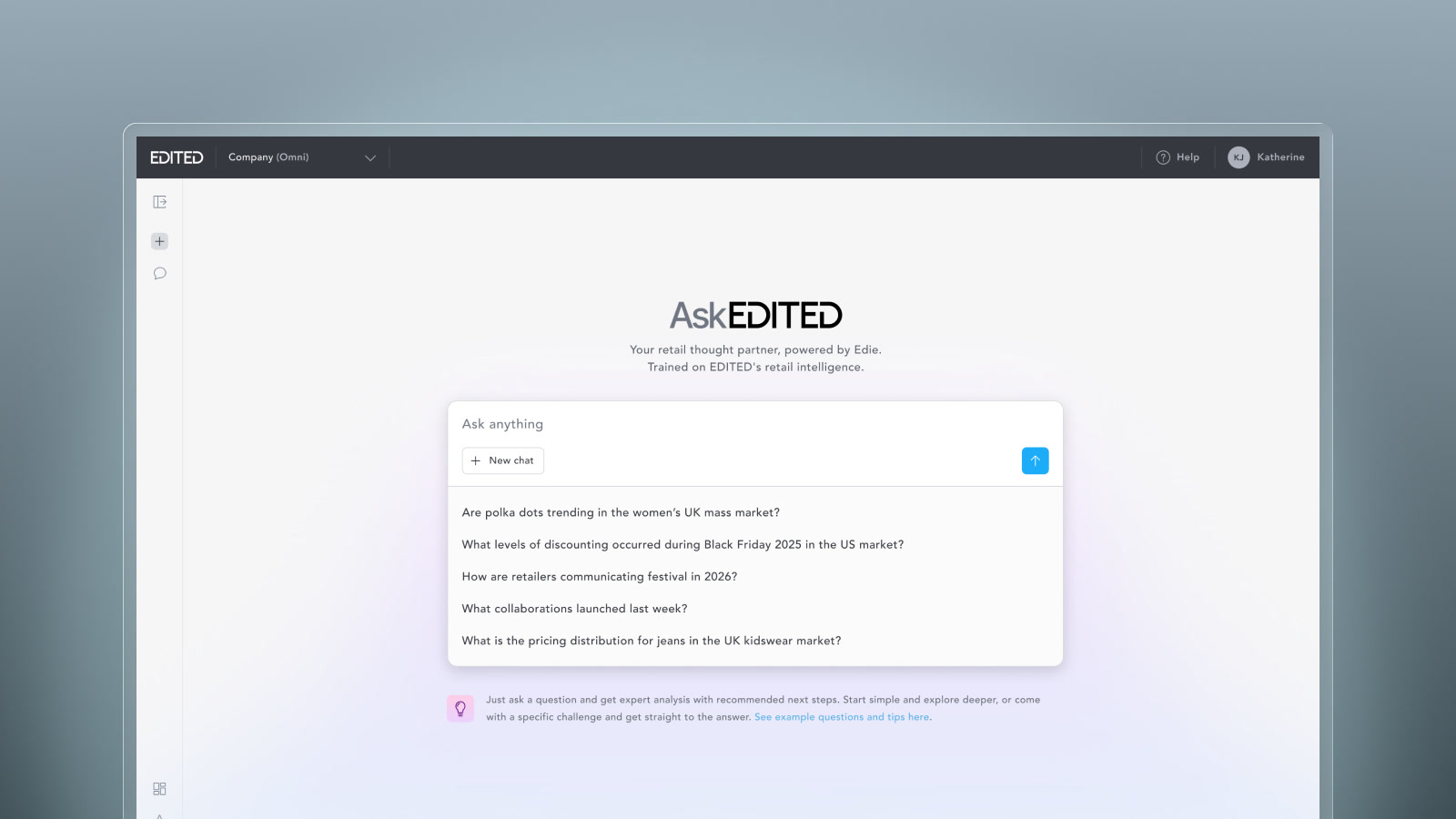
myEDITED, launched in 2023, organized recurring retail questions into a guided interface. The January 2026 product release pushed guided, AI-assisted workflows for trend validation, whitespace and market monitoring. In July came AskEDITED, a plain-language product powered by a retail agent named Edie. In August, EDITED MCP made three datasets - competitive market data, research, and promotional messaging - callable from Claude, Cursor, VS Code and custom agents through the open Model Context Protocol.
This is the company's most consequential interface change since the dashboard. A merchant can ask whether women's leggings are priced competitively, request the evidence and export a chart. A developer can let an internal planning agent fetch current market context without copying a spreadsheet between systems. EDITED says AskEDITED coordinates specialist Market, Research, Promo and Match agents rather than relying on one general model call.
The four publicly described rounds above total $50 million. The $29 million 2020 investment backed product development and hiring; the 2023 capital was intended to accelerate growth. EDITED sells enterprise subscriptions by quote. Its 2011 starting price is a historical artifact, not a current rate, but it reveals the target from the beginning: this was software for organizations with enough buying complexity to make better decisions worth real money.
The part worth copying
The tempting lesson is “put a chat box on proprietary data.” That begins near the end. EDITED's more transferable sequence started with one expensive frustration and a defined user: fashion professionals making commercial decisions without timely evidence. It then gathered a hard-to-reproduce record, developed a taxonomy, hired people who understood buying and merchandising, and moved from description toward recommendation.
- Start with a decision, not a dashboard. EDITED anchored itself to pricing, assortment and merchandising questions that already carried financial stakes.
- Normalize before narrating. If two products cannot be compared reliably, a fluent AI summary merely delivers the error faster.
- Join outside context to inside consequence. Competitor movement becomes actionable when it meets stock, margin, returns and customer behavior.
- Put the answer where work happens. The progression from dashboards to guided questions, conversation and MCP follows users into meetings and technical workflows.
The method works best for retailers with a meaningful digital market, enough comparable products, disciplined internal data and teams empowered to alter prices, buys or product exposure. It is a weaker fit for tiny brands that cannot justify enterprise pricing, categories with sparse online signals, or creative bets where history is deliberately irrelevant. It also cannot make competitive whitespace equal demand by declaration. The customer lens has to earn that conclusion.
That evolution helps explain the company's place in the market. EDITED is neither a general business-intelligence suite nor simply a fashion inspiration service. It is vertical enterprise software with retail-specific data as its moat. The brand names and giant SKU count make a handsome poster; the practical value arrives in smaller moments - a buyer defending a color choice, a pricing analyst answering during a meeting, a site merchandiser deciding which item deserves the first row.
Fowler wanted knowledge sturdy enough to challenge instinct. Watts knew how to build the measuring machine. Seventeen years later, the machine can talk. Its credibility still depends on whether it counted the dresses correctly.