At Hamilton Health Sciences, the patient monitor could send its numbers into an electronic record. Other critical-care equipment could not. Data from machines supporting kidneys, lungs and anesthesia still needed a human hand to move it into a chart. The hospital had bought sophisticated instruments and then assigned people the work of being their couriers.
That awkward handoff is where Philips Capsule earns its living. Its subject is the conversation between medical devices and the systems clinicians use. A ventilator speaks one technical language; a patient record expects another. Capsule supplies the connections and software that help the message arrive with its meaning intact.
- It brings bedside measurements into patient records and other clinical tools.
- Its appeal is compatibility across equipment brands, rather than a hospital buying one brand of everything.
- The hard work includes field mapping, testing and workflow ownership.
- Connected data can support surveillance and research. Clinicians still have to judge and act.
01 The nurse was the interface
Hamilton’s account describes an 18-month integration project across four acute sites. Bedside Neuron hubs connected equipment to Epic. Clinical informatics and biomedical teams checked the data before go-live. Every variable needed a destination the record could recognize.
The old arrangement had made manual transcription an ordinary part of care. The new one widened the set of connected devices. The revealing detail is the testing: a cable can carry a number without proving that the receiving system understands it. That is why the deployment involved clinical teams as well as technicians.
There is a transferable lesson here for anyone buying enterprise software. Look for the repeated handoff that staff have quietly absorbed into their jobs. Give it an owner. Then test the receiving system as carefully as the sending one. A polished dashboard cannot rescue a field mapped to the wrong place.
02 One hospital, several dialects
Capsule’s core product is the Medical Device Information Platform, or MDIP. It captures and normalizes device data, then distributes it to other systems. Its integration work can include measurements, equipment settings, alarms and waveforms. An electronic record is one destination; clinical applications and research systems are others.
The company reports support for more than 1,200 devices and integration with more than 100 downstream systems. Those figures describe breadth, rather than a promise that every machine in every hospital will connect automatically. A hospital’s particular models, firmware and required outputs still matter.
A simplified data route. Clinical validation and configuration depend on the workflow.
The breadth is supported by less visible work. Capsule says it cooperates with device and software manufacturers to revise its drivers when their products change. Its expertise includes understanding how different instruments describe information and keeping those translations usable after an upgrade. Compatibility is a continuing obligation.
03 The bedside hub has two jobs
Neuron 3 is the physical connectivity hub in this arrangement. Philips describes USB, serial and network interfaces, with software suited to different care areas. Vitals Stream serves continuous data collection. Chart Xpress serves periodic transfer, the sort of workflow associated with spot-check vital signs. Axon is another connectivity option that sends device data through the hospital network to the Capsule server.
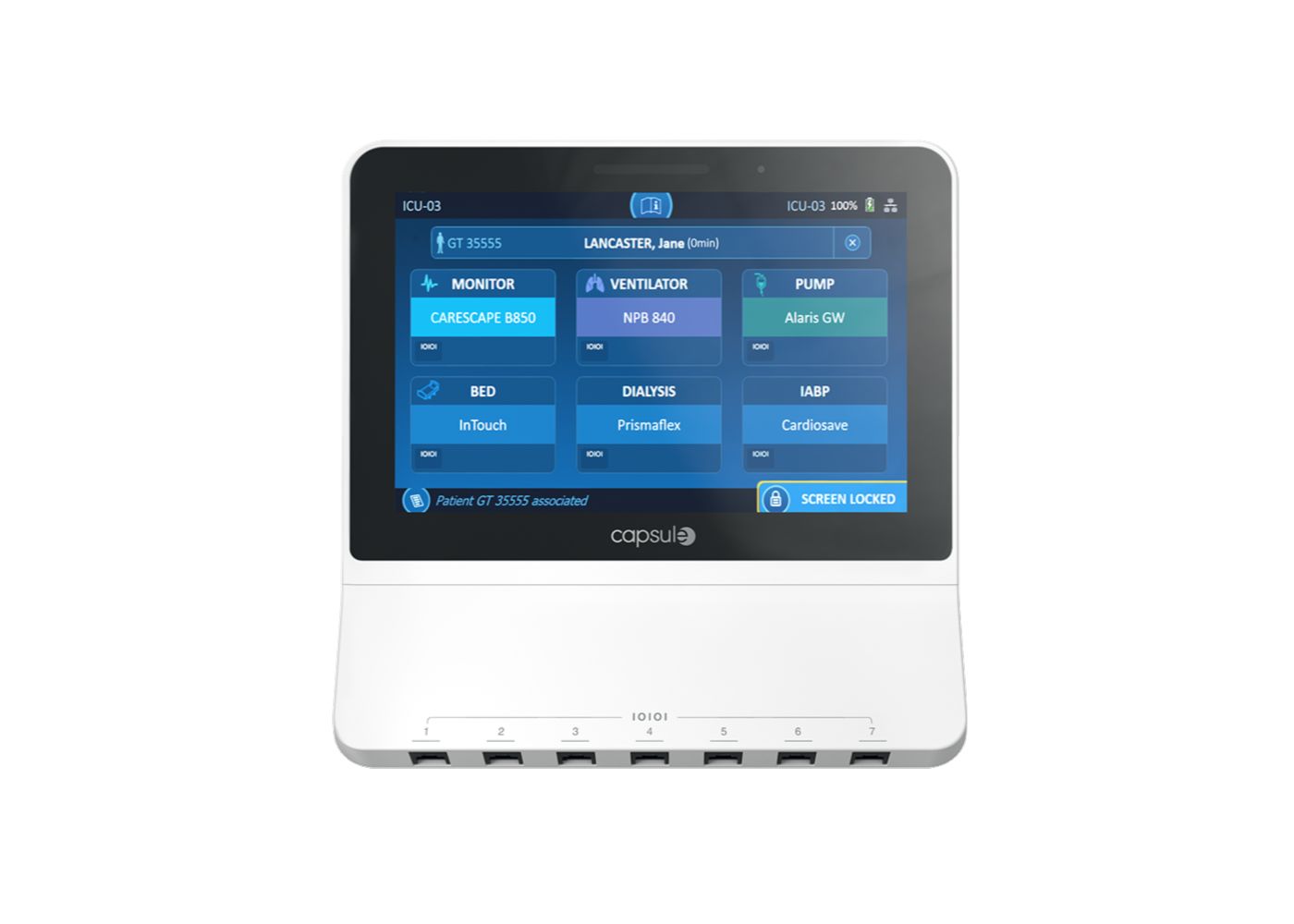
These distinctions matter because a hospital has several rhythms. An intensive-care bed needs a stream. A general-floor vital-sign check is an event. A useful integration system has to fit both without asking staff to pretend their work is identical.
Memorial Healthcare System offers a concrete example. Its program began alongside an Epic upgrade in 2012. A Philips case study published in February 2026 describes more than 250 Neurons running Vitals Stream and more than 500 running Chart Xpress. Anesthesia data goes to Epic’s OpTime; other areas send vital signs to the record.
“I can’t do my job without it.”
Lisa Levine, Memorial Healthcare System, recounting users’ typical reaction
The previous record had limited what Memorial could do. Moving to a more capable destination changed the opportunity for device integration. The experience suggests a useful purchasing question: what will this hospital be able to do with the data after it arrives? Buying a better connection has less value when the destination cannot use its output.
04 Philips bought the translator
Founded in 1997, Capsule was already serving more than 2,800 hospitals and healthcare organizations in 40 countries when Philips announced its acquisition in January 2021. The cash consideration was $635 million. Capsule had recorded more than $100 million in 2020 sales, with most sales coming from recurring software subscriptions and licensing.
Cash acquisition consideration paid for the business - distinct from a hospital’s implementation budget.
Philips already sold patient monitoring, telehealth and informatics. Capsule added a platform designed to connect equipment from multiple manufacturers. The strategic attraction is easy to see: a hospital’s installed fleet offers useful information even when its machines carry somebody else’s badge.
Today, Capsule sits within Philips Acute Care Informatics. Its own website reports installations in more than 4,300 facilities across over 50 countries. The company describes its mission in terms of simpler clinical workflows and usable insights. Its careers page emphasizes quality, focus, integration and teamwork - suitable ambitions for a business whose product crosses so many professional boundaries.
The commercial model combines enterprise software with hardware and services. Buyers are healthcare organizations; daily users include clinicians, informatics staff, IT and biomedical engineers. Evaluating the purchase means scoping the devices, destinations and implementation work together. The acquisition price is a documented corporate transaction, not a price tag for connecting a ward.
05 A number becomes a notification
Once data is connected, the next question is what to do with it. Capsule Surveillance continuously analyzes patient information using configurable smart rules, producing contextual notifications. Its updated release received an FDA 510(k) clearance announced in March 2022; the agency’s decision is dated January 14.
The release expanded ways to view information and connect with mobile clinical communication, eICU and virtual-care systems. This gives a care team additional ways to oversee patients and identify concerning changes. Regulatory clearance establishes a specific regulatory status. It does not settle the outcome of every deployment.
Alternatives occupy different parts of the same territory. Dräger’s Infinity Gateway exchanges data between its monitoring network and hospital systems. Oracle Health offers bedside medical device integration. Capsule’s pitch centers on accommodating a mixed fleet and distributing information to multiple destinations. A comparison should begin with the actual equipment inventory and intended workflow.
06 Before the AI, the inventory
In February 2025, Philips and Mass General Brigham announced a collaboration joining live device streams with other clinical information, including laboratory results and patient records. MDIP brings device data together; Clinical Insights Manager supports retrospective analysis; Capsule Surveillance supplies continuous processing and smart alerts.
The initial research program focuses on patients undergoing continuous heart monitoring. Its purpose is to explore earlier detection of cardiac events and other critical issues. That is a research ambition, rather than a finished claim that a new algorithm has already improved outcomes everywhere.
For a technology buyer, the sequence is instructive. First obtain usable streams. Then examine historical data and test ideas. Only then consider how an insight enters live care. The glamorous part of the plan depends on the patient, unglamorous work underneath it.
07 Somebody has to own the alarm
Capsule’s September 2026 discussion with clinical alarm experts returns to organization. Its contributors recommend observing actual workflows, collecting a baseline and giving implementation tasks clear owners. They also argue for including bedside staff, biomedical engineering and the night shift in alarm governance.
That advice makes the platform’s limits tangible. A device driver cannot convene a committee. An alert cannot assign its own responder. Where responsibilities are vague, a hospital can acquire more information and still struggle to use it. The experts recommend testing changes in a pilot unit for 30 to 90 days before widening them.
The copyable part is refreshingly plain: establish what happens today, decide who can change it, and measure a limited intervention. Philips Capsule provides infrastructure for that work. The hospital supplies the judgment, the staff and the response. The conversation becomes valuable when somebody knows what to do next.
Keep the conversation going
Read the Hamilton implementation account, the Memorial case study, and the Mass General Brigham collaboration announcement. Capsule’s clinical alarm discussion turns the infrastructure question into a practical management exercise.