An aircraft can survive the business that built it. In March 2025, Philip van der Burg put that proposition to work. Kite Aero, the new company he leads, announced that it had acquired Swoop Aero’s aircraft and drone operations software. There were machines to keep flying, technology to develop and relationships to carry forward. The business had changed hands. The accumulated experience still had somewhere to go.
For van der Burg, formerly chief executive of Carbonix, this was a return to familiar airspace with a different commercial starting point. He was taking responsibility for technology that already had an operating history. The transaction brought the KITE aircraft together with the software used to manage autonomous flights. His next task was to turn those assets into a business that could keep serving operators.
There is an appealing economy to the arrangement: an investment banker becomes an aviation executive, then uses an acquisition to begin another aviation company. The neatness ends at the purchase agreement. Aircraft need manufacturing capacity, operators need support, and software needs to fit the people using it. A signature gets a deal across the line. It does comparatively little for a drone waiting for its next mission.
From the transaction desk to the workshop
Van der Burg is Dutch and based in the Sydney area. His education joined business engineering at Hogeschool van Utrecht with a master’s in management at London’s Cass Business School, now Bayes. His investment banking work at Jefferies took him into mergers and acquisitions and aerospace and defence, in London and New York. He subsequently worked in corporate development at Management Consulting Group and as a finance chief at a London data analytics startup.
That background places his aviation career in a useful context. Before running an aircraft company, he had worked on the financial and organisational machinery around companies. Aerospace was already part of his professional life. The later move into uncrewed aviation brought him closer to the physical product and the obligations that come with supplying it.
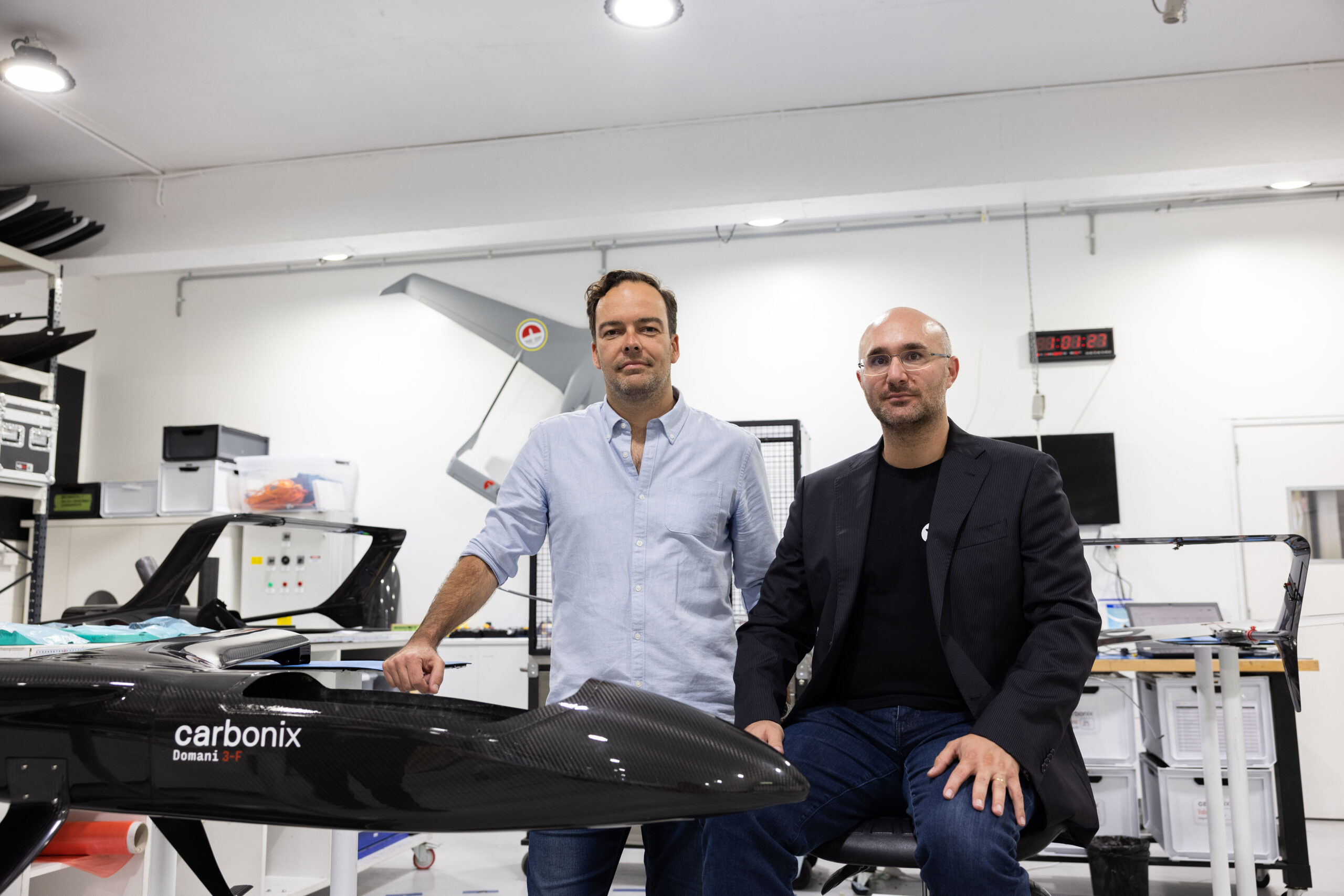
At Carbonix, he worked alongside founder Dario Valenza. A workshop photograph captures them with an aircraft between them: van der Burg in a pale blue shirt, Valenza in a dark jacket, workbenches behind. The setting is pleasingly unceremonious. A drone may spend its public life in an image of open sky; quite a lot of its working life belongs to rooms full of tools.
The aircraft needed company
The Carbonix years give the new venture a substantial backstory. In November 2022, Fugro announced a partnership with Carbonix to develop long-range remote aerial operations. Volanti and Ottano aircraft would support surveying and data capture, with work to integrate them into Fugro’s remote operations infrastructure. The proposed relationship extended over 27 months.
The point was the fit between two capabilities. Carbonix supplied aircraft; Fugro brought an existing network of remote operation centres and experience conducting work at a distance. Van der Burg’s comments at the time focused on aligning the companies’ capabilities and resources. He was describing a relationship in which the aircraft became useful through another organisation’s operations.
The same practical pattern appeared in the American expansion. Carbonix formalised a relationship with ArgenTech Solutions, an operator with experience on complex uncrewed missions. Van der Burg described the agreement as a way into the United States and the wider Americas. The two companies had already been collaborating before putting that relationship on a formal footing.
Manufacturing required its own alliances. A contract with Quickstep covered production of 40 aircraft over 12 months. A separate agreement with GPC Electronics addressed avionics manufacture, testing and design input. These are different kinds of dependency, and each has to hold. The customer eventually sees one aircraft. Behind it sit several companies, each responsible for making a part of the promise deliverable.
One flight, 150 kilometres of powerlines
In March 2024, Carbonix described the outcome of an 18-month partnership with SA Power Networks: a CASA-approved flight inspecting more than 150 kilometres of powerlines in one journey. It was a tangible assignment for long-range aviation. An electricity network does not arrange itself around the convenient reach of a pilot standing in a field.
Beyond visual line of sight, usually shortened to BVLOS, means operating beyond the remote pilot’s direct view. The approval process considered the aircraft, pilot training and supporting systems. That combination mattered to the powerline mission. Longer routes could reduce the repeated cycle of landing, packing equipment, relocating and taking off again.
Van der Burg presented the flight as evidence that regulatory and technical barriers had been addressed together. The episode helps explain the emphasis on operations in his later work. A range figure becomes commercially interesting when an operator can use it on a permitted task, collect the required information and repeat the job.
Another collaboration, with RIEGL and Phase One, put a laser scanner and a medium-format camera on Carbonix’s Ottano X. The partners announced a successful combined flight in March 2024. The work connected flight capability to surveying equipment and the information a customer actually wanted. Van der Burg’s career in drones had acquired a recurring cast: manufacturers, specialist partners, operators and regulators.
Powerlines inspected in a single journey during his Carbonix tenure.
The second take-off
Kite Aero’s acquisition announcement arrived on 24 March 2025. Swoop Aero had entered administration the previous November. The sale followed a collapse, with consequences for employees and creditors. The new company’s beginnings therefore came with an existing responsibility: deciding what could be continued after the earlier business had failed.
Van der Burg’s stated ambition was to build on Swoop’s technical work. The acquisition included both hardware and software, and Kite Aero announced that the software stack and avionics would be opened to third-party integration. It also said it would explore bringing former Swoop employees and industry partners back into the operation.
In a May 2025 interview, he identified the difficulty connecting regulators, operators and manufacturers. His succinct diagnosis was that “they are very fragmented”. The observation gives the acquisition a rationale beyond owning another aircraft design. Software could provide a shared operational framework across parties that otherwise have separate responsibilities and separate views of a flight.
Read this way, Kite Aero is an attempt to make those relationships easier to manage. It is a commercial thesis, with the usual burden of proof still attached. An acquisition supplies assets and a starting position. Whether customers can use them reliably, and whether the organisation can support that use, determines what follows.
“they are very fragmented”Philip van der Burg on regulators, operators and manufacturers / May 2025
A logbook has more than one chapter
The distinction between inherited experience and new performance deserves attention. Kite Aero’s software platform arrived with years of flight history. Its aircraft also had missions behind it before the new owner appeared. Those records help describe the technology, but they do not all belong to the new company’s operating period.
By September 2026, Kite Aero separated the aircraft figures in its manufacturing announcement: more than 2,000 flights and 800 hours under its own flag, alongside 11,000 flights and 2,500 hours under previous ownership. The broader software record covers different aircraft and operators. An aircraft log and a platform-wide software total answer different questions.
For van der Burg, the useful story in those figures is continuity followed by fresh use. The acquired system has continued to fly. Keeping the accounting clear also makes the new organisation’s contribution visible. A restart is easier to understand when the reader can see where the old logbook ends and the next chapter begins.
Aircraft figures shown separately by ownership period. These are distinct from AXIOM’s broader software-platform totals.
The next address is a factory
In September 2026, the next chapter acquired a manufacturing address. Kite Aero announced production at Sykes Advanced Manufacturing in Geelong. The facility had previously been operated by Quickstep. Composite production, large-format 3D printing and five-axis machining would sit within the Australian manufacturing arrangement.
The partnership brings an unexpected sporting connection. Sykes’ composite manufacturing heritage includes rowing boats associated with Olympic and world championship medals. The materials expertise now has an aviation assignment. There is something satisfying about a supplier whose past involves getting people through water now helping an aircraft carry things through air.
Kite Aero reported a pipeline exceeding 100 units. A pipeline is prospective business, rather than a count of aircraft delivered, and the production arrangement addresses the capacity needed to pursue it. Van der Burg tied local manufacture to supporting customers and keeping aircraft available for use. The headline event was a factory partnership; the commercial concern was what happens after a customer receives a machine.
The organisations beyond the aircraft
His professional life also includes the less photographed work of boards. Van der Burg was elected to the Australian Association for Uncrewed Systems board in 2022. The association acknowledged his three years of service at its 2025 annual general meeting. It was another place where the industry’s separate participants had to meet and work through common questions.
His Dutch community commitments ran alongside that aviation work. His public professional history lists service on Dutchlink’s board and seven years as chair of the supervisory board of Nederlandse school de Kangoeroe, ending in November 2024. These roles add a different scale to a career involving aircraft and international commercial partnerships: community organisations with their own continuing obligations.
The through-line is visible without inventing a childhood fascination with flight or a dramatic conversion on a runway. Van der Burg has moved from advising businesses to running them, from arranging transactions to taking responsibility for what the acquired technology does next. Kite Aero now puts that experience to a fairly demanding test. There are aircraft with a past, customers with work to do and a factory expected to help supply the future. The next take-off has a considerable amount of ground work beneath it.