Consider a dress. On one website it is this season’s temptation. On another, it is last season’s inventory. In somebody else’s closet, it is the thing worn once to a wedding. The fabric may be identical. The prices need not be. Shopping online means discovering which version of that story you are being sold.
- Phia compares fashion across new and secondhand listings.
- The consumer tools are free; qualifying referrals earn retailer commissions.
- The opportunity is less searching. The test is whether shoppers and merchants can trust the result.
Phia, founded by Phoebe Gates and Sophia Kianni, tries to put those scattered offers into one decision. Its premise is appealingly impertinent: the price on the page deserves a second opinion. Before a shopper commits, an assistant can check alternatives, assess the offer and watch for a reduction. The bargain hunt moves from an evening’s occupation to a step inside the purchase.
A bad prototype with a good question
The founders were Stanford roommates before they were business partners. Their shared irritation was secondhand shopping’s fragmentation. Finding something desirable was one task; discovering whether it existed elsewhere, for less, was another. Resale offered possibility, but demanded patience. A shopper might love the clothes and loathe the administrative work required to find them.
The first experiment was a Chrome extension showing secondhand alternatives. A professor’s $250,000 grant gave the pair room to build. That is a useful distinction in the origin story: the seed of the company was a specific comparison problem, backed by enough money to attempt a solution, rather than a fully formed autonomous shopping agent.
The extension disappointed them. Gates later recalled that users remained interested despite its poor quality. That persistence changed the interpretation of the failure. A clumsy implementation did not necessarily mean an unwanted service. By April 2025, Phia had launched an iPhone app. The founders kept the question and changed the experience around it.

The secondhand rack joins the search
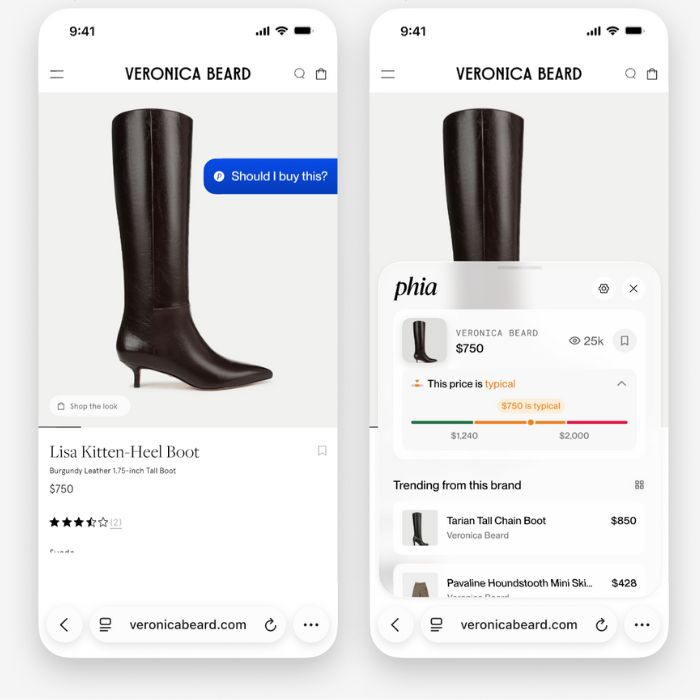
Phia occupies the space between wanting a particular piece and deciding where to buy it. The app’s “Should I Buy This?” function offers price context and alternatives while someone browses in Safari. Chrome brings the idea to desktop shopping. Web discovery also lets a visitor describe an item in ordinary language, rather than begin with a retailer’s catalogue.
The distinction is easiest to see in the comparison itself. A coupon tool can reduce a store’s price. A fashion comparison assistant can ask whether that store should get the purchase at all. Phia searches across retail and resale, where the same label may appear at markedly different prices. It also surfaces similar styles, which requires a different judgment from identifying an exact match.
At launch, the company promoted scanning more than 40,000 sites. Its current website advertises 220,000-plus. That is a coverage claim, not a count of signed commercial partners. A large index creates more chances to find a useful offer; it does not make every listing equally suitable. Size, condition, delivery charges and return rules still matter.
There is also a boundary around expertise. Phia says it relies on resale partners to authenticate goods. It can help locate an offer without becoming the guarantor of the handbag inside it. A cheaper listing with the wrong size or an unacceptable return policy is an expensive way to win an argument with a price tag.
Free for the shopper, paid by the sale
The consumer service is advertised as free. Phia explains that it earns a commission when shoppers purchase through qualifying suggested links. Retailers supply the money because a useful referral can bring a sale. The arrangement makes sense when the assistant introduces or influences a purchase and records that contribution accurately.
More recent features widen the proposition. Automatic coupons reduce checkout work; price alerts reward waiting; eligible purchases can earn points redeemable for gift cards. These are different reasons to return to the same app. Collections and personalized suggestions also move Phia closer to discovery, where the assistant helps decide what to want in the first place.
Brands have a separate entrance. Phia’s website offers exposure through feeds, exclusive deals and curated collections, while a portal carries the Phia Intelligence name. For merchants, the attraction is reaching shoppers near a decision. For the company, serving both sides introduces a familiar tension: helping someone spend wisely while earning money when they spend.
Distribution has familiar faces
The founders’ public presence helps explain why the product received attention. Their podcast, The Burnouts, makes the business journey part of the entertainment. This is distribution with a human face: a listener can encounter the people building the app before encountering the app itself. The founders have also described user events and interviews as ways to hear what shoppers find confusing.
Capital followed. Phia announced an $8 million seed round in September 2025 and a Series A initially reported at $35 million in January 2026, later described as $35.5 million. The latter was led by Notable Capital, with Khosla Ventures and Kleiner Perkins participating. The company later detailed the round’s backers. The company reports 1.5 million-plus users. That is a company-reported audience figure, not a monthly activity measure.
“The people who are closest to the problem are best positioned to solve it.”Phoebe Gates, speaking to The Modems
The commission must be earned
In July 2026, researcher Ben Edelman documented forced affiliate clicks and interference with other publishers’ referrals. Separately reported testing found Phia claiming purchases without shoppers using its assistance. Impact.com suspended the startup. Phia initially described the problem as a software bug and said it had fixed it.
August analysis examined additional historical behaviors, including affiliate links triggered when shoppers dismissed a panel and periodic cookie refreshes. Phia has said it removed misattribution features, began transaction reversals and was hiring a compliance head. Those statements describe its response; they do not settle every disputed claim.
Borrow the question, check the answer
For founders, the transferable lesson is to watch what people keep trying to do when a prototype frustrates them. For shoppers, it is to compare before checkout and treat waiting as an available choice. Neither requires celebrity investors. Both require a clear idea of the decision being improved.
The approach is less useful when comparable inventory is scarce or condition matters more than the headline price. Its sustainability argument also depends on behavior: replacing a new purchase with an existing garment is different from buying extra things because they are cheap. Phia’s useful promise remains modest enough to test. Find the piece, examine the alternatives, and let the price tag explain itself.