The first customer of an ecommerce business can be expensive. The thousandth should be cheaper. At Bikayi, the old venture behind Bik.ai, this tidy rule met a less tidy reality: helping small merchants sell online increasingly meant helping them market, too. That work needed people, campaigns and hand-holding. Every new merchant brought a new store, but also a new set of chores. Software could open the door; getting customers through it was another business entirely.
- The turn: Bikayi’s founders moved from storefront tools and hands-on marketing for small sellers to a CRM for ecommerce brands.
- The product: BIK joins customer data, campaigns, automated journeys and support across channels including WhatsApp, Instagram and email.
- The arithmetic: subscriptions and selected AI usage charges pay for the platform; buyer results need to be judged against message and staffing costs.
That shift is the useful part of the Bik.ai story. The company now pitches an “agentic AI CRM” to retailers and direct-to-consumer brands. Strip away the fashionable adjective and the proposition is clear enough: a brand should know that the person commenting on an Instagram post is the same person asking where an order went, browsing a product and receiving a follow-up message. It should be able to act on that knowledge without making four teams reconcile four dashboards.
The small seller had a large appetite
Sonakshi Nathani and Ashutosh Singla founded Bikayi in 2019. The first offer was a way for small merchants to get online: a digital storefront with catalogues, payments and shipping tools. In 2020 it raised a $2 million seed round led by Y Combinator; in 2021, a $10.8 million Series A led by Sequoia Capital India. Funding bought room to expand, but it could not repeal the economics of a service-heavy operation.
Nathani later described a pilot of digital marketing services for 15 customers that grew to more than 1,000 businesses in roughly two and a half months. Demand was real. So was the labour. In a 2022 interview with Inc42, she put the problem plainly: “Scaling up marketing services for SMBs was a huge challenge.” Managing the team required to deliver those services had become part of the cost of growth. The company moved toward brands with established customer bases and more capacity to pay for automated engagement and retention.
The company’s own history says the new BIK product emerged from a 2022 hackathon. Its founders also offer a small joke about the name: remove the dot from bik.ai and it reads “bikayi.” The punctuation survived the pivot; the target buyer did not. The old pitch gave a merchant a storefront. The new one assumes a brand already has a store and asks what happens to the shopper before and after checkout.


A comment is a sales channel in disguise
Consider the most ordinary of Instagram comments: “Price please.” It looks like a request for a number. For a retailer, it can be the start of a product recommendation, a conversation, a lead and, occasionally, an order. BIK’s Price Please automation can filter comments by tone and map a product to a post. A negative remark about price should not receive the same chirpy sales response as a genuine inquiry. It is a small distinction, and exactly the sort of distinction that makes automation useful rather than embarrassing.
BIK’s wider toolkit handles segmented broadcasts, behaviour-triggered journeys, an omnichannel helpdesk, analytics, customer data and configurable AI agents. A merchant can set a goal and instructions for an agent, connect a product catalogue, route an unresolved question to a person, then inspect the resulting journey. The company also operates Manifest AI, a shopping assistant for ecommerce storefronts. Its public site says more than 500 brands use BIK globally; it names Recode Studios, Fuaark, Conscious Chemist and Atmosphere Studio among customers.
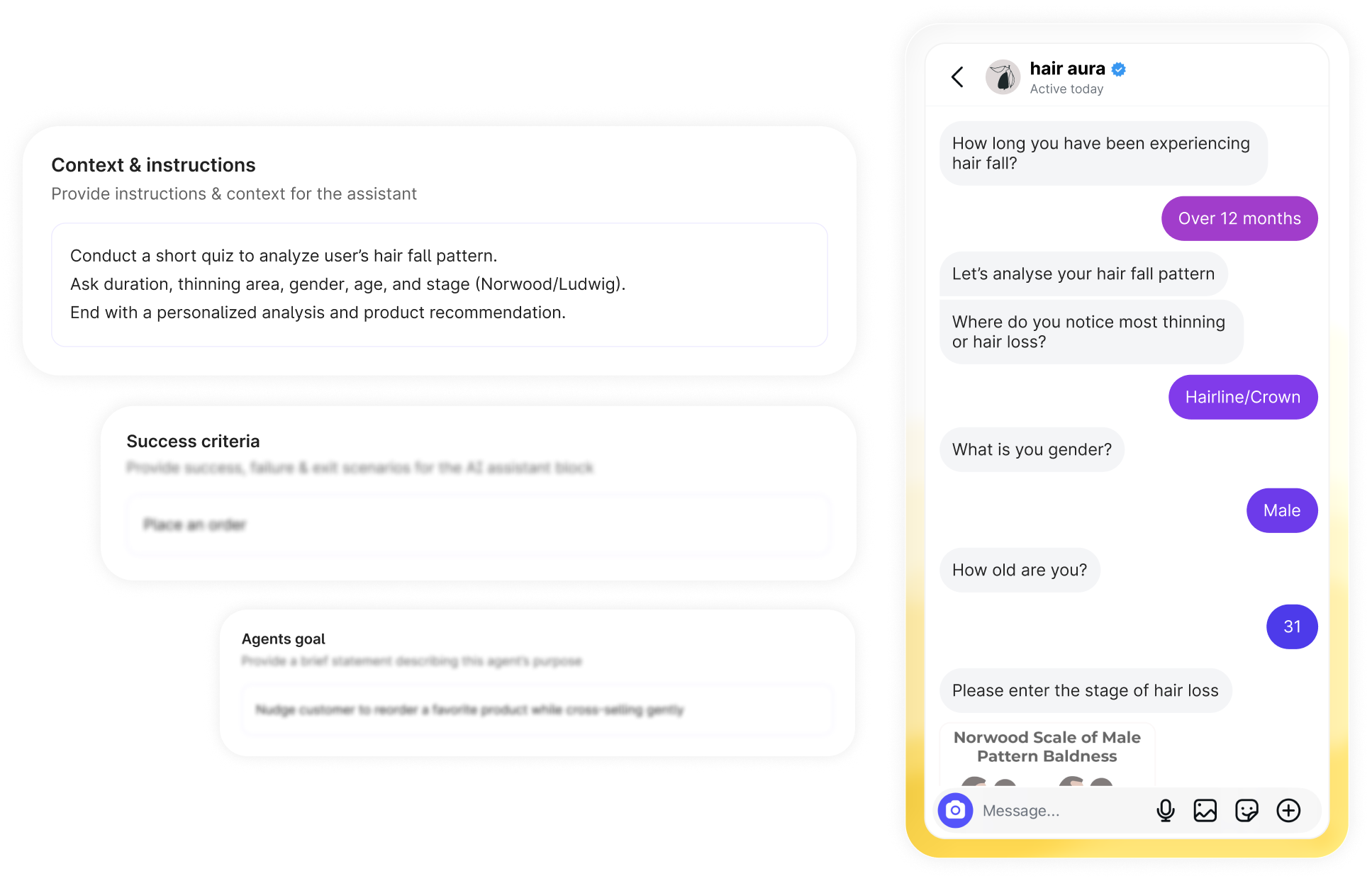
A typical BIK journey
The most interesting agent knows when to stop
The AI language is loud, but the product documentation is more revealing. BIK’s AI Assistant draws on FAQs, uploaded files, links and product data. It can stay in a conversation until the customer asks for a person or strays beyond the material it knows. Its newer AI Reply tool drafts helpdesk responses from order details, policies and knowledge-base content; the human agent reviews the draft before sending. Those are sensible limits. A wrong refund promise is not a charming hallucination to the customer waiting for money.
This also describes the conditions under which the system has a chance. The product catalogue must be accurate. Return and shipping policies must be current. Contacts across channels need enough identity and consent data to be useful. An automation that begins with stale policies or duplicate customer records can send the wrong message faster than a human could. BIK’s own help articles warn that conflicting source material can produce inconsistent answers. In other words, the customer’s homework is part of the product.
A storefront asks, “Can I sell online?” A commerce CRM asks, “What did this customer just tell us?”The pivot in two questions
The bill, and the number on the dashboard
BIK sells business software, with subscriptions and usage charges. In August 2026 it began billing selected AI features, including helpdesk spam filtering and conversation labels, through AI credits and a wallet when credits run out. Exact customer spend depends on plan, messaging volume and selected features. That matters because an automated journey can be cheap per interaction and still be costly if it sends unnecessary messages or needs frequent human repair.
Then there is the seductive revenue number. BIK reports campaign, journey and popup performance and says it avoids counting the same order twice within its own attribution system. Its default campaign and journey window is seven days; a sale may be attributed after a click, open or delivery, depending on settings. The company explicitly notes that its figures need not match Shopify or Google analytics. A brand judging an experiment should compare incremental orders, message costs, AI charges and support time, and keep the attribution rule steady. Otherwise the most successful part of the campaign may be the dashboard.
The company’s site claims a 35% rise in repeat purchases for Fuaark over three months and points to other customer stories. A July 2024 report said BIK had passed 500 brands and $1.5 million in annual recurring revenue. These are useful signposts, not universal conversion rates. They show the sort of business BIK wants to win: brands with enough traffic and repeat interaction for better timing to matter.
A stack with an opinion
BIK competes in a crowded field. Klaviyo, MoEngage and CleverTap sell marketing orchestration; Gupshup and Haptik address parts of conversational commerce; customer-service platforms can handle the ticket. BIK’s argument is that marketing, support and product context belong together for ecommerce. That is a sharper claim than simply saying it has AI. It promises fewer seams between the message that acquired a shopper and the answer that keeps one.
The practical lesson is portable. Start with one repeated customer question or one abandoned-cart journey. Connect only the data needed to answer it. Put a person at the handoff. Measure completed orders and resolved issues against every message and minute spent. Then add the next journey. Bikayi learned that demand can hide a great deal of work. Bik.ai is an attempt to make that work legible, repeatable and worth the price.