Consider the professional distance between a tax reference book and Dog Man. One helps an adult avoid a costly mistake; the other invites a child to enjoy a policeman with a dog's head. Peter Warwick's career has room for both. Before he became president and chief executive of Scholastic in August 2021, he had spent years running businesses whose customers included lawyers and accountants. Now the reader he needs to win may still be losing their baby teeth.
That change of audience makes Warwick an interesting choice for a company built around childhood. Scholastic had passed its hundredth birthday when he took the job. He was only its third chief executive. A business that sells new beginnings by the bookshelf had been remarkably sparing with them in the corner office.
Warwick arrived with an unusually long view of publishing. His route included a doctorate in African history, educational books, professional information, and responsibility for the people working inside a global information company. The connecting question is deceptively plain: how do you get useful material into the hands of someone who will actually want to read it? At Scholastic, that question comes with illustrations.
Before the dog, the doctorate
Warwick was born in the United Kingdom and studied history at Bristol and York, completing a doctorate in African history. He began publishing educational and academic books for and about Africa. The starting point matters. His early work concerned learning and place, long before his job involved famous fictional worlds or a quarterly conversation with shareholders.
He spent twenty years at Pearson, beginning in editorial work and eventually leading its professional education and information business. The progression took him from making publishing decisions to running a publishing enterprise. An editor asks whether a book works. An executive has to keep asking that question while also ensuring the organization that produces it can pay its bills.
In 1998 he joined the business then known as Thomson, based in Sydney and responsible for legal and regulatory operations in Asia Pacific. In 2000 he moved to New York to lead Thomson Tax & Accounting. He became chief executive of Thomson Legal in 2005. These were different readers, different markets, and different kinds of urgency. The common element was information people could use.
His later role as chief people officer at Thomson Reuters added another kind of editorial problem: the organization itself. He held that position from 2012 until retiring in 2018. By then he had also joined Scholastic's board, in 2014. Retirement, it turned out, left a rather substantial unfinished chapter.
Thomson
Tax & Accounting
President & CEO
A very small club of chief executives
Warwick had been an independent director for seven years when Scholastic appointed him CEO. His start date was August 1, 2021. Dick Robinson had led the company before him; Iole Lucchese became chair of the board in the same leadership transition. The titles describe separate jobs, a distinction easily lost when a familiar publishing name becomes a corporate succession story.
For Warwick, the boardroom years offered familiarity without making him a lifelong Scholastic employee. He knew the institution's decisions and its people, while bringing operating experience from elsewhere. His appointment joined continuity to a change of perspective. The company was asking someone with a background in professional knowledge to help shape the reading lives of children.
He framed his intentions around the existing mission, new content, print and digital education, and stronger relationships with families and educators. Those relationships are a practical asset. A publisher can own a compelling story and still struggle to put it in front of the right reader. Scholastic's schools, clubs, and fairs give that problem a particular geography.
There is a smaller example of Warwick's approach to education inside the company. Judy Newman, associated for decades with Scholastic Book Clubs, publicly credited him and Robinson with supporting her return to school. She completed a master's degree in education while working remotely. At a company selling learning, a senior colleague was allowed to become a student again. The anecdote is modest, and rather better for it.
Seven years on the board.
2014 → 2021
Then, the operating job.
The reader gets a vote
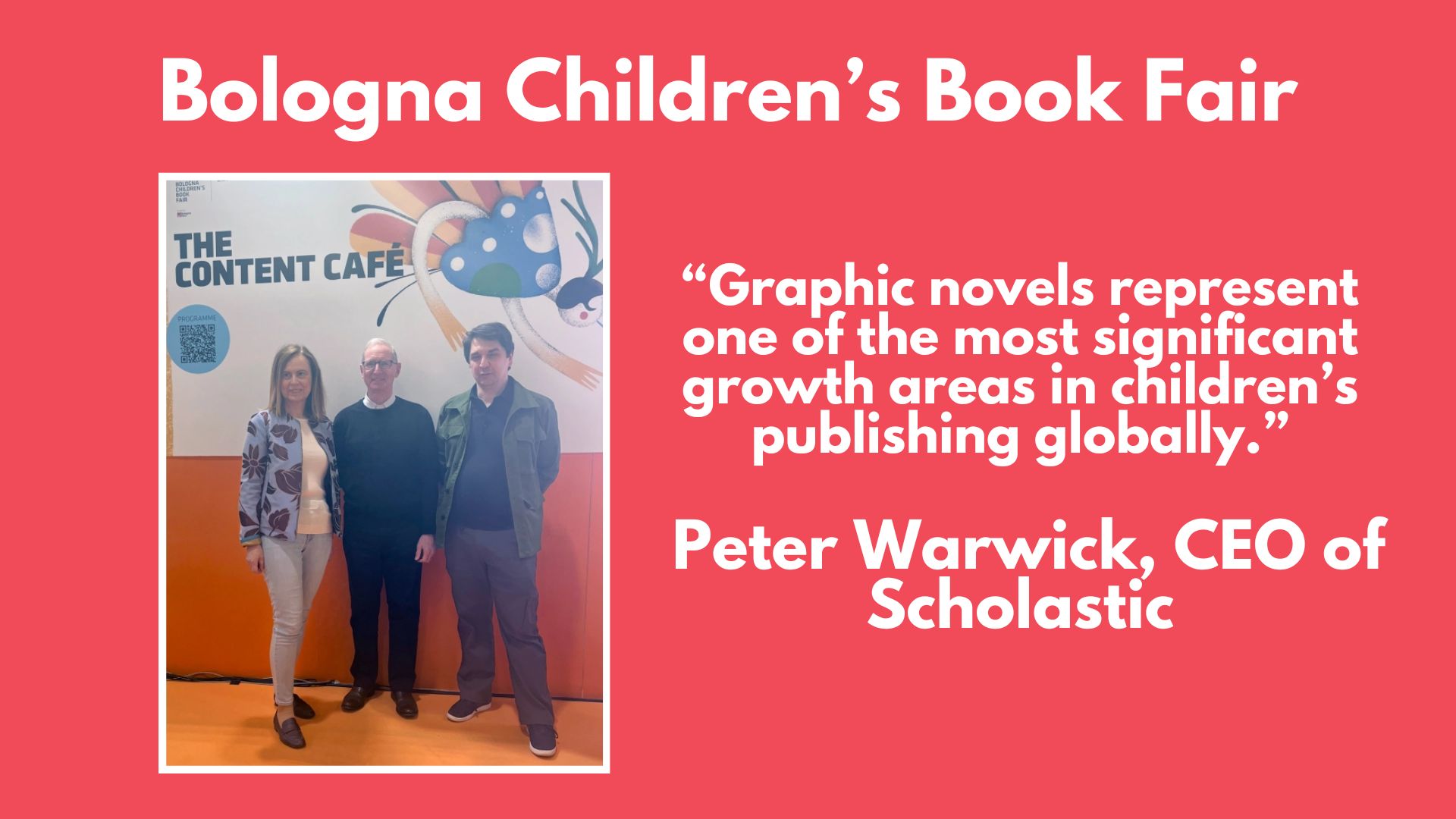
In 2025, Warwick went to the Bologna Children's Book Fair to discuss graphic novels with publisher Renata Gorgani and moderator Ed Nawotka. The occasion coincided with the twentieth anniversary of Scholastic's Graphix imprint. His argument concerned the breadth of stories the format could carry: memoir, history, science fiction, and social subjects, alongside the superheroes people might expect.
The numbers gave him something concrete to discuss. Scholastic reported that the share of children saying they wanted to read graphic novels had risen from 22 percent in 2018 to 37 percent. It also pointed to more than 2.5 million worldwide sales for Dav Pilkey's latest book since its December release. These are reminders that children's taste is observable, even when adults are tempted to prescribe it.
For a publishing executive, respecting that taste has commercial consequences. The format a child chooses may look different from the format an adult remembers choosing. Pictures, panels, and speech balloons still require decisions about story and meaning. Warwick's public case for graphic novels gives those preferences room to count. A reader's enthusiasm is useful information; dismissing it would be a peculiar research method.
A story can enter through a screen
Scholastic's investment in 9 Story Media Group closed in June 2024, expanding its capabilities in production, distribution, and licensing. The two businesses already had a long working relationship. Bringing them closer gave Warwick's strategy an organizational form: stories could travel through print, screens, and merchandise, with more of that journey taking place inside the same group.
He has described an approach in which a book need not always be the starting point. A character encountered in a game or video can lead a child toward another version of the story. The familiar publishing sequence becomes less orderly, which may be inconvenient for a diagram but quite natural for an audience. Children do not generally arrange their enthusiasms according to a company's divisional chart.
“We are determined to meet children exactly where they are,” Warwick said in 2024. That sentence provides a useful test for the strategy. Reaching a child is the first task. Creating enough interest for another encounter is the next. The commercial hope is that attention can move between formats, allowing a story to build a longer relationship with its audience.
There is already a small, specific illustration of the idea: the launches of a Magic School Bus channel on Tubi and a Clifford Classic channel on YouTube were part of the new entertainment operation's early activity. These familiar properties gained additional places to be discovered. A large red dog, apparently, can accommodate another distribution channel without becoming any less red.
The fair still pays the bills
The balance of Scholastic's business puts the screen strategy in perspective. In fiscal 2026, book-fair sales reached $576 million, up 5 percent. Entertainment revenue was $65.7 million, up 8 percent. The fair business remained many times larger. Warwick's future therefore runs through both a digital audience and the decidedly physical business of getting books into schools.
The company's overall results also resist a simple transformation narrative. Annual revenue fell 3 percent to approximately $1.58 billion, while operating income was $15.2 million. Education sales declined 14 percent. Trade publishing faced a comparison with the previous year's release of Suzanne Collins's Sunrise on the Reaping. A successful title can make the following year an awkward arithmetic exercise.
In September 2026, Scholastic reported first-quarter revenue of $216.8 million, down 4 percent, and an operating loss of $92.2 million. The quarter was seasonally small, and the company reaffirmed its full-year outlook. These figures describe an enterprise still working through its plan. They give Warwick's ambitions a measurable setting, rather than allowing the ambitions to stand in for results.
When the publisher had to turn its own page
Access also means decisions about what a publisher allows onto the page. In April 2023, Warwick issued a public apology after Scholastic proposed changes to the author's note in Maggie Tokuda-Hall's Love in the Library while seeking to license it for a classroom collection. The book tells the story of her grandparents, who met in a World War II incarceration camp.
Warwick called the suggested editing approach wrong and inconsistent with Scholastic's values. He said the company had apologized to the author, illustrator, and editors, and had met the collection's mentors. He also committed to reviewing the curating and publishing process. The episode belongs alongside the growth plans: a publisher's relationship with an audience depends on its relationship with the people whose stories it asks to share. An apology records an error and a promise; what follows determines whether the promise holds.
The museum belongs in this story
Warwick's work outside publishing brings the question of access into another setting. He is a board member and former chair of the Queens Museum. In 2022 he became chair of The Olana Partnership, which supports Frederic Church's historic home and designed landscape in New York's Hudson Valley. He stepped down after a three-year term and remains on its board.
His involvement continued beyond that chairmanship: he chaired the strategic-plan task force for Olana's Strategy 2030. Preserving an artist's environment and running a children's publisher are different responsibilities. Both, however, involve maintaining an institution so that an audience can encounter something worth its time. That parallel is a way to read his career, rather than a claim about what he thinks over breakfast.
In November 2024 he joined Room to Read's global board. Scholastic's partnership with the organization already stretched back to 2001 and had supplied more than 1.8 million books to libraries in five countries. Warwick entered an established relationship, bringing experience that crossed education, information businesses, and cultural institutions.
His explanation of the attraction was pointed: literacy could be “a unifying mission in increasingly polarized societies.” That is a different measure of reach from a subscription count. It concerns what people can do once reading becomes available to them, and whether access can be treated as shared ground.
The story returns, then, to the historian who went into educational publishing. Warwick has spent a career moving between audiences: students, professionals, employees, museum visitors, and children choosing a book. Scholastic asks him to connect those long institutional habits with an impatient reader's next decision. The company may plan in fiscal years. The child decides whether to turn the page.
Keep reading
- Scholastic biography ↗
- 2024 conversation on publishing ↗
- Bologna graphic-novel discussion ↗
- Fiscal 2026 results ↗
- September 2026 results ↗
- Room to Read appointment ↗
- Warwick’s 2023 publishing statement ↗
- Queens Museum ↗
- The Olana Partnership ↗
- Watch: Warwick at the 2021 Frankfurt Conference ↗
- Peter Warwick on LinkedIn ↗
- Scholastic website ↗