The most consequential thing inside a solid-state drive is difficult to photograph. It is not the rows of NAND flash that hold the bits, nor the tidy metal case with a capacity printed on top. It is the controller: the chip that decides where information goes, how errors are corrected and how quickly the server gets an answer. In 2019, when PETAiO emerged with its Titanium-DC controller, it was selling a decision-maker for other people's storage. By the following year, it was selling the whole drive.
- What it sells: enterprise SSD controller silicon, firmware and finished NVMe drives for data centers.
- The central idea: build the control chip, then tune a family of drives around it.
- The buyer: server makers and operators who care about power, data protection and predictable behavior under heavy workloads.
That move makes sense when you look at the purchase decision. A server buyer does not order a controller in isolation. They order capacity, endurance, power draw, security and behavior under the awkward workloads that rarely make the front of a brochure. PETAiO can offer the chip and the drive around it. It also assumes the trouble of making both work together.
The little square with a long job description
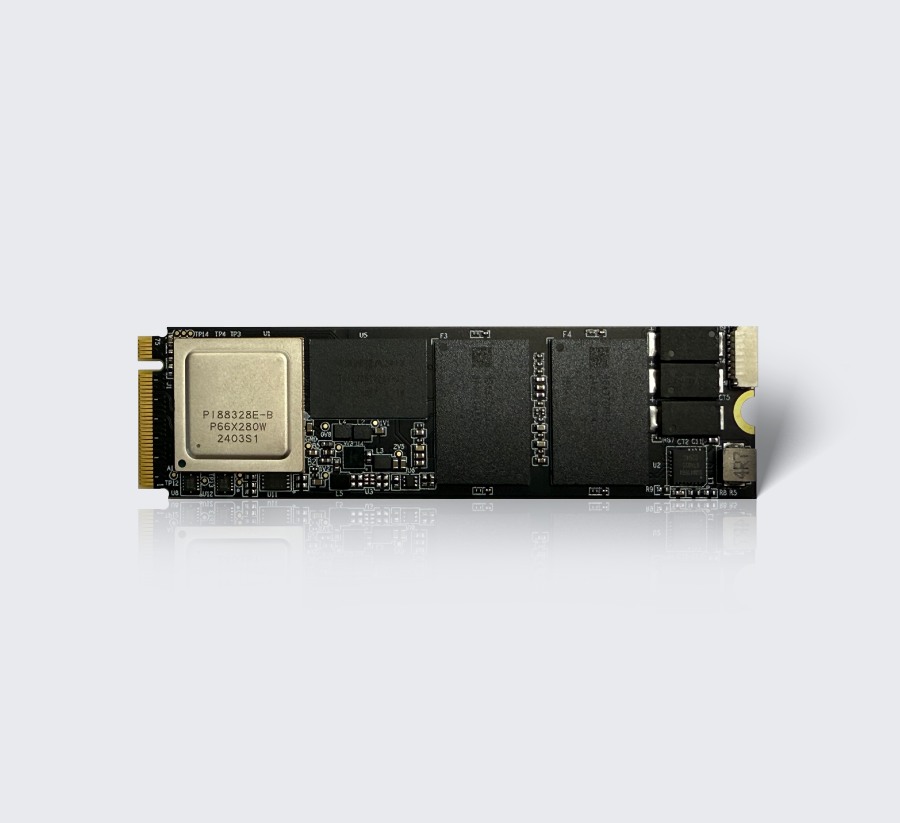
Tim Ding founded PETAiO in 2016 after years in the storage industry, including an earlier controller company, TiDAL Systems. The company built its core team in Silicon Valley and came out of stealth in 2019 with Titanium-DC. Its pitch was specific: an eight-channel PCIe Gen4 x4 controller for enterprise SSDs, using NVMe 1.4. The announced die measured 29.9 square millimeters. That is roughly the area of a small fingernail, entrusted with the behavior of terabytes of flash.
The figures in the launch materials were brisk: up to 7 GB/s sequential reads and 1.2 million random read operations per second at the controller level, with typical controller power reported at 2.75 watts. These are vendor specifications, measured in defined configurations, not a promise that every workload will see the same result. A 2020 PETA8118 drive release was more revealing because it showed different results for different NAND speeds, capacities and read or write tests. The cost of speed, in other words, includes the memory you attach to the controller and the power the assembled drive consumes.
The word enterprise can hide a dozen distinct problems. In a data center, the drive may be asked for small random reads all day, run hot in a dense rack or endure a power interruption without corrupting data. Titanium-DC was PETAiO's answer at the component level: controller architecture, error correction and firmware that could be adjusted for the customer's use. Its later drive line turned that architecture into something a systems buyer could specify and install.
Four shapes, one argument
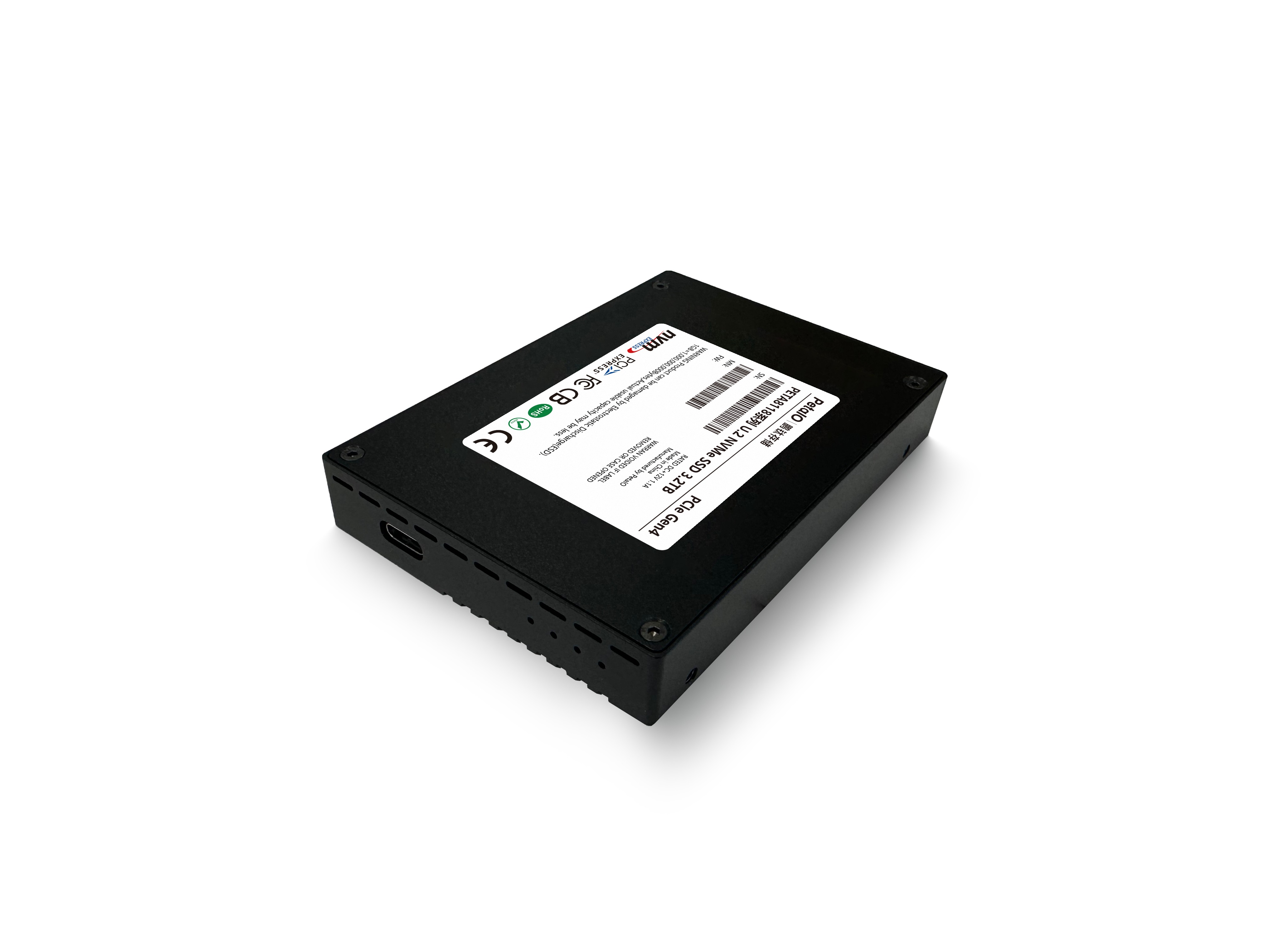
PETAiO's current catalog lists PETA8118 drives in U.2, M.2, E1.S and add-in-card formats. This is a map of server real estate. U.2 goes into the familiar enterprise drive bay. M.2 fits a compact board slot. E1.S makes room for dense, serviceable racks. The add-in card occupies a PCIe slot. The same controller family can therefore meet buyers where their machines have room, rather than asking every buyer to rearrange a rack.
Titanium-DC manages traffic between host and NAND flash.
Software tunes reliability, monitoring and workload response.
PETA8118 packages the platform for a server slot.
The listed U.2 and E1.S drives run from 2 to 8 TB; the M.2 range starts at 0.48 TB and reaches 4 TB. PETAiO advertises reads up to 7.1 GB/s for those models, and lists a power ceiling of 12 watts for U.2 and E1.S, below 8 watts for M.2. It also lists self-encrypting-drive features and end-to-end data protection on some models. These details are less flashy than the top read number, but more useful to the operator who must fit thousands of drives inside a thermal and power budget.
There is a trade-off in selling the full drive: every component choice becomes your problem. NAND quality, power-loss behavior and firmware alerts have to work in the same box. PETAiO's product pages explicitly discuss diagnostics, log management and notifying a host about abnormal conditions. That is where an enterprise SSD earns its keep: not on its fastest afternoon, but on its least convenient one.
The controller is the part that makes a fast drive act like a dependable one.Editorial reading of PETAiO's product strategy
A customer asks for a system
PETAiO operates in a crowded market. Samsung, SK hynix and Micron sell their own enterprise SSDs; specialists including Phison, DapuStor and DERA work in or near the controller and drive business. PETAiO's distinction is narrower than a claim to have invented fast storage. It says it develops its own controller, firmware and finished SSDs, and emphasizes a localized supply chain for Chinese infrastructure buyers.
The company's website says its products serve financial institutions, securities firms and rail transportation in China. It names two server relationships more concretely. Greatwall Technology uses PETAiO products in its business and gave it a supplier award for 2024. BAIXIN announced work with PETAiO on domestic servers for AI workloads. A company case study reports gains in a DeepSeek setup, but those performance figures have no published independent test methodology; the firmer point is that the drive was being sold as part of a server, not as a loose chip.
The organization itself reflects that two-sided market. US company records and its LinkedIn page place PETAiO in Santa Clara. Its current corporate website calls Nanjing its headquarters and lists research teams in Shanghai, Shenzhen, Wuhan, Silicon Valley, Taipei and Seoul. The site says more than 75% of the team works in R&D. That concentration of engineers is plausible for a business whose differentiator lives deep in silicon and firmware; the exact headcount is less clear across public company databases.
The next bottleneck has moved
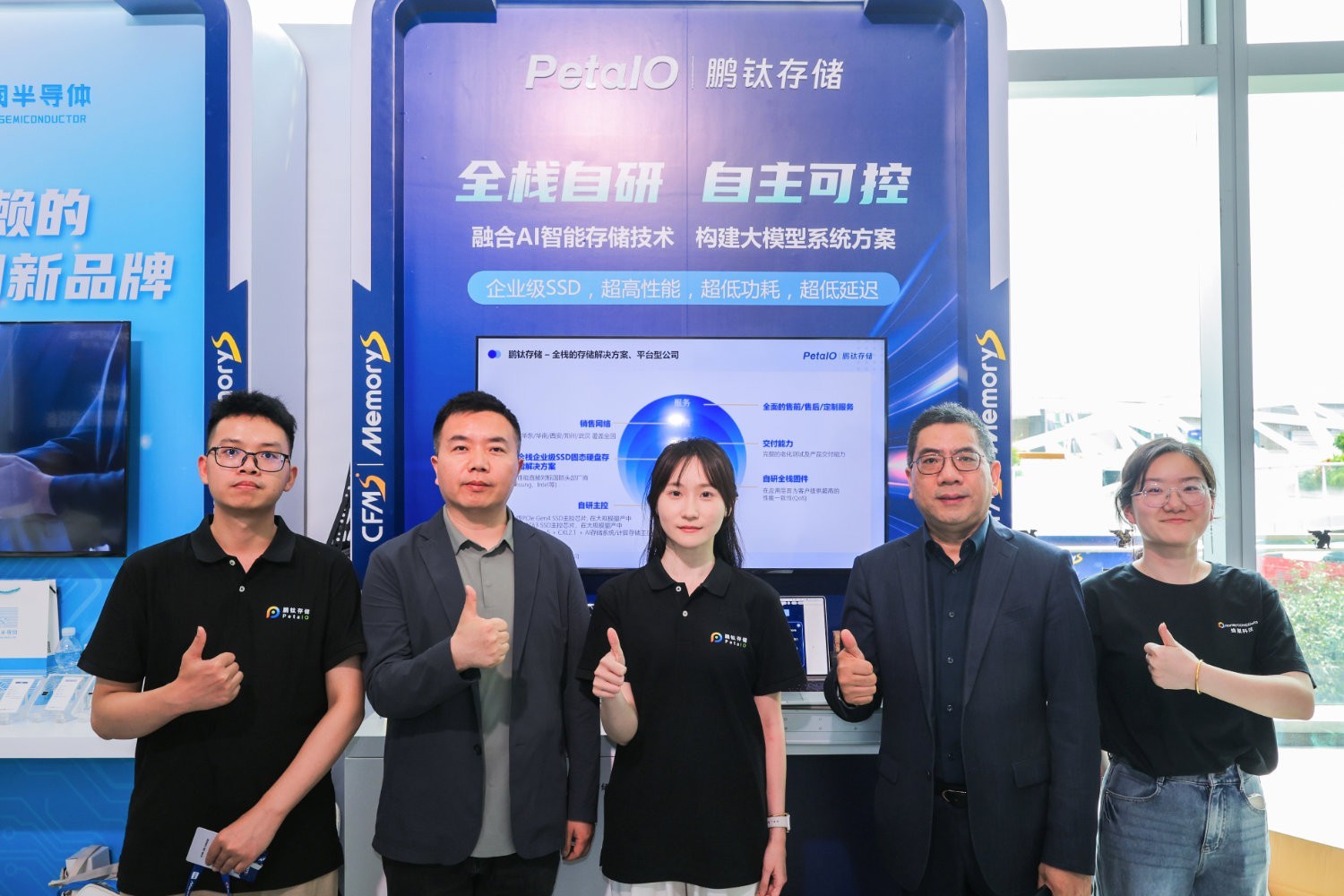
PETAiO's more recent language shifts from storing data to making it accessible to AI systems. At a 2024 flash-memory summit it presented the PETA8228 Smart NVMe SSD, built around a newer Titanium-XP controller and described with PCIe 5.0 x4 and CXL 2.0 interfaces. The company also talks about "memory semantic" storage and expansion for large models. That is a roadmap and a product presentation, not a reason to treat its most ambitious capacity projections as deployed systems.
There is a useful business lesson here for anyone building complex hardware. PETAiO began with the part that determined performance, then offered a complete product so customers could buy an outcome. The sequence is copyable; the chip is not. It requires deep controller and firmware expertise, the capital to make silicon, and a way to validate drives across real workloads. The strategy is strongest where a buyer needs a coordinated design. A buyer shopping purely on price, or one whose software never reaches the storage bottleneck, may see less value in that integration.
In March 2025, PETAiO joined an Inspur-led discussion of technical specifications for enterprise PCIe SSD controller chips. That is an unusually revealing milestone. Once a company has persuaded customers that its chip matters, it also has an interest in defining how chips should be tested. The controller remains small. Its job description keeps growing.