There is a particular sort of confidence in building a company around something you have removed. TenaFe's something is DRAM: the little bank of fast memory that conventional solid-state drives carry to keep track of their affairs. Remove it and an SSD becomes cheaper, smaller and cooler. It may also become slower at awkward moments. TenaFe exists in the distance between those two sentences.
The controller is the SSD's air-traffic tower. It receives requests from the computer, places data across NAND flash, corrects errors, encrypts information and tries not to cook itself. Consumers shop for capacity and speed; manufacturers fret about the controller that makes those promises plausible. TenaFe, founded in 2019 in Campbell, California, sells to the fretters.
The first thing to fail was the old bargain
As drives grew faster and capacities rose, the conventional bargain began to pinch in three places: bill of materials, heat and board area. Dedicated DRAM costs money, consumes power and occupies precious room on an M.2 stick or a soldered-down package. The constraint arrives before the user sees a benchmark. A thin laptop has only so much thermal patience.
TenaFe's answer is Host Memory Buffer, an NVMe feature that lets the SSD borrow a modest slice of the computer's main memory. Its controller still does the hard housekeeping; it simply leaves one suitcase at home. The first public expression was the TC2200, unveiled in 2021: a four-channel, 12-nanometre PCIe Gen4 controller rated at 4.8 GB/s sequential reads while operating without onboard DRAM.
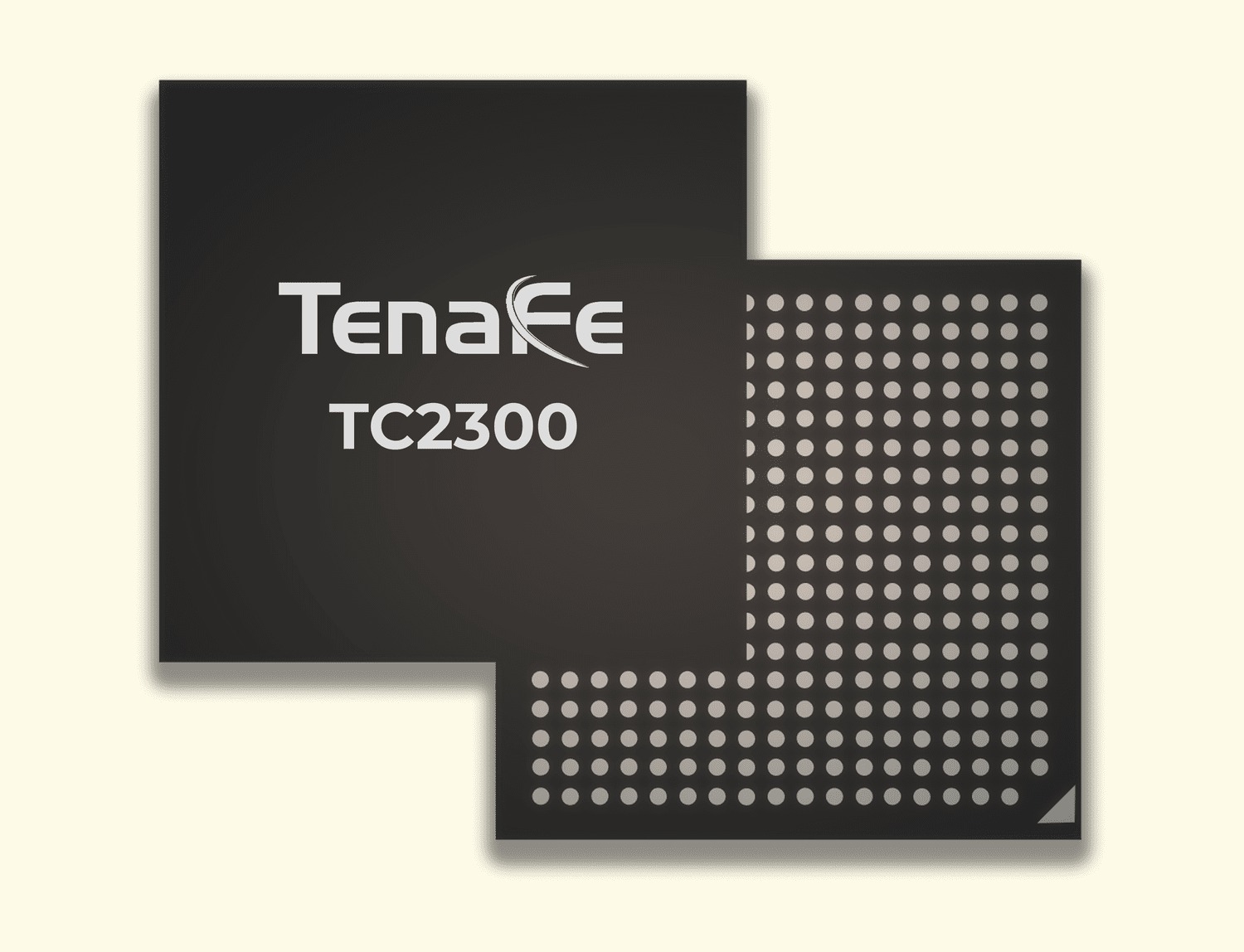
Its sequel shows what the company believes it learned. The TC2300 moves to a 6 nm process and PCIe Gen5, remains DRAMless, and is rated at up to 12 GB/s with four NAND channels. TenaFe says controller power stays below 2.5 watts. Peak claims are not the same as independent workload results, but the direction is clear: more bandwidth without returning the missing component.
Three controllers, one stubborn omission
Manufacturer-rated maximum sequential read speeds. Different interfaces and generations make this a product evolution, not a controlled benchmark.
The expensive part was learning what to fear
TenaFe's founders did not arrive from a fashionable detour into chips. Mike Lee previously founded Tidal Systems, the flash-controller company Micron acquired in 2015. Priyanka Thakore worked across SSD architecture and became TenaFe's chief architect. The company says its founding group averaged more than fifteen years in storage when TC2200 launched. Their advantage is not a secret material. It is a long acquaintance with failure.


NAND wears out. Bits drift. Firmware encounters combinations no clean-room demo anticipated. TenaFe's FlexLDPC engine corrects errors in TLC and QLC flash, while its designs advertise end-to-end data protection, secure boot, protected firmware updates and industry security standards. The more distinctive layer may be TenaFe Insight, an on-site or cloud platform intended to connect architecture, firmware development, qualification and mass production.
“We will use this as a baseline to set an even higher bar for our next-generation data center-focused controller.”Mike Lee, co-founder and CEO, at the TC2200 launch
This is where the company changed the question. The sale is not merely, “How fast is the chip?” It becomes, “How quickly can your exact NAND, firmware and form factor survive qualification?” A controller vendor that shortens that ordeal sells calendar time as well as silicon.
Eighty-seven million dollars buys several kinds of patience
The disclosed bill for the wager was $29 million in a 2020 Series A and $58 million in a 2021 Series B. The latter was led by Shunwei Capital, with Eight Roads, Northern Light Venture Capital, Tyche Partners, Zhangjiang Hi-Tech Investment and Source Code Capital among the participants. TenaFe said the money would push TC2200 into PC OEMs, fund new client and data-center products, expand the team and - during a global chip shortage - secure production capacity and inventory.
Publicly disclosed Series A and B financing. In semiconductors, money is not applause; much of it is prepaid patience for design, fabrication, firmware and qualification.
There are signs of the route into the market. KingSpec and Netac shipped or announced TC2200-based SSDs. A Haier Raytheon gaming notebook used the controller. In 2026, TenaFe said its faster TC2201 powered Seagate's FireCuda X1070, a PCIe Gen4 drive for gamers and creators. These are B2B victories: TenaFe's name may be absent from the box even when its logic governs the bits inside.
One architecture, four very different rooms
The product line now stretches. TC2311 adds an eight-channel Gen5 design for high-performance clients. TC2310 aims at data centers with throughput above 14 GB/s and a claimed 2.5 million random IOPS. TF2201 puts the company's storage thinking into CFexpress cards for cameras. PB50i compresses controller and NAND into a 16 by 20 millimetre BGA package for vehicles, IoT gear and embedded systems, with a stated operating range from -40°C to 85°C.
PC and gaming
HMB is available, component cost matters, and a slim thermal envelope rewards efficient bursts.
Edge and embedded
Small packages, low power and resistance to heat, shock and vibration outrank vanity benchmarks.
Data-center boot
Reliable boot, logs and management can suit DRAMless economics better than the heaviest write stream.
Sustained writes
When host memory is scarce or long writes dominate, a design with dedicated DRAM may remain the wiser tool.
That last square matters. Architecture is never a morality play. DRAMless designs depend on host support and can lose their appeal under sustained write-heavy work or in systems where borrowing memory is undesirable. TenaFe's approach is most persuasive when power, physical space, heat and cost count alongside speed. It is less persuasive when consistent worst-case performance is the only religion.
The part worth copying
The transferable lesson is not “remove DRAM.” It is to begin with the first constraint that customers actually feel, remove the component that causes it, then wrap the resulting compromise in software. TenaFe did not stop at a lean controller. It built error correction, firmware, security and a qualification platform around the absence.
That is a useful pattern for any hardware company. A cheaper bill of materials is easy to copy; a system that helps the customer finish a product is not. Nor is it enough to declare an architecture universal. TenaFe moves from gaming laptops to enterprise boot drives by naming the workload, thermal envelope and form factor each controller is for. Specificity is more credible than conquest.
The company sits in a crowded middle. Phison, Silicon Motion, InnoGrit, Maxio and Realtek sell alternative controllers; integrated storage giants can pair their own NAND and controller roadmaps. TenaFe counters with a narrow claim: experienced firmware, DRAMless efficiency, small forms and a shorter qualification path. It is a sensible place to stand, provided the products keep appearing inside other companies' machines.