Payam Zamani got the ending an entrepreneur is supposed to want. In 1999, AutoWeb, the online car marketplace he had started with his brother Frank, went public. The company reached a valuation of $1.2 billion. Eleven years earlier, the brothers had arrived in America with $75 between them. Put those numbers next to each other and the biography seems practically obliged to stop. Roll the credits. Order something expensive.
Except Zamani kept living. The public offering brought money and recognition, but it also brought a question that would occupy much of his subsequent career: what, exactly, was all this building for? He eventually left AutoWeb’s board. He started again. And when he founded One Planet Group in 2015, he wanted his convictions to have a place inside the business, where decisions happened, rather than wait outside until someone wrote a donation check.
That makes his story more interesting than the arithmetic. The founder, investor and author has spent years trying to reconcile two ambitions: making companies profitable and making their everyday conduct useful to other people. His preferred phrase is “spiritual capitalism.” It is a phrase that invites questions. He has given himself plenty of opportunities to answer them.
A country that would make a case for him
Born in Tehran in 1971, Zamani grew up in a Baha’i family. After Iran’s 1979 revolution, persecution closed down possibilities that other children could take for granted. Education, work and ordinary belonging became conditional on an identity he would not surrender. In 1987, his parents used their remaining savings to send their teenage son out of the country with smugglers.
The route took him through the Dasht-e Lut desert and into Pakistan. There was no business plan attached to this journey. The immediate objective was to reach safety, then find a way to start a life. The geographical distance was only part of it. Leaving also meant separation from his parents, familiar language and the routines that make a place home.
In Islamabad, the American embassy arranged legal help for his admission to the United States. Zamani has returned to that moment in interviews for years: a government that did not know him was willing to argue for his future. His gratitude toward America has this particular origin. Before America became a market in which he could build a company, it was a country willing to let him enter.
He and Frank arrived in San Francisco in June 1988. A cousin collected them and took them to Modesto. Zamani recalls working at a pizza business during the day and a screen-printing shop in the evening. Within weeks, the brothers had rented a one-bedroom apartment and furnished it with garage-sale purchases. The celebrated $75 beginning was followed by work, rent and the small domestic negotiations of starting over.
- 1987Iran → Pakistan
Escape from persecution - 1988California
A new beginning - 1994AutoWeb
Brothers become cofounders - 1999Nasdaq
A public company - 2015One Planet Group
A different set of priorities
Before the internet, there was house paint
Zamani’s business education included a useful detour through ladders and exterior walls. At UC Davis, where he studied environmental toxicology, he found a Student Painters internship through the career center. Over one summer, he says, running a house-painting business earned him $20,000 and recognition as California’s rookie manager of the year.
The revealing detail is what impressed him about the money. These were profits from a business he had helped operate, rather than wages. He had learned to organize work, take responsibility and make the numbers hold together. He went on to recruit and mentor other student managers. Before an internet marketplace, there were customers who expected someone to show up and paint their house.
Graduating in 1994, he joined Frank in founding AutoWeb that year. Their proposition was intelligible even to people who had barely encountered the internet: help customers connect with cars without requiring the whole search to happen at a dealership. It was an early experiment in moving the shopping process online, bringing consumers and dealers together through a new medium.
By 1999, that experiment was on Nasdaq. The scale of the change is striking, but the path contains more apprenticeship than the familiar refugee-to-IPO shorthand allows. College, summer work and responsibility for other people’s work all came before the public offering. A painting internship rarely makes the movie poster. Here, it deserves a speaking part.

The second question after the IPO
Zamani’s later account of AutoWeb includes disappointment with the way success felt and with the incentives surrounding it. Having reached a goal that once seemed distant, he found himself questioning the cycle of building and selling in anticipation of a satisfaction that kept moving further away. Another company, another transaction, another finish line: the arrangement could keep a person occupied indefinitely.
In 2001, he launched Reply.com, the performance-marketing business later relaunched as Buyerlink. That work kept him close to the practical problem of connecting consumers with businesses. The larger experiment came with One Planet Group, an umbrella for operating companies and investing in entrepreneurs. It gave him room to apply a set of principles across more than one enterprise.
He remains an entrepreneur who wants profits. In conversation about his approach, he asks, “What do you do with those profits?” His answer includes giving enough for it to matter to the giver. Business success, in this account, creates obligations as well as options. Having more capacity should change how much a person can contribute.
“Capital should serve humanity.”
Payam Zamani
That conviction draws on his Baha’i faith, especially its emphasis on the oneness of humanity. For Zamani, the connection is personal and continuous. The faith for which he was excluded in Iran also informs the kind of workplace he hopes to build in America. He brings the same beliefs into a setting where he now has the authority to make decisions.
What a belief looks like on a Tuesday
Company values become easier to understand when they acquire a calendar entry. One Planet’s stated practices include paid days for community service and allocating a share of profits to charitable causes. Its culture principles also address the less photogenic parts of work: consultation, prejudice, fairness and gossip. These are subjects a company can encounter long before it has a philanthropic budget.
In his writing, Zamani describes introducing anonymous employee questions and comments that were read and addressed at weekly all-hands meetings. The intention was to make direct discussion possible and reduce gossip. It is a modest mechanism with a demanding consequence: leaders have to hear what people are actually asking. A suggestion box becomes more consequential when someone has to open it in public.
There are outward-facing examples, too. In 2020, the company helped pay off student meal debt in Oakland’s public schools. Its Holidays with a Purpose initiative redirects resources associated with conventional office celebrations toward charitable fundraising. By a 2024 account, those events had raised more than $2 million for organizations supporting women’s rights and education.
Zamani and his wife, Gouya, also created an endowed scholarship for students of Iranian heritage at UC Davis in 2006. The university later recognized him with a 2018 Award of Distinction. The scholarship makes a specific connection across his life: someone once excluded from educational opportunity helping another student make use of it. The return to campus carries more meaning than an alumni photograph.
Make room for quieter voices.
Give time as well as money.
Bring values into everyday decisions.
An experiment with real-world friction
In August 2024, Zamani took on a different operating challenge. One Planet Group invested in Inspirato, the luxury vacation club, and he became its chairman and CEO. The company announced a $10 million capital infusion alongside the appointment. This was an existing public business with obligations, costs and shareholders, a setting in which his ideas would meet immediate practical demands.
During his tenure, Inspirato pursued cost reductions and changes to its property portfolio. A proposed combination with Buyerlink in 2025 introduced another complicated decision. The proposal would have joined two companies in which Zamani held important interests. Public filings described those interests, and shareholders faced a choice involving both strategy and governance. Intentions alone could hardly settle the matter.
The eventual outcome followed a different route. Exclusive Investments completed its acquisition of Inspirato on February 3, 2026, paying $4.27 per share in cash and taking it private. Zamani’s tenure ended with the transaction. In his public farewell, he emphasized the efforts of the employees and described the experience as the end of a chapter. The business had supplied a less tidy test than a conference stage ever could.
This part of the biography matters alongside the founding stories and charitable commitments. An operating philosophy has to coexist with ownership structures, financial constraints and competing judgments about what a company should do next. Zamani’s record contains those decisions, too. A principle earns attention when its application becomes difficult.
A longer conversation
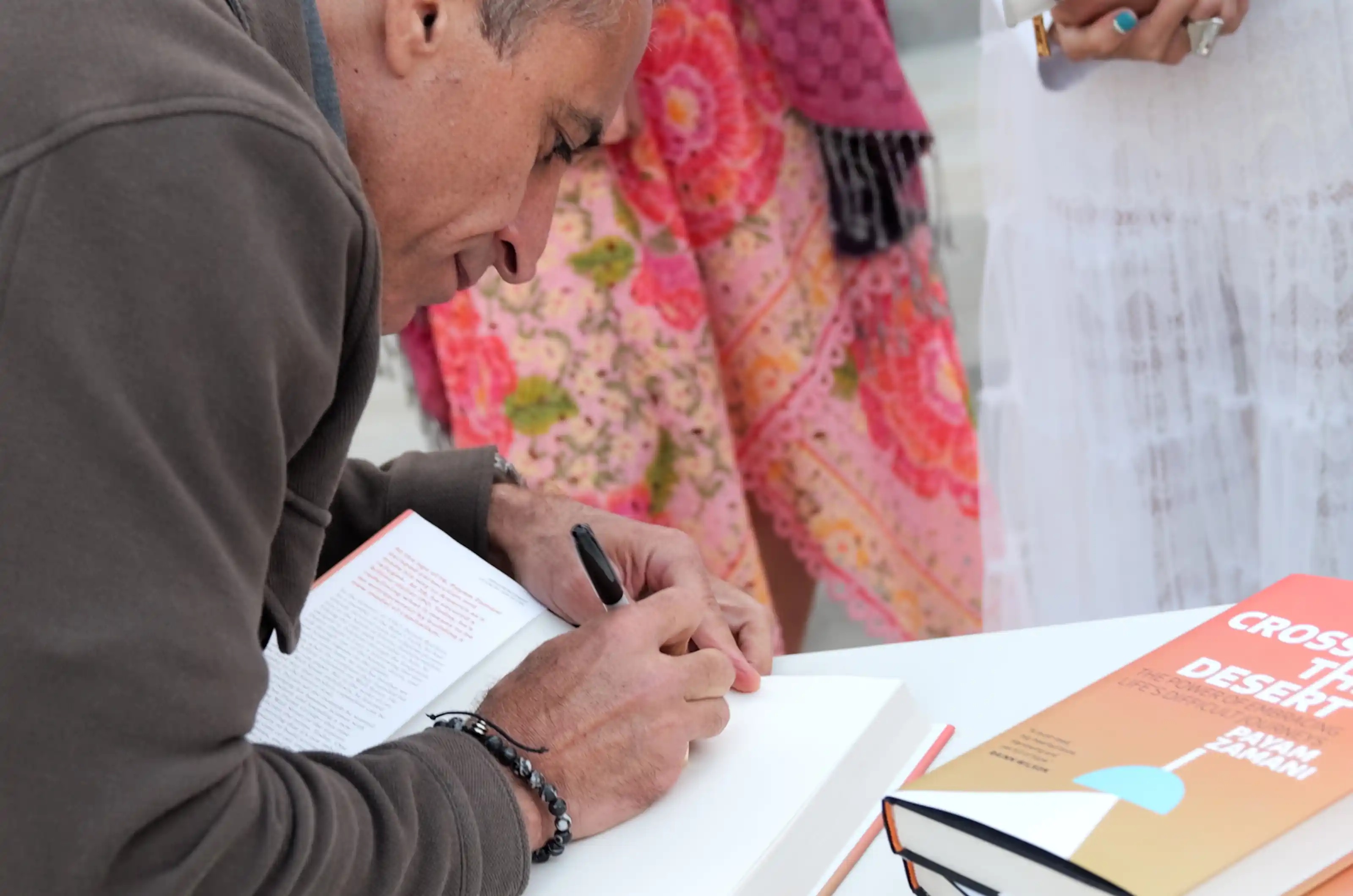
His 2024 memoir, Crossing the Desert: The Power of Embracing Life’s Difficult Journeys, puts the escape, entrepreneurship and subsequent questioning into one account. The book gives him a way to talk to the earlier versions of himself: the young refugee, the student and the founder trying to understand the consequences of success. In August 2026, he revisited those experiences on the Matthews Mentality podcast.
There is a quieter conversation behind the public ones. Zamani says he met Gouya at a Baha’i-inspired conference on business ethics, and their first discussion lasted five hours. They have two daughters. He describes his wife, herself a designer and entrepreneur, as someone whose counsel he relies on. Five hours on ethics is an unusually thorough first conversation. It also seems fitting.
The $75 and the billion-dollar valuation remain useful numbers. They explain the distance traveled. They leave out the question that has kept Zamani occupied since: how should a person behave after opportunity has worked out? One Planet Group is his continuing attempt to answer through decisions about companies, people and money. The next chapter still requires work.
Continue the conversation
Read, watch and follow Payam Zamani.