Eight days before Highgate became a registered company, Thomas Eymond-Laritaz already had a problem to solve. It involved a private aircraft, Japan, Lebanon and Carlos Ghosn. Most founders hope their first assignment will be memorable. This one arrived with rather more international baggage than usual.
In his account of the firm's beginnings, a friend approached him on 2 January 2020 to help the aviation company whose aircraft had carried Ghosn out of Japan. Eymond-Laritaz described the company as a victim of a corrupt employee. His role was advising the business after the escape. Highgate's incorporation followed on 10 January. The paperwork was catching up with the work.
By then, he had spent years moving between government offices, philanthropy and international consultancy. He had worked in Paris, Sofia, Kyiv and Tbilisi before becoming a senior adviser in London. The new firm put that experience under one roof. Its opening assignment supplied an unusually vivid demonstration of the sort of trouble that refuses to stay inside one professional category.
An engineer among the politicians
Eymond-Laritaz trained at the École des Mines de Paris and the Corps des Mines, graduating from the latter in 1998. His first professional world was French public administration. Engineering training preceded the diplomatic meetings, the international conferences and the reputation work. The sequence is useful to remember when considering a career now concerned with problems that rarely come with an instruction manual.
In 2001, he became an interministerial coordinator on European issues in the French prime minister's office. He worked under Lionel Jospin and Jean-Pierre Raffarin, crossing a change of government while dealing with European affairs. By 2003, he was advising Bulgarian prime minister Simeon Saxe-Cobourg on European issues. A French administrative career had acquired a distinctly international itinerary.
His work also included the French environment ministry. He later described his involvement in creating the first international emissions trading system. Environmental policy, European coordination and political advice share an awkward practical question: how do people with different responsibilities agree to act? His subsequent career would keep returning to that question, in places where the participants had even fewer reasons to agree.
Five years that kept bringing him back
In 2004, Eymond-Laritaz became chief of staff to Ukrainian investor Victor Pinchuk. He stayed in that role for five years. Alongside it came the work of establishing the Victor Pinchuk Foundation and becoming its president in 2006. This was a period spent building organisations and international relationships, rather than simply issuing advice from a comfortable distance.
By 2008, the foundation's budget had risen from $2.3 million in 2006 to $25.7 million. In an interview that year, he described philanthropy in Ukraine becoming more strategic, transparent and accountable. He also argued that much more could be done. The ambition extended beyond one institution's spending: he wanted to encourage the development of philanthropy in Ukraine and internationally.
He helped develop Yalta European Strategy, the network promoting Ukraine's European integration, and organised Ukrainian lunches and philanthropic roundtables at Davos. Those projects made conversation part of the work itself. A lunch can sound like a modest entry on a professional biography. Convening the people who might otherwise talk past one another can give it rather more consequence.
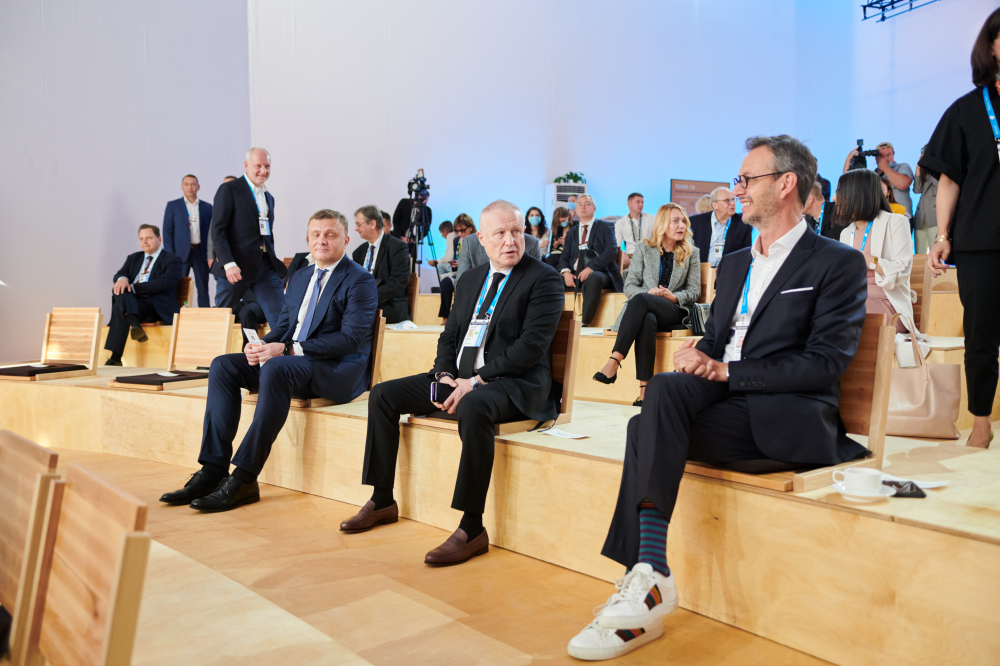
In 2009, he moved to Georgia to advise on European Union relations within President Mikheil Saakashvili's National Security Council. Ukraine remained a continuing commitment. In 2024, he said he had attended every annual YES meeting since its creation in 2004 and had run it from 2004 to 2009. Twenty years is a substantial relationship with a conference, and an even more substantial relationship with a country.
A room built for disagreement
Another Ukrainian undertaking began in 2008, when he created the country's first Aspen seminar. He later helped bring Aspen institutions into being in both Ukraine and the United Kingdom. He remains a member of Aspen Institute Kyiv's supervisory board. The institute gives his biography a second recurring setting: a room in which people meet to consider leadership and public responsibility.
Highgate became a partner and funder of Aspen Institute Kyiv in 2021. Its support was directed towards additional Responsible Leadership seminars. Here was a connection between his business and an organisation he had helped initiate years earlier. The philanthropic work continued alongside the advisory career, with a specific institutional home and a practical means of supporting it.
His London career, meanwhile, took him through APCO Worldwide and Mercury. At APCO, he established and led a global geopolitical and reputation practice. He was an executive director there before becoming a managing director at Mercury. The positions brought political experience into assignments involving businesses, prominent individuals, litigation and reputational pressure.
Hiring people whose experience differs from yours
When Eymond-Laritaz started Highgate in 2020, he wanted a small group of senior advisers with different professional backgrounds and a willingness to take on complicated international assignments. By August 2021, the firm had eleven consultants. His explanation of the opportunity was concise: an “appetite for complex, international assignments”. A fair appetite, given the first case.
Polly Kennedy and Patrick Harrison joined in January 2022. Kennedy came from APCO UK to become chief operating officer. Harrison arrived from Weber Shandwick, having previously spent more than a decade as press secretary to the Prince of Wales. Highgate reported eighteen consultants and a doubling of revenue during 2021. The recruitment choices showed where Eymond-Laritaz intended to invest.
Clients, he explained at the time, needed experienced people they could respect and trust when a problem took them beyond familiar territory. His own career had repeatedly required moving between institutions and countries. The hiring policy extended that breadth through other people's experience. A founder's address book might open a door; an adviser still has to know what to do once inside.
Consultants reported at each milestone. A historical view, not a current headcount.
By its fifth anniversary, Highgate reported forty-five permanent consultants speaking more than twenty languages. Eymond-Laritaz's anniversary message was less restrained than the usual corporate announcement. There were repeated thank-yous in French and an enthusiastic tribute to colleagues, clients and partners. He called it a collective adventure. It reads like someone pleased with the company he has chosen to keep.
“We operate as their trusted advisers.”Thomas Eymond-Laritaz · on Highgate’s work
The case beyond the case
The work that interests him occupies the space around formal proceedings: political interests, public reputation, financial incentives and the information reaching decision-makers. Highgate works alongside legal advisers and investigators to encourage settlement. His contribution is to ask what else determines an opponent's willingness to move. A convincing argument can have a surprisingly unconvincing effect on someone who benefits from delay.
In December 2024, he co-authored an FT Alphaville article with Jay Newman, formerly a senior portfolio manager at Elliott Investment Management. They argued that investor-state arbitration and litigation were failing to resolve sovereign investment disputes effectively. The subject fits his experience of both political offices and private clients: governments bring calculations to a dispute that extend well beyond its legal merits.
In April 2025, Highgate announced a partnership with China specialist Tim Clissold. Eymond-Laritaz explained the circumstances in which he thought extra help was needed: a large dispute, unequal resources, political interference or weak rule of law. He also offered an unusually limiting sales proposition, saying that “in 90% of the disputes” the firm's services were unnecessary. That was his own characterisation of the market, rather than a measured industry statistic.
Who gets to question the intelligence?
His January 2026 conversation with Gary Miller on The Intelligence Advantage explored another difficulty: the relationship between gathering intelligence and interpreting it. Miller's account of their discussion stressed how a person who collects information can become attached to the source, the effort involved and the conclusion. Separating collection from analysis gives a decision a better chance of surviving scrutiny.
The point has particular relevance to someone whose clients may already be receiving confident advice from several directions. More information can increase confidence without increasing understanding. The useful intervention may be a question about the information's origins, or about who has been allowed to challenge it. For an adviser selling judgement, the willingness to interrupt certainty is part of the job.
Eymond-Laritaz has also expressed concern about declining trust in politics, business and media. In a conversation about reputation, he advocated authentic communication; Highgate's work included an online reputation scoreboard to assess clients' standing. Measurement and persuasion sit beside each other here. The engineer's early training makes an interesting companion to a profession usually associated with words.
Still taking the journey
In September 2026, he returned to Kyiv for meetings, continuing a connection that began more than two decades earlier. In October, he joined the Resilience World Nexus Summit's geopolitical discussion. His sixth-anniversary message earlier in the year had celebrated growth while acknowledging mistakes and learning. The public picture is of a founder still travelling, comparing experiences and building the firm through the people around him.
The distance from French public administration to Highgate is considerable. So is the continuity: European affairs, philanthropy, political advice and commercial disputes all require understanding people whose incentives differ. His story is populated by presidents and prime ministers, but it also turns on colleagues, seminar participants and a friend with a difficult request. Highgate began with a request before it had finished becoming a company. Eymond-Laritaz had already spent a career preparing to answer.
Continue the conversation
- Highgate · biography
- LinkedIn · Thomas Eymond-Laritaz
- Watch · The Intelligence Advantage
- Read · Highgate’s first assignment
- Read · Foundation interview, 2008
- Explore · Aspen Institute Kyiv
- Read · Senior appointments, 2022
- Read · Sovereign investment disputes
- Read · The China partnership
- Explore · Spear’s adviser profile
- Read · Early team, 2021
- Read · YES career biography
- Explore · 2026 summit