Paul Schlueter’s promotion came with an interesting piece of continuity. When he became CEO of Flynn Wright on February 2, 2026, his responsibilities still included client strategy and the agency’s research function. Twenty-nine years into his time at the firm, the new title left him connected to the work of finding out what people think, what they need and what might persuade them to act. The corner office, in this telling, still requires homework.
He took over day-to-day business operations as Aaron Kennedy moved to chairman and Sarah DeKock became president. Kyle Prendergast, Bridget Proctor and Jeff White also took new executive roles. The announcement read like a change in the working arrangements of an established team. There was a practical reason for that: the people involved had already spent years inside the business, learning its clients and its habits.
Advertising supplies plenty of opportunities to make a personality conspicuous. A chief executive’s face can become shorthand for the whole enterprise. Schlueter’s career offers a different editorial interest: the relationship between patient investigation and public persuasion. Before an agency can put an idea into the world, someone has to ask whether it deserves to be there. His continuing research responsibilities make that question part of the chief executive’s job description.
A pirate with a reading list
On his own agency biography, Schlueter introduces himself through curiosity. History, philosophy and psychology are the subjects he names. He describes reading as a way to learn about empathy, strategy and persistence. Then the language takes a nautical turn: he places pirates alongside entrepreneurs and innovators in his account of doing things differently. It is an amusing combination. The reading list suggests a seminar; the pirate suggests that the seminar might end with a mutiny.
His stated purpose is decidedly practical. “Because if our clients are successful, we’re successful.” That sentence gives the adventurous vocabulary a destination. Difference has to help somebody else’s business. A campaign can attract attention and still leave a customer unmoved; an unusual idea can be enjoyable and still miss the assignment. The useful question is what the difference accomplishes.
His LinkedIn profile places him in Ankeny, Iowa, and lists the University of Northern Iowa for 1991-1995. Its professional introduction foregrounds strategic marketing and market research. These details give his public identity a consistent shape: an Iowa-based advertising executive whose vocabulary includes both human behavior and business decisions. Curiosity is a fine quality in a reader. For a strategist, it also provides a reason to resist the first convenient answer.
“Because if our clients are successful, we’re successful.”
Paul Schlueter
First, find out what people mean
Flynn Wright describes a working sequence that begins with research, proceeds to strategy and then moves to action. Its research team uses qualitative and quantitative methods to explore consumer attitudes and behavior. Account teams connect those findings with an audience, a message and a client’s business goals; creative and media teams carry the work into execution. In that sequence, the attractive finished advertisement arrives relatively late.
That order matters because the object being sold and the reason for buying it are rarely identical. A company knows its own specifications. A customer brings a separate set of priorities, doubts and distractions. Research is the opportunity to hear those priorities before the creative work makes them look tidy. Strategy then requires a choice about which finding deserves attention. A page full of findings has yet to become a plan.
Consider one piece of the agency’s work for Colorbiotics, which sells mulch colorant. Flynn Wright worked with the company’s research and development team on colored, custom-cut cubes, packaged as a physical palette. Customers could see and feel the samples. The campaign also used droplets and three-dimensional animation to represent the liquid product. This is agency work rather than a personal project credit for Schlueter, but it makes the business he leads easier to understand.
The sample box is a pleasingly concrete answer to a communication problem. A technical product becomes something a buyer can handle. The broader lesson is about choosing a form that suits the decision: some questions benefit from a sentence, some from a demonstration, some from an object on a desk. The clever part begins with recognizing which kind of question the customer is asking.
Sioux Falls was a choice about people
In August 2022, Schlueter was president when Flynn Wright opened in downtown Sioux Falls. Midco and NorthWestern Energy were among its clients with ties to the city. He emphasized consumer insight, customer acquisition and the firm’s research and strategy foundations. He also made clear that the new office’s staff would contribute across the agency’s work. The location was intended to add talent to the whole business.
“We tend to develop culture across the table,” he said. At the time, nearly all employees worked in the office daily, with flexibility in their day-to-day arrangements. The phrasing is specific enough to picture: people encountering one another while a question is still unresolved, rather than meeting only when somebody has polished the answer. A table can be a fairly modest piece of infrastructure with a considerable amount riding on it.
Portland followed as a third office, announced in September 2025. Schlueter spoke of the time the agency had spent there and of its appeal as a place to build business relationships. The geography widened from an Iowa headquarters to South Dakota and Oregon. Expansion, viewed through those two announcements, involved learning about a place before establishing a presence in it.
There is a useful tension here. More locations offer more people and more opportunities; a shared culture has to travel with them. An office address can be printed in an afternoon. Working trust takes longer. The task for a leader is to make participation in the wider business credible enough that distance does not reduce a new colleague to a name at the bottom of an email.
The intern who became a partner
Kiersten Maertens offers a tangible example of advancement within the agency. She arrived as a public relations intern in 2006, moved into account services in 2009 and became a partner effective July 10, 2025. By then she was vice president of account services. Schlueter’s public comments on her appointment linked client success with positive outcomes for the team. He treated her path from intern to partner as evidence of opportunity inside the firm.
A story like that is useful to an employer because a prospective colleague can put dates beside the promise. Internships are often described as beginnings. This one can be followed through a change of discipline, promotions and eventually ownership-level responsibility. The interesting detail is the time between those stages. A career develops through successive chances to do more, alongside the everyday work that gives other people a reason to trust you.
The agency’s careers page makes long tenure part of its pitch, noting that many team members have been there for more than a decade. It also invites people to bring interests from outside their job descriptions. The list includes cricketers, backpackers, plant enthusiasts and Grateful Dead fans. That is a statement about the team’s range, rather than a list of Schlueter’s hobbies. Still, it sits comfortably beside his own enthusiasm for reading beyond the advertising shelf.
By February 2026, Schlueter was describing succession as an ongoing responsibility. He wanted the business to endure beyond the tenure of its individual leaders. “It takes a long time to do it right,” he said. His account tied the future to hiring, development and room for younger people to demonstrate their abilities. For a newly appointed CEO, that is a notable direction of attention: toward the people who will eventually carry the business further.
A region has a reputation, too
His research work has also intersected with the public ambitions of Central Iowa. A July 2013 Capital Crossroads progress report records a June 24 presentation by Schlueter at Flynn Wright’s offices to close to 100 stakeholders. The topic was the Capital Corridor branding initiative, with agricultural bioscience central to the discussion. The report identified him as vice president of research and interactive.
The same document listed him among participants in a meeting with U.S. Secretary of Agriculture Tom Vilsack about the initiative. Other attendees came from Iowa State University, agricultural businesses and regional economic development organizations. It is a different setting for an advertising strategist: a room in which the product under discussion is a region’s economic identity, and the audience includes people who must help make the identity convincing.
A regional brand asks more than a logo can answer. It requires decisions about which assets belong together, which story outsiders can understand and whether local institutions recognize themselves in it. Research gives those questions somewhere to begin. The 2013 record supplies an early public example of Schlueter’s work reaching beyond an individual client’s sales brief into the way a community describes its prospects.
Flynn Wright’s later work for Catch Des Moines brings the regional question into a more playful register. The tourism campaign used the city’s pronunciation as a creative device, extending exclamations across print and video and developing visitor-oriented lists. Again, this is the agency’s work. Its interest here is the change in tone: civic communication can make room for a joke while still giving a visitor something useful to do next.
The question after the title
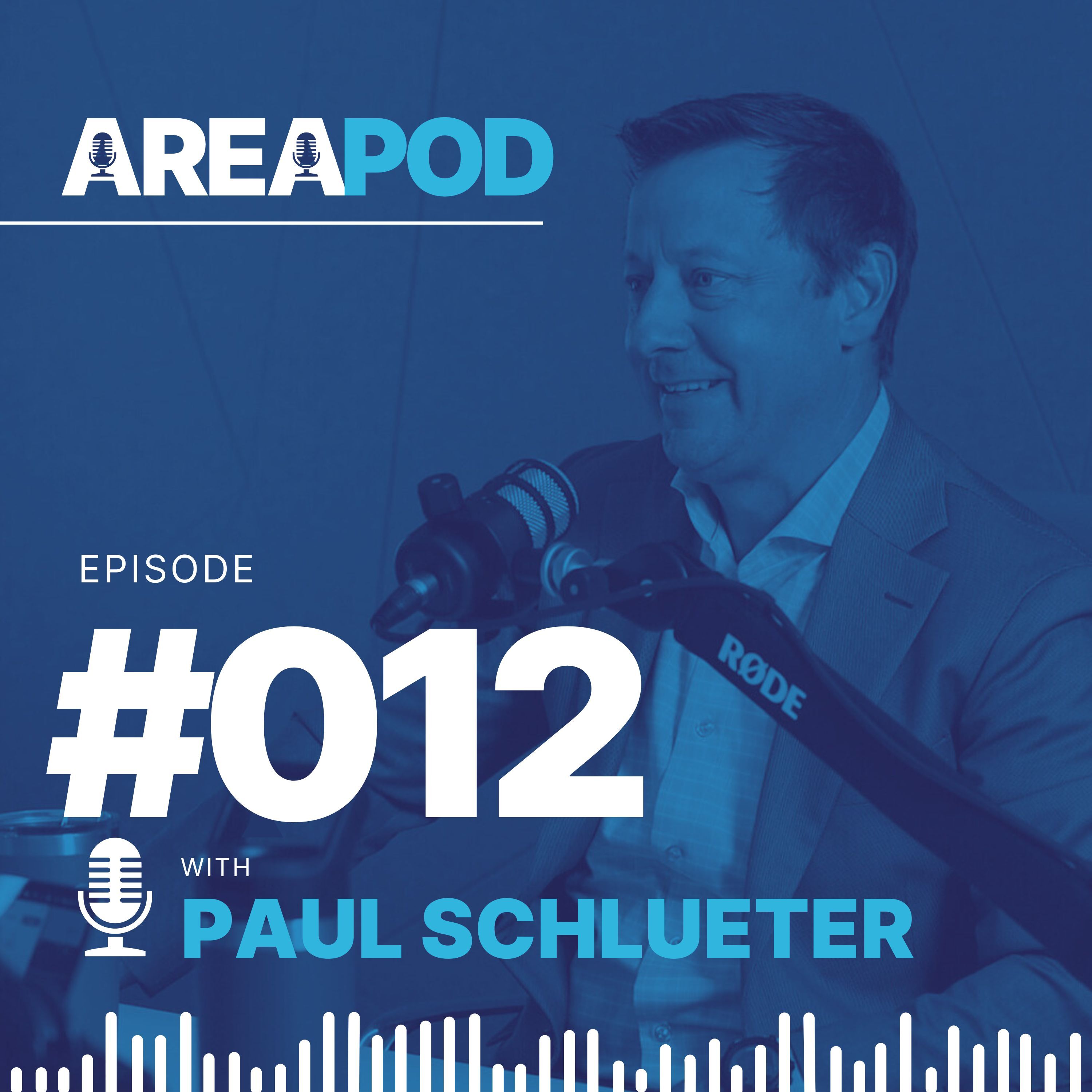
In September 2025, Schlueter appeared on episode 12 of the AREA Podcast, a conversation about leading through change, strategy, creativity and a culture oriented toward client success. The episode runs about an hour. It belongs to the period just before his CEO appointment, when his public role was president and his tenure at Flynn Wright was approaching three decades.
The sequence is revealing without requiring a dramatic conversion story. A research executive appears in a regional planning effort. A president explains the logic of a new office. A colleague celebrates an intern’s progression to partner. A CEO keeps responsibility for research. These are different assignments with a recurring concern: understanding the people involved before deciding what comes next.
The agency’s phrase “one step ahead” sets a deliberately manageable distance. A step is close enough to require knowledge of the ground. For Schlueter, the public record makes that ground unusually visible: the clients whose decisions matter, the colleagues whose careers develop over years, the cities where the agency works. His new title enlarges the assignment. The questions that brought him there remain worth asking.