Paul Roetzer spent an estimated 300 to 400 hours on a project that would once have required him to explain an idea to somebody who could code. In 2026, he worked through dozens of prototypes himself, using Claude to turn his business assessments into functioning web pages. Then he handed the work to developers. For someone whose profession involves explaining how AI changes work, this was a particularly demanding piece of homework.
The tool was AI Score, designed to help individuals and organizations assess their progress with artificial intelligence. Roetzer already understood assessment design from his years in marketing consulting. What had changed was his ability to make the thing he had imagined. He estimated that doing the prototyping himself saved between $100,000 and $250,000 in development costs. Those were his estimates, rather than audited savings, but the hours were a useful corrective to the fantasy of effortless invention. The machine had made new work possible. It had also given him rather a lot to do.
That combination of possibility and obligation runs through his career. Today he leads SmarterX and Marketing AI Institute, co-hosts The Artificial Intelligence Show with Mike Kaput, and teaches businesspeople how to approach a technology whose capabilities keep moving. His route into that work began with a different machine, a television quiz show, and a question he could not quite put down.
A quiz show with consequences
In February 2011, IBM’s Watson defeated Ken Jennings and Brad Rutter on Jeopardy! Roetzer, a Cleveland marketing agency founder, wanted to understand what he had watched. The performance suggested something with implications beyond collecting prize money. A machine was processing language and answering questions. What might that eventually mean for the decisions his clients paid his agency to make?
He began reading and researching. Christopher Steiner’s Automate This, about algorithms changing industries, helped him think through the possibilities. Marketing was becoming a business of proliferating channels, data, and choices. A strategist had to weigh audiences, spending, timing, and distribution. Roetzer wondered how far human judgment alone could go in finding the best combination. His curiosity had a customer attached to it.
He had graduated from Ohio University’s E.W. Scripps School of Journalism in 2000. That background matters to the kind of AI business he eventually built. His work centers on investigating, explaining, and teaching. He was approaching the machinery from the reader’s side of the page, asking what its abilities would mean for somebody trying to do a job on Monday morning.

First, take apart the invoice
Roetzer had already spent years questioning how professional work was organized. In February 2004, he concluded that the agency model needed changing. Billable hours rewarded time consumed; familiar measurement systems could tell a client how much attention a campaign received without explaining what it accomplished. Requests for proposals consumed effort on both sides. These were ordinary agency rituals, which made questioning them professionally inconvenient.
In November 2005, at 27, he started PR 20/20. Before leaving his previous employer, he spent nights and weekends developing a different way to sell services. He later recalled roughly 600 hours building a guide with 19 categories, 105 services, and three pricing levels for each. The spreadsheet was, by his description, a monster. Even rebellion against bureaucracy apparently needs a spreadsheet.
The principle was straightforward: define the scope carefully enough and a service could carry a standard price. In his example, writing a sell sheet could include a specified interview and number of revisions. That specificity gave the client something concrete to buy. It also forced the agency to understand what it was promising before starting the clock.
In 2007, he encountered HubSpot and became a customer. PR 20/20 became HubSpot’s first partner agency, before a formal partner program existed. By early 2008, the firm was packaging services for HubSpot customers at set fees. His work connected an unfamiliar technology with an understandable commercial offer. The company now known as Ready North was an early rehearsal for a much broader teaching business.
Publish it, and learn in public
The AI research initially lived inside the agency. In 2016, it became Marketing AI Institute, beginning with a blog and newsletter. There was an appealing economy to the approach: investigate questions the team already had, then share the answers with other people who might have them too. Education grew out of work already underway.
That also gave Roetzer a practical way to test whether the subject made sense to anybody beyond his own office. Explaining a technology makes gaps in understanding harder to hide. A newsletter needs another edition. A class invites another question. An institute sounds settled; the activity underneath it was continued learning.
Books provided another outlet. The Marketing Agency Blueprint appeared in 2012, followed by The Marketing Performance Blueprint in 2014. In 2022, he and Kaput published Marketing Artificial Intelligence: AI, Marketing, and the Future of Business. The titles trace a widening field of concern, from how an agency operates to how technology changes the work its customers do.
He created the Marketing AI Conference, MAICON, whose inaugural event took place in 2019. In 2021, he sold the agency. That decision put his attention on AI before ChatGPT’s public arrival in November 2022. He has been careful about the distinction: he saw advanced writing capabilities developing, rather than foreseeing that particular product. Timing can look wonderfully tidy once somebody else writes the timeline.
“My only advice is to just take the next step.”
Paul Roetzer, May 2026
The teacher has homework, too
The Artificial Intelligence Show gives Roetzer and Kaput a recurring appointment with an unruly subject. They research AI developments and discuss what those developments could mean for business. The show relaunched in 2022. Its usefulness depends on a familiar editorial task: choosing what deserves attention when there is more material than anyone can sensibly consume.
Other teaching happens through AI Academy and live classes. His official biography reports more than 40,000 registrations for his free monthly Intro to AI class since its 2021 launch. That is a registration count, not a claim that every registrant finished a course. It nevertheless explains why education has become the organizing idea of his businesses. A classroom can reach people an individual consulting engagement cannot.
In January 2025, he announced the AI Literacy Project. Its published principles favor accessible education, sharing research, and helping people develop new capabilities. They also advocate redeploying talent for growth and innovation rather than using efficiency gains simply to eliminate jobs. For an entrepreneur selling AI education, that is a consequential choice of emphasis. The people being asked to learn are also the people who may bear the cost of change.
In May 2026, Roetzer wrote that even he was struggling to keep up. After attending Google Cloud Next in Las Vegas, he returned to a familiar managerial problem: which systems should his own company commit to? He decided on the flight home to form SmarterX Labs and organize small building sessions for noncoders. He called them “Vibes,” acknowledging the name’s lack of originality. The teacher’s response was to set an exercise and join the class.
A future with room for people
His interest in technology has always had to share space with an interest in getting home. He has spoken about declining agency growth opportunities because he wanted evenings with his family. Former colleagues describe an approachable boss with a sense of humor who cared about their development. His old agency biography offers a more compact portrait: he listens to Lil Wayne while drinking hot tea. Corporate personality assessments rarely improve on that level of detail.
He and his wife, Cheryl, began dating in high school. Golf and reading appear among his interests. These details put some ordinary life around a career devoted to extraordinary technological claims. His concern about the future of work includes the schools and job market his children will encounter. The consequences are close enough to the kitchen table to resist becoming merely an interesting conference topic.
In a March 2025 interview, he described entrepreneurship in terms of the work itself and the people it reaches, rather than a distant payout. He said, “I just am so appreciative of every day getting to do what we do.” There is a consistency here with the business he has chosen: learning something, explaining it, and seeing whether it helps somebody else.
The optimism has conditions
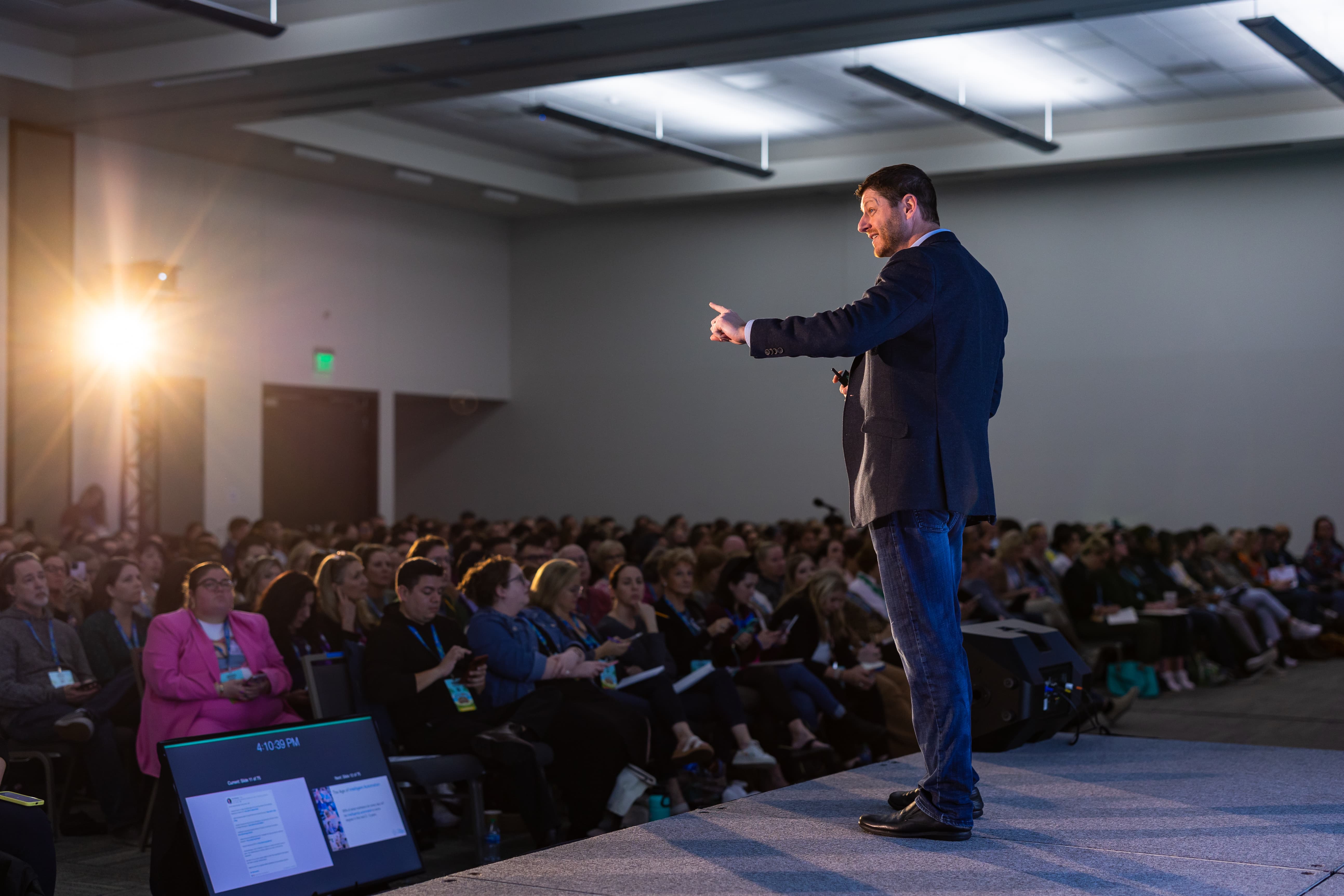
At MAICON in Cleveland in October 2026, those conditions were visible in the program. Nearly 2,000 marketers and business leaders attended, Roetzer wrote afterward. Kevin Roose and Andrew Yang spoke, while Karen Hao’s session examined the human costs behind AI’s development. Hosting critical accounts alongside practical sessions on adoption asks an audience to hold more than one thought about the technology.
That fits the conference’s theme, used since 2019: “More Intelligent. More Human.” The second half gives the first half something to answer to. A company can become more productive while its employees become less secure. A tool can be impressive while raising difficult questions about how it was made. A useful education has to leave space for both observations.
Roetzer’s September 2026 announcement of The AI Transformation Blueprint: A Human-Centered Guide to Organizational Change extended that approach into another book and a companion assessment. AI Score was designed to examine eight business pillars and five personal pillars, including literacy and judgment. His stated purpose was to help organizations manage change with people in mind. The prototype work had brought him back to a longstanding occupation: making an abstract idea specific enough to use.
The line from the early pricing spreadsheet to those working prototypes is unusually clear. Roetzer studies a problem, builds a framework, and makes the framework available to others. The tools have changed substantially since 2005. The question underneath the work remains recognizable: how can people do something useful with what comes next? For now, his answer is another class, another experiment, and another reason to keep learning.
Keep following the questions
- SmarterX - education, experiments, and tools ↗
- Marketing AI Institute - the blog and MAICON ↗
- Roetzer’s latest writing - ExecAI Insider ↗
- The Artificial Intelligence Show - episodes and transcripts ↗
- Watch: Episode 146 - AI-first companies and the future of work ↗
- Listen: Lay of the Land - the entrepreneurial journey ↗
- Read: Ohio University’s “More human” ↗