The Economist
Who Wouldn't Sit Down
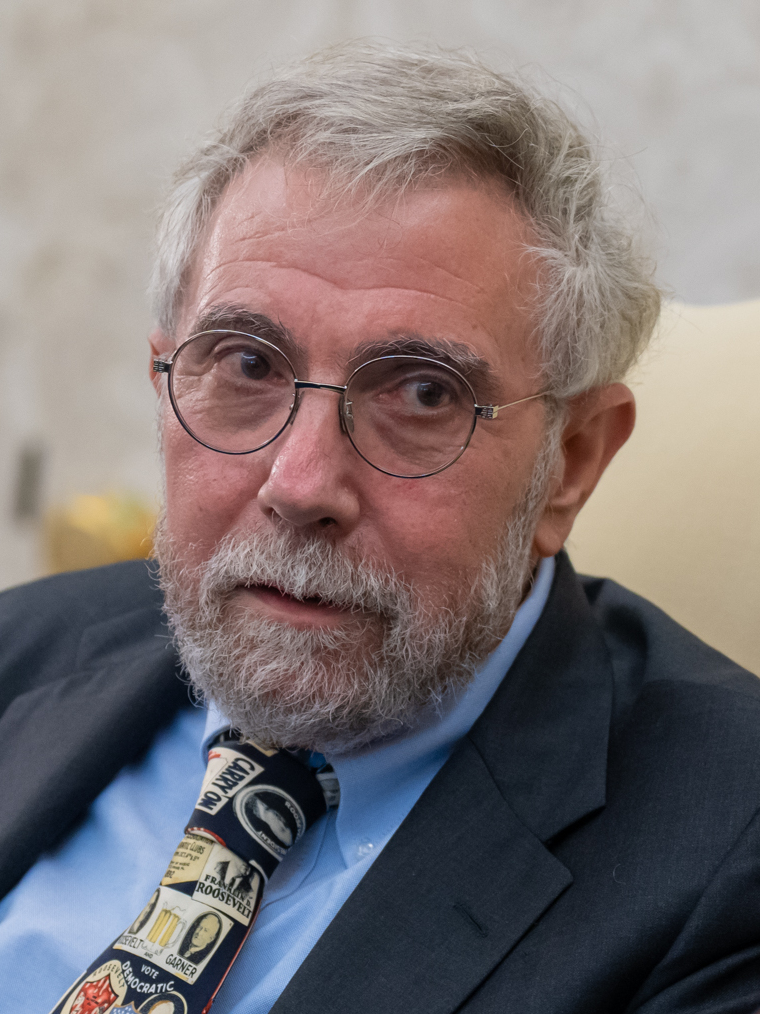
Paul Krugman is, at this point, less an economist and more a weather system. He arrives daily in your inbox, your feed, or your morning paper - wherever you've allowed him to land - and leaves you with the uncomfortable feeling that he was right again. Not about everything. But about enough. The 2008 Nobel Memorial Prize in Economic Sciences was awarded to a man who had already been right about Asia's financial crisis, right about the Bush tax cuts, and right about the dangers of deregulation. The committee cited his work on New Trade Theory and New Economic Geography. The public knew him as the columnist who wouldn't pretend that the emperor's economic clothes were real.
Born in Albany, New York in 1953, Krugman grew up in a Ukrainian and Belarusian Jewish household where his grandparents had fled Europe in the 1910s and 1920s. He traces his interest in economics to an unlikely source: Isaac Asimov's Foundation novels. The fictional science of "psychohistory" - predicting vast human behavior through mathematical models - struck the young Krugman as the most fascinating thing he'd ever encountered. When he discovered that economics was the closest real thing, he pursued it with the single-mindedness of a man who found his calling before he turned twenty. He had his bachelor's from Yale by 1974 and his Ph.D. from MIT by 1977, at age twenty-four.
His academic work is genuinely brilliant - the kind that changes how entire fields think. New Trade Theory, developed in the late 1970s, explained why countries with similar economic profiles trade the same types of goods: it's about economies of scale and consumer demand for variety, not just comparative advantage. New Economic Geography explained why Silicon Valley exists, why Wall Street clusters in Manhattan, why Detroit was once the center of automobile manufacturing. These weren't just clever papers. They were new lenses. The Nobel committee doesn't hand out medals for productivity, so the fact that Krugman won his in 2008 - twenty-five years after the core work appeared - should tell you something about how long it takes the world to catch up to genuine insight.
"The economics profession went astray because economists, as a group, mistook beauty, clad in impressive-looking mathematics, for truth."
- PAUL KRUGMANThe New York Times column, which ran from 2000 to December 2024, was its own phenomenon. Krugman became, in the words of observers who didn't particularly like him, "the most hated and most admired columnist in the US." That description, typically meant as criticism, functioned for him as something close to a mission statement. His own credo, posted on his old MIT website: "If an op-ed or column does not greatly upset a substantial number of people, the author has wasted the space." He lived by this sentence for two and a half decades. His column on the Bush administration's economic policies - running in real time during a period when many mainstream outlets were printing gentler assessments - earned him devoted readers and ferocious enemies in roughly equal measure.
He left the Times in December 2024. Not quietly. His final column was titled "Finding Hope in an Age of Resentment," and the story of his departure was its own editorial. His editors, he reported, had become increasingly reluctant to run columns that might "get some people (particularly on the right) riled up." He was offered a reduction from two columns per week to one. He declined and launched a Substack newsletter instead. Within months, it had more than 569,000 subscribers reading nearly daily posts on economics, politics, and whatever is currently infuriating him about policy. The Substack's stated business model - subscriptions as a "tip jar" for what amounts to a full-time daily column - has done rather well. Hundreds of thousands of people, it turns out, would rather pay to read Krugman without editorial interference than read him carefully sanded down.
His academic home is now the CUNY Graduate Center in New York, where he holds a Distinguished Professorship in Economics and serves as a Senior Scholar at the Stone Center on Socio-Economic Inequality. He also maintains advisory relationships with the Federal Reserve Bank of New York, the World Bank, and the IMF - organizations that benefit from his institutional credibility and, presumably, accept that he will disagree publicly with their decisions when he thinks they're wrong. He and his wife Robin Wells, who holds a Ph.D. in economics from UC Berkeley and is also a yoga instructor, co-author economics textbooks together. The collaborative arrangement apparently works.
"There are no atheists in foxholes and there are no libertarians in financial crises."
- PAUL KRUGMANKrugman is not, by his own admission, someone who projects warmth in person. He describes himself as "a bit of a loner and shy," which surprises people who have watched him eviscerate economic fallacies in print for forty years. But the public combativeness and the private introversion are not actually contradictions - they're common in writers who process the world through argument rather than through cocktail parties. His social media presence (4.3 million Twitter followers; active on Bluesky at @pkrugman.bsky.social) is vigorous and occasionally sharp-elbowed, but he's also the person who maintains a YouTube feed devoted to music and history videos because he's deliberately keeping politics out of one corner of his digital life.
His most-cited wrong call - and he would be the first to tell you about it - was a 1998 prediction that by 2005, the Internet's economic impact would be no greater than a fax machine's. He has addressed this prediction multiple times since, describing it as "fun and provocative, not careful forecasting." The willingness to document and revisit his errors publicly is, perversely, one of the things that makes him trustworthy. Bad forecasters rarely write post-mortems. He spent a decade at MIT's economics faculty from 1979, briefly served on Ronald Reagan's Council of Economic Advisers as Chief Staffer for International Economics (yes, that Reagan; yes, he remained a liberal Democrat throughout), then moved to Princeton in 2000 where he stayed until 2015. The resume is long and the convictions have remained fairly consistent: he believes in free trade, regulated markets, and the kind of social safety net that Keynes would have recognized.
In 2026, at seventy-three, Krugman shows no signs of the deceleration that polite biographies usually describe as "stepping back to focus on." He is, in fact, doing more output than most economists half his age, publishing nearly every weekday to a subscriber base that continues to grow. The Foundation novels that launched his career obsession featured a small group of thinkers trying to preserve civilization's knowledge during a period of collapse. It's probably reading too much into things to suggest that this is Krugman's operating metaphor. But it would also be reading too little.
The man the right loves to hate - and can't stop reading.The Krugman Files
The Quotable Krugman
"Debt is one person's liability, but another person's asset."
"I believe in a relatively equal society, supported by institutions that limit extremes of wealth and poverty. That makes me a liberal, and I'm proud of it."
"Economists need to abandon the neat but wrong solution of assuming that everyone is rational and markets work perfectly."
"If an op-ed or column does not greatly upset a substantial number of people, the author has wasted the space."
The Scoreboard
- Nobel Memorial Prize in Economic Sciences, 2008 - sole recipient, for New Trade Theory and New Economic Geography
- John Bates Clark Medal (1991) - awarded to the top American economist under 40 by the American Economic Association
- Centenary Professorship at the London School of Economics
- Asturias Award from the King of Spain
- 24 years as op-ed columnist at The New York Times (2000-2024)
- 27 published books, including multiple New York Times bestsellers
- 200+ peer-reviewed articles in academic journals
- Advisor to the Federal Reserve Bank of New York, World Bank, and IMF
- Substack newsletter launched December 2024, reaching 569,000+ subscribers
- 4.3 million Twitter/X followers - among the most-followed economists in the world
The Person Behind the Column
The Timeline
-
1953Born in Albany, New York. Ukrainian and Belarusian Jewish heritage - grandparents arrived in the US in the 1910s-1920s.
-
1974B.A. in Economics from Yale University.
-
1977Ph.D. from MIT at age 24. Joins MIT economics faculty as Ford International Professor.
-
1982Chief Staffer for International Economics on Reagan's Council of Economic Advisers.
-
1991John Bates Clark Medal - awarded to the top US economist under 40.
-
2000Joins Princeton University. Begins New York Times op-ed column.
-
2008Nobel Memorial Prize in Economic Sciences - sole recipient. The citation covers work done largely in the late 1970s.
-
2015Becomes Distinguished Professor of Economics at CUNY Graduate Center.
-
2024Leaves The New York Times after 24 years. Launches Substack newsletter "Paul Krugman." 569,000+ subscribers follow.