Paul R. Garcia had given his company a small problem: it needed to catch up with its stationery. Global Payments became independent in 2001, carrying a name that suggested a business already comfortable crossing oceans. Nearly all its revenue came from the United States. The geography was ambitious. The letterhead had arrived early.
Garcia was perfectly capable of laughing at this. “That name was a little presumptuous,” he said later. He had taken charge of National Data Corporation's eCommerce business in 1999, before it acquired its new name and separate public-company life. Independence gave him a chance to set a direction for an operation that had been struggling to grow. He believed its existing products and people offered something to build on.
This is a useful place to begin with Garcia, because the familiar shorthand can obscure his actual job. Global Payments came out of an established corporation. Its founding CEO was taking a functioning operation into a different future, with customers, colleagues and obligations already attached. A name could announce the destination. Getting there required agreements with other people, in other countries, who had their own reasons to say yes.
Annual revenue, at independence and at the CEO handover
Rounded historical figures. The 2001 bar uses $350 million as an upper bound; 2013 is fiscal-year revenue. These are revenues, not payment volume.
Before the boardroom, a laundry truck
Garcia was born in Newburgh, New York, and graduated from Ithaca College in 1975 with a bachelor's degree in history. Work had started much earlier, at fourteen. His youthful jobs included factory shifts, driving a laundry truck, plumbing, waiting tables and clearing them. It is a CV with considerably more standing up than the usual executive biography allows.
After college, he joined Citigroup in New York, working with travelers checks and commercial instruments. Asked what that beginning taught him, his advice was brief: “Show up.” The simplicity is part of its charm. A person arriving for work could do something useful before acquiring a theory of leadership.
Payments was also familiar territory at home. His father had worked in the industry's early development at American Express and Diners Club. Garcia went on to hold senior roles at NaBanco and First Data, and led Productivity Point International before joining NDC. The eventual international expansion belonged to a career already spent learning how financial services businesses operate. He reached the spin-off with experience accumulated well before the celebratory bell.
Canada supplied the first practical answer
The Canadian Imperial Bank of Commerce transaction closed on March 20, 2001. Global Payments acquired the bank's merchant-acquiring business and formed a ten-year marketing alliance. CIBC received shares in the company as part of the exchange. Later that year came National Bank of Canada's merchant portfolio and another long-term alliance.
These arrangements show the mechanics behind Garcia's ambition. Buying an operation brought existing merchant relationships. An alliance added a route to future customers through a bank that already knew the market. Expansion had both an acquired business and an ongoing commercial relationship behind it. The announcement could be brief; the relationship would have to last years.
A shop taking a card payment needs the transaction to work, regardless of the corporate negotiations that made its processor available. That everyday requirement gives the deals their human scale. Garcia's company was building a wider business through services merchants would use at the counter, during an ordinary working day. There is little room for theatrical ambition when somebody is waiting for the receipt.
A bank relationship crosses the ocean
In September 2005, HSBC announced an agreement to put its merchant-acquiring businesses in ten Asian countries and territories into a joint venture with Global Payments. The proposed split gave Global Payments 56 percent and HSBC 44 percent. HSBC would refer new card-merchant customers to the venture in the covered markets.
The arrangement carried the same recognizable logic as the Canadian expansion: combine processing expertise with an existing bank's customer relationships. For Garcia, the significance was geographical as well as commercial. An agreement could carry the business into several markets together, while leaving a substantial local banking partner involved. Going abroad did not require starting every relationship from a blank sheet.
The partnership widened again in 2008, this time in Britain. HSBC's announcement described a business serving 135,000 stores and outlets, with 400 processing staff moving to Global Payments. A ten-year marketing alliance accompanied the proposed joint venture. Here was international growth expressed in workplaces and people as well as ownership percentages.
Global Payments initially bought 51 percent of the British venture, then purchased the remaining 49 percent in June 2009. The bank referral alliance continued. These details help explain what Garcia was assembling: operating control alongside relationships that survived changes in ownership. The bank could remain a source of customers after its equity stake had gone. A partnership had more than one way to earn its keep.
- 2001 / CANADACIBC merchant business + referral alliance
- 2005 / ASIAHSBC joint venture announced
- 2008 / BRITAINHSBC merchant-services majority stake
Trust has to survive the transaction
Garcia's 2008 message to shareholders put trust at the center of the business. He connected it to expertise, security, stability, responsiveness and an international presence. These are unglamorous words until a transaction fails. Then each becomes a rather urgent customer expectation. The company's revised mission tied its service to partnerships and commitments to customers and employees.
The language helps make sense of his acquisitions. A new market added obligations along with revenue. A processor had to deliver a service consistently enough that the bank referring a customer could stand behind the recommendation. For an executive buying businesses across borders, trust was something every transaction could either support or test.
By fiscal 2013, the company was also introducing PayApp, allowing a smartphone to accept card payments. Its shareholder letter discussed expanding referral partnerships across its eleven Asia-Pacific countries. A business built through acquisitions still had to keep its offer useful. The photograph of a signing ceremony might age gracefully; the technology at a merchant's counter had to keep working in the present.
The $413 million change inside the shop
In October 2012, Global Payments completed its purchase of Accelerated Payment Technologies for $413 million in cash. APT supplied integrated payment solutions to smaller and midsize merchants through roughly 700 value-added resellers, covering more than thirty vertical markets. The acquisition brought software-linked distribution into the expansion story.
The interesting wrinkle was familiarity. Global Payments already processed most of APT's transactions through an existing relationship. The deal announcement said company revenue would therefore not change materially. A purchase this size could matter without producing a similarly dramatic jump in the next revenue headline.
It also expanded direct distribution in the United States. For Garcia, growth now involved the place payment occupied inside the customer's business software, alongside the countries on the corporate map. Acquiring APT changed the relationship with a business Global Payments already served. Ownership made the connection closer, rather than simply adding an unfamiliar stream of transactions.
There is a practical intelligence in that distinction. Corporate expansion is often narrated as a list of new territories. This deal asks a different question: how close can the processor get to the merchant's everyday work? Garcia's international strategy and the APT acquisition addressed different dimensions of the same commercial task - becoming useful enough to remain part of a customer's routine.
A closer connection to the merchant's software.
Leaving the chair occupied
Jeff Sloan became chief executive on October 1, 2013. He had joined as president in 2010. Garcia remained chairman through the end of the fiscal year in May 2014, keeping a role in strategic planning and business development during the handover. The change gave the company an overlap between the executive leaving and the executive taking responsibility.
At independence, annual revenue had been below $350 million. By fiscal 2013, it was nearly $2.5 billion. Those are company revenues, rather than the value of payments passing through its systems. The distinction matters in this industry, where an impressive number can describe several quite different things. Garcia's tenure had changed the scale of the operating business itself.
Sloan later credited his predecessor with assembling an international physical presence, local products and bank-sponsored operations that supported subsequent strategy. A successor's account makes the lasting part of Garcia's work easier to see. Each earlier agreement left something for the next executive to use. The business could keep developing after the person who had negotiated its initial direction stepped away.
An award, and another seat at the table
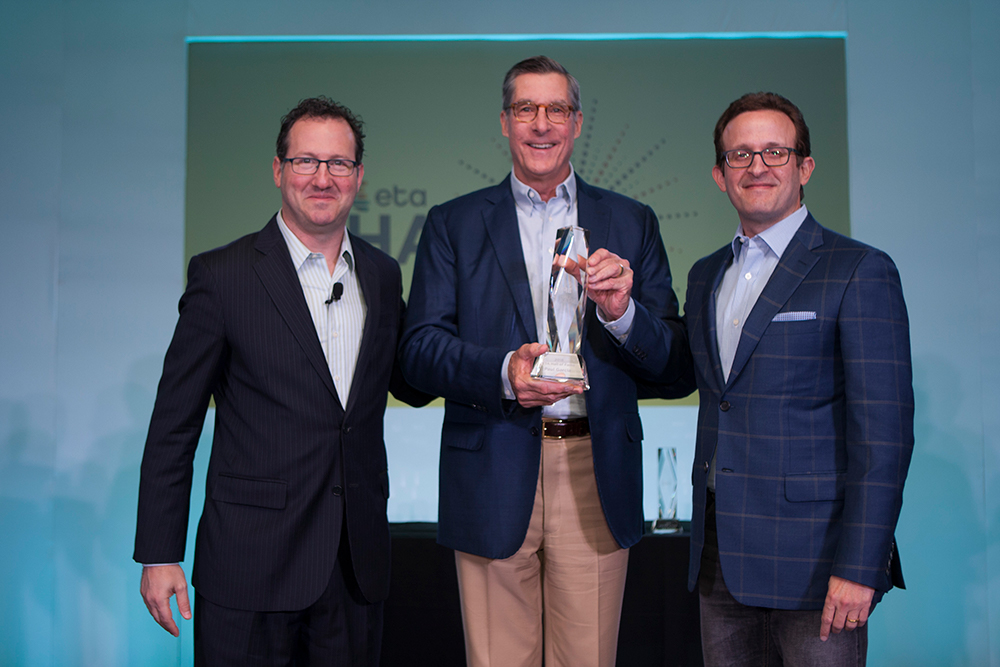
In October 2018, Garcia stood between Jason Oxman and Jeff Sloan at the Electronic Transactions Association's first Hall of Fame induction. The photograph brings the handover into one frame: Garcia holding the award, his successor beside him, and the trade association recognizing a career in the machinery of commerce. The trophy is considerably easier to photograph than a functioning payment network.
His later work continued through boards. He joined Deluxe's board in 2020, bringing an operator's experience to its development in payments and financial technology. In 2025, he led shareholder engagement meetings as chair of the Compensation and Talent Committee. Deluxe reported that the team met every shareholder who accepted its invitation, representing approximately 42 percent of outstanding shares.
In April 2026, Deluxe elected him non-executive board chair. The current title adds another chapter to a career often compressed into the Global Payments years. Garcia had moved from running the processor to helping oversee other businesses, including serving on REPAY's board. The work had changed its setting, while remaining close to the industry he had known since youth.
His own description of management was modest enough to fit almost any workplace. Read alongside the bank deals, the succession and the board work, it gives the growth story a useful scale. A company can stretch across borders while the manager's immediate responsibility stays close at hand. Someone needs the authority, the support and the opportunity to do the next piece of work. Garcia gave the business a large name. Many people had to make it true.
“Management is simply people taking care of people.”Paul R. Garcia
Continue the conversation
Interviews, company biographies and the moments behind the story.
Garcia on leading across borders ↗The early Global Payments strategy ↗The payments Hall of Fame interview ↗Jeff Sloan on the business he inherited ↗Garcia's current Deluxe biography ↗Garcia's REPAY board profile ↗Global Payments ↗