Pat Oldenburg has a useful habit for a marketer: he distrusts a tidy number. A click can be real and still be beside the point. A lead can be qualified and still be one face in a buying committee. An inbox can fill while revenue stands still. Across two decades in enterprise software, Oldenburg has kept returning to the less glamorous question beneath the dashboard: what, exactly, are we counting?
Today he is chief marketing officer at AppZen, the San Jose company applying artificial intelligence to expense audits, accounts payable, and other finance work. The category arrives with a big promise - autonomous operations - and an equally large burden of proof. Finance leaders do not buy poetry alone. They want accuracy, compliance, integration, and evidence that an AI system can be trusted around invoices and money.
Oldenburg's route to that assignment did not begin with AI. It began with the connective work of customer references, content, digital systems, and marketing operations at companies including EMC, McAfee, Five9, and ServiceMax. His titles grew, but the preoccupation stayed recognizable: find the gap between attention and action, then build a process sturdy enough to close it.
The e-book with an afterlife
In 2014, Five9 had a familiar corporate problem. Lots of people made content. Public relations made one kind, product marketing another. Campaigns were notionally integrated, yet nobody owned the line running through all of them. Two promotional videos drew visitors, then lost momentum when the paid push ended. The work had produced activity without a durable center.
Oldenburg had joined Five9 in digital marketing in late 2012. When the company created a content-marketing function, he was asked to build it. He started by interviewing customers, studying leads and closed deals, and surveying contact-center professionals. The loudest problem was agent efficiency. So he researched the subject, outlined an e-book, and wrote its first draft in a week.
The writing matters because it reveals his bias toward doing the unscalable thing long enough to learn the scalable lesson. The e-book became the pillar for blog posts, social material, a nurture program, and the final video in the series. Each asset had a role; the departments had a shared idea. A published case study reported four times as many leads and three times as many closed deals as the previous campaign.
Five9 campaign result · previous campaign = 1×
It is tempting to remember only the multiplication. The more revealing detail is the subtraction. The content stopped leading with the product and started with the customer's problem. Oldenburg said readers were more willing to pass along material that was useful rather than promotional. Restraint, in this case, proved commercial.
The ten-day wait
Later, at ServiceMax, the bottleneck was no longer a campaign. It was plumbing. As demand generation grew, the team examined how long it took to contact valuable leads. The answer was more than ten business days. Salesforce routing rules had failed to keep pace with the company.
This is the kind of discovery that ruins a celebratory dashboard. Marketing can create demand, but delayed routing quietly spends it. Oldenburg helped make lead management a system: assignment, account matching, visibility, and follow-through. His pithiest description of the resulting setup was, “LeanData powers everything we do once we receive a lead.” The sentence is about software, but the principle is about ownership. Interest must arrive somewhere, and someone must know what to do next.
“Marketing doesn't win if sales doesn't buy in!”Pat Oldenburg, on building an account-based motion
At ServiceMax he made that partnership concrete. Marketing and sales agreed on bookings, revenue targets, and the expected share of sourced opportunities. Field marketers met with sales regions, looked at territories down to the representative, and built plans around coverage and pipeline needs. In his formulation, it mattered less which department sourced an opportunity than whether both could move it through the funnel.
One opportunity, nearly twenty people
When Oldenburg joined Motive in 2022 as vice president of global demand generation, the company was strong in small business and building an account-based framework to move further upmarket. That created a measurement problem. A small-business funnel and an enterprise account motion could share revenue goals, but they could not sensibly share every intermediate metric.
Oldenburg drew the distinction with arithmetic. Research he cited put an average buying center at seven people for deals under $50,000 in annual contract value, rising toward twenty people above $250,000. Treat every engaged person as an independent marketing-qualified lead and the dashboard begins counting one committee as many victories. The opportunity, however, remains singular.
The account becomes the unit of truth
and influencers
engagement view
marketing signals
His alternative was to measure at account level: engagement trends, prioritized accounts with opportunities, pipeline coverage, conversion, days to close, and days spent in a stage. This demands cleaner account data, reliable hierarchies, territories, and lead-to-account matching. It also demands patience. Oldenburg calls account-based marketing a marathon, an unusually athletic metaphor for database hygiene.
Yet his method is not mechanical. Marketing continues educating people around the formal buying group while sellers work the active opportunity. Engagement insights move to sales so the team can judge where an account sits in its evaluation. The database supplies a common map; conversation supplies the movement.
A CMO built from the middle
In spring 2024, Oldenburg left Motive after a little more than two years. His farewell named colleagues across demand generation, sales, product, and customer success. He described the meaningful moments as times the teams had won together. The phrase could have been generic. The responses made it specific: former colleagues praised his ability to guide people while letting specialists remain specialists.
That summer he became CMO of Zingly.ai, a customer-experience startup combining generative AI, digital interactions, and telephony. The appointment widened his scope to product marketing, communications, brand, demand generation, and sales enablement. In public remarks, he framed the opportunity around changing customer behavior and the need to rethink service for digital channels and generative AI.
Digital marketing expands into a new buyer-centered content function.
Demand, routing, attribution, and field marketing converge around revenue.
A separate account-based framework gives enterprise buying a clearer scorecard.
Oldenburg takes responsibility for the full marketing system.
The category changes again; proof, alignment, and operational clarity remain.
At AppZen, the subject changed from customer experience to finance operations. The company announced a $180 million growth round in September 2025, aimed at its AI agents and global expansion. Oldenburg's public hiring message tied the marketing build-out to AI storytelling, sales partnership, pipeline, and revenue. It was a compact job description for his entire career.
The work beside the work
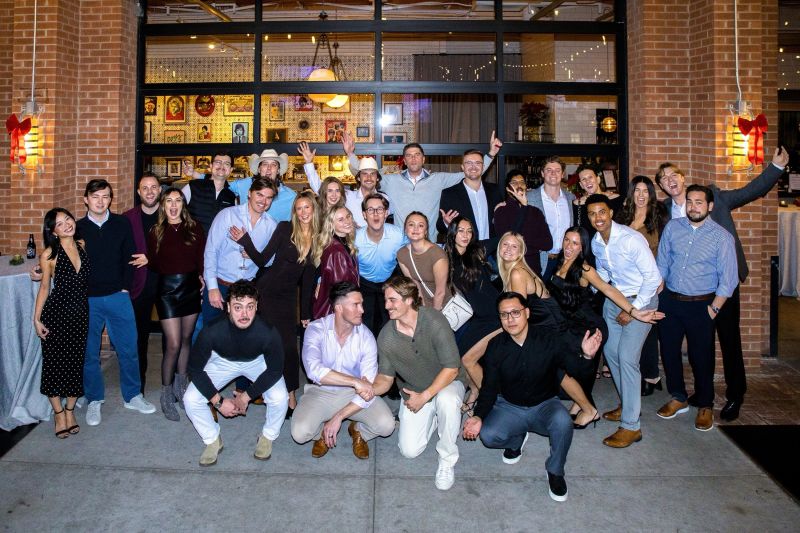
In late 2025, after AppZen's first global marketing all-hands in Arizona, Oldenburg wrote that “the mix of focus, alignment, and fun matters more than people give it credit for.” He listed shared goals, clear KPIs, tight execution, and showing up for one another in person. The photograph attached to the post is cheerful and slightly chaotic, as honest team photographs tend to be.
There is a useful tension here. Oldenburg markets software designed to make financial work increasingly autonomous, but his own account of good work is resolutely social. Systems reduce ambiguity. They do not eliminate the need for trust, judgment, or a colleague who notices that a handoff has stalled.
His career makes more sense as a sequence of handoffs than a parade of logos. A customer's problem becomes a piece of content. Attention becomes a routed lead. Leads become an account. An account becomes a shared opportunity. A campaign becomes a plan that sales can use. Each handoff can leak. Oldenburg's specialty is standing in the middle, tracing the lost signal, and giving it somewhere useful to go.
That may be why the account-level argument feels larger than a quarrel about MQLs. It asks marketing to see the customer as a group of people making one consequential decision, not a pile of names arriving separately. It asks sales to see marketing as a participant in revenue, not a decorative prelude. And it asks leaders to prefer an awkward truth about the funnel over a flattering number in the report.
The software industry will rename itself again. Cloud became AI; automation is becoming autonomy. Oldenburg's questions are likely to survive the wardrobe change. Who is deciding? What do they need? Where did the signal stall? Does the other team agree? The answers are rarely glamorous. They are, however, countable.