Affiliate marketing has always had a small absurdity at its center. A travel review, a creator's video, a loyalty app, and a coupon site can all nudge the same person toward buying a suitcase. Then a tracking system points at the final click and declares: this one did it. Partnerize built a business around making that verdict less crude. Its software gives brands one place to recruit the people and companies that send them customers, write the rules, watch the sales, calculate commissions, move the money, and catch the cheats.
The company calls this partnership automation. The less polished description is useful: Partnerize is the plumbing behind a large brand's extended sales force. It sits between advertisers and affiliates, publishers, influencers, loyalty programs, comparison sites, apps, and other brands. When the machine works, a marketer can see who produced what, reward a valuable new customer differently from a low-margin repeat order, and pay partners in dozens of currencies without rebuilding the finance department.
The original sin was the black box
Partnerize began in Newcastle in 2010 as Performance Horizon Group. Co-founders Malcolm Cowley and Paul Fellows had already built buy.at, an affiliate network sold to AOL in 2008. Sean Sewell, now Partnerize's general manager for Europe, the Middle East, and Africa, is also identified by the company as a co-founder. They were not outsiders storming the castle. They knew exactly where the stairs squeaked.
The first thing that failed was the old network model. Networks served many brands with standardized processes, limited data, and campaigns simple enough to administer at scale. Brands could buy access, but they surrendered detail and direct contact. Fellows later described the founding insight as gradual, not cinematic: marketers were moving toward a data-driven, platform-based way of working, and the shift had reached a tipping point.

“We saw an opportunity to centralise clients' global marketing activity as a strategic technology partner in a way that wasn't possible as an affiliate network.”Malcolm Cowley, co-founder and former CEO
That difference became the pitch: do not outsource the relationship; own it. In 2016, the company said its software let brands bypass conventional affiliate networks, build direct publisher relationships, and run more granular campaigns. In 2018 it changed its name to Partnerize, a slightly on-the-nose signal that coupons and cash-back sites were no longer the whole category. Creators, referral programs, loyalty clubs, media companies, mobile apps, and brand-to-brand deals had entered the room.
Six verbs, one control room
The current product is organized around six verbs. The order matters because every handoff is a place where a program can leak time or money.
The Partnerize loop
Discover searches for suitable partners. Track connects clicks, app events, and transactions. Manage holds contracts, campaigns, creative, and communications. Measure reports performance and attribution. Pay handles invoices, commissions, currencies, and approval. Protect watches for fraud, policy violations, and branded-search abuse. Services can sit around the software: a company can operate in-house, lean on an agency, or ask Partnerize to manage more of the program.
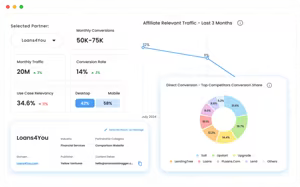
This is also where Partnerize differs from a lightweight affiliate plug-in. It is built for programs with negotiated terms, many markets, unusual partner types, and finance teams that would prefer not to wire money by hand. The company says it operates across more than 214 countries and territories and 60 currencies. Its public customer gallery has included Expedia, Emirates, British Airways, GoPro, StubHub, Tarte Cosmetics, THE ICONIC, TSB, Leatherman, and PlayStation.
What changed the buyer's mind?
Not a prettier dashboard. Control changed minds. In interviews for a 2020 Forrester study commissioned by Partnerize, customers said manual program management had limited growth. They wanted direct relationships, transparent data, more flexible commissions, and steadier costs than the traditional override model. One head of acquisition put it plainly: “We were trying to manage our margins and grow the partnership program, and that's what fueled our switch to Partnerize.”
The model calculated a 330 percent return, less than three months to payback, and $2.6 million in three-year costs. It also estimated an 18 to 22 percent reduction in excess commissions. That last figure may be the most instructive. Partnership software does not need to discover a magical new audience to earn its keep. It can stop a brand from paying the wrong rate for the wrong outcome.
So, what does it cost?
There is no public dollar price. Partnerize offers custom quotes with fixed-license or performance-based structures. Cost changes with campaign count, regions, currencies, transaction scale, and service level. The Forrester composite is a picture of enterprise economics, not a menu. A small merchant should not mistake a 330 percent modeled return for a promise that a heavyweight platform will beat a simple plug-in.
The acquisitions explain the strategy
Partnerize has assembled its scope in pieces. It bought BrandVerity in 2020 to add paid-search monitoring, compliance, and brand protection. Months later it acquired Pepperjam, adding an established affiliate network, managed services, and a large influencer population. In 2025 it acquired Tel Aviv-based Konnecto for AI-powered partner discovery, competitive intelligence, clickstream analysis, benchmark reporting, and predictive fraud scoring.
Each deal filled a different hole: police the channel, widen the channel, then make recommendations inside the channel. The result sits between pure software and a traditional network. That hybrid can be a feature for a multinational brand that wants control without staffing every specialty. It can also complicate the sales comparison. The closest alternatives - impact.com, CJ Affiliate, Awin, Rakuten Advertising, Everflow, TUNE, and PartnerStack - overlap unevenly on network reach, services, payments, creator tools, and enterprise customization.
Now the click itself is failing
Partnerize's newest bet starts with an uncomfortable observation: an affiliate link cannot record a journey that never produces a referral click. A publisher's review may be summarized by an AI assistant; a consumer may form a shortlist there, then purchase directly later. The publisher supplied the influence, the brand got the sale, and the old ledger saw nothing.
In June 2026, a Partnerize and eMarketer survey of 100 U.S. marketing leaders found that 91 percent believed AI discovery was already changing their approach, but only 13 percent had a clear way to connect that visibility to partner compensation. Partnerize's VantagePoint product attempts that connection. It combines influence signals with business outcomes and proposes fractional compensation beyond last click. The publisher version entered limited release after an AAM review. A Lighthouse program brings brands, publishers, creators, and technology companies together to test the framework.
The clever move is not “add AI.” It is to identify the economic argument AI has broken: who deserves to get paid?The open question behind VantagePoint
The idea is timely and unproven at market-wide scale. Attribution models become powerful only when both sides trust the inputs, the counterfactual, and the payment rule. A brand will resist paying for influence it believes was incidental; a publisher will resist a black box that politely undervalues its work. Partnerize spent its first era arguing against black boxes. Its AI era will be judged by the same standard.
What an operator can copy
Vary rewards by margin, new-customer status, product, placement, or lifetime value. A conversion is not a commodity.
Keep direct contact with the partners who understand your audience. Software should support trust, not impersonate it.
Coupons close carts; content, creators, loyalty groups, apps, and other brands can create demand earlier in the journey.
Record whether paid placements appeared, whether tracking survived, and whether brand rules were followed. Screenshots are not a system.
The most portable lesson is organizational. Assign one owner to the channel, define the outcome before defining the commission, connect partner data with commerce and CRM data, and review incrementality rather than raw orders. Partnerize can automate those habits. It cannot supply the judgment that makes them coherent.
When it will not work
Partnerize fits where a partnership program has become too important to remain a black box and too complicated to run as a mailing list. Its business is neither glamorous nor mysterious. It is a ledger, a recruiting desk, a rules engine, a payment operation, and a compliance watchtower sharing one login. The company's next chapter is riskier: build an economic record for influence that happens inside machines. If it succeeds, the least visible company in the customer journey may help decide who gets credit for the most invisible sale.