A rolling pin is an unusual addition to a technology executive’s public duties. In August 2020, Paolo Cavicchioli was named the ceremonial oste, or host, of Castelfranco Emilia’s traditional tortellino festival. The organisers announced a handover of the symbolic mattarello for September. By then, he had helped establish a company devoted to digital communications and was serving as president of Fondazione di Modena. His working life had room for software, civic institutions and a very tangible piece of kitchen equipment.
The detail is useful because it puts him back in a place. Cavicchioli’s career is rooted in Modena, even as Doxee, the company he co-founded with Sergio Muratori Casali, operates across national borders. Its starting material was equally concrete: the printed communications through which organisations tell people what they owe, what has changed and what they need to do. The journey from those documents to cloud software is the central business story. His years in the city’s institutions give it another dimension.
The business inside the envelope
Cavicchioli graduated in computer engineering at the University of Modena in 1995. His early career took him into the Venturini group, working in the industrial printing business. He held responsibilities in application development and operations before starting a company of his own. That background places the engineer inside the machinery of producing and delivering communications, with its practical demands, rather than at a comfortable distance from it.
There is a particular sort of opportunity in knowing how an ordinary process works. An envelope can look like the end of a job: information assembled, document printed, message dispatched. For its recipient, the job is just beginning. Someone has to open it, understand it and decide what happens next. The gap between an organisation’s completed task and a person’s unfinished one is a useful place to look for a business.
In 2001, Cavicchioli and Muratori Casali founded Ebilling in Modena. Their backgrounds overlapped in printing but covered different responsibilities. Cavicchioli brought engineering and operations experience; Muratori Casali had worked in sales and marketing and become commercial director of a services division. The partnership paired the workings of the service with the work of selling it.
The company’s original ambition was to help large organisations move beyond paper and the limitations of dependence on a single print vendor. It adopted the Doxee name in 2012. Its customers include enterprises and public bodies, with communications needs in banking, utilities, telecommunications and public administration. These are the everyday institutions whose messages often arrive carrying obligations. An electricity bill rarely needs help commanding attention. Understanding it is another matter.
Modena
with Muratori Casali
presidency begins
chairman and CEO
The scale is easy to miss because the product is so familiar. In a public account of Doxee’s work, Cavicchioli described an annual output of nine billion digital objects. The industrial vocabulary survived the move away from printing: he presented the business as a factory operating in an immaterial domain. He also discussed technical teams, work with universities and research centres, and the importance of training. The medium had changed; production still required people with skills.
A city has an operating system, too
In 2015, Cavicchioli became president of the foundation then known as Fondazione Cassa di Risparmio di Modena. He remained until May 2023. His institutional experience also included the university’s board and industrial associations, while his foundation work expanded into regional and national roles. He served as president of Emilia-Romagna’s association of banking-origin foundations and as vice president of ACRI. The software founder had become involved in the less easily diagrammed business of getting institutions to work together.
His reappointment to the foundation presidency in 2019 came with an emphasis on collegial decision-making and projects pursued with local institutions and associations. The foundation also credited him with promoting Fondazione Modena Giustizia, intended to improve the tribunal’s resources through institutional funding. This is a different setting from a technology company. There are more constituencies, different forms of accountability and no single customer contract to bring everyone into line.
One practical example came through Italia Domani - Modena, a partnership involving the Province of Modena and the foundations of Modena, Mirandola and Vignola. It supported local authorities in preparing proposals for Italy’s recovery-plan funding. In July 2022, the partners reported nineteen applications and roughly €600,000 of support for projects worth about €26 million. The foundation’s money helped with the preparatory work needed to seek much larger public resources.
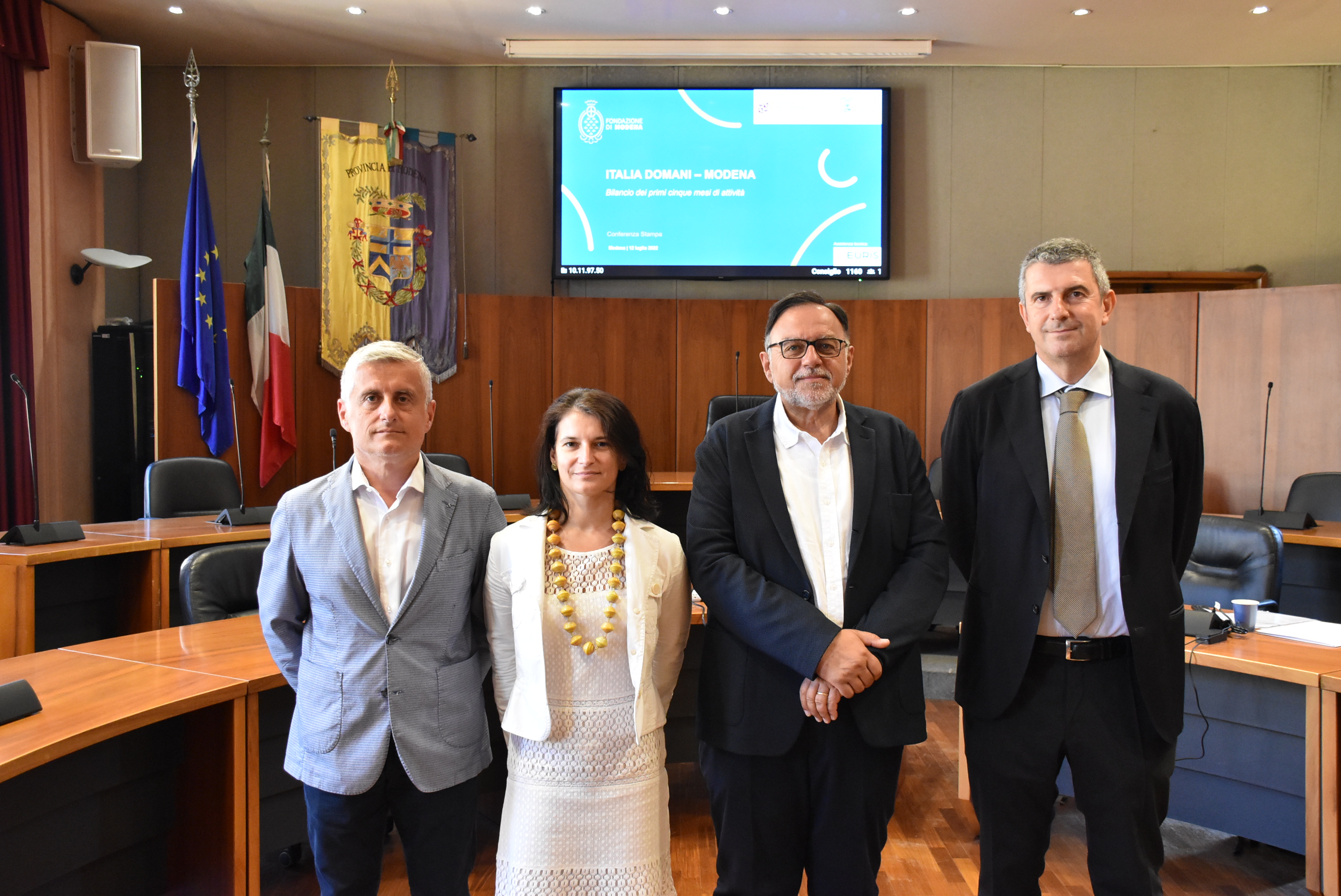
The distinction matters. The partners were supporting the capacity to develop projects, not claiming that a modest grant had already completed €26 million of construction. Cavicchioli described the results as the product of the institutions’ ability to form a network. His emphasis was on collective work that could bring more funding into the territory. The photograph is suitably untheatrical: four representatives in a council chamber, standing beneath the name of a joint programme.
Cultural projects offered another version of that work. In July 2022, he appeared alongside Gallerie Estensi director Martina Bagnoli and mayor Gian Carlo Muzzarelli at the presentation of a museum expansion funded through the ministry and recovery-plan resources. He placed it within a wider vision for the Sant’Agostino complex, with culture at the centre of the city. The concern was how institutions and places could fit together, as well as what an individual building might become.
Later that year, he took part in discussions about establishing Fondazione Ago - Modena Fabbriche culturali as a participation foundation. The proposed arrangement brought together the municipality, university and foundation, with cultural activities and collections forming part of the wider Sant’Agostino project. Software platforms and cultural buildings are very different things. Both, however, can be judged by what they allow other people to do. In this civic chapter, Cavicchioli’s work was among partners, with an outcome that belonged to the city.
A rolling pin enters the picture
The tortellino festival appointment sits neatly inside those years. The organisers announced him as their 2020 host while he was foundation president, explicitly noting his experience in digital communications. The ritual involved a rolling pin and a ceremonial succession from the previous host, former university rector Angelo Andrisano. It was a public honour with a local vocabulary, far removed from the terminology of a company presentation.
It also makes the biography more enjoyable to read. The same career can accommodate an operating role in a printing company, a university board seat and a place in a food festival’s traditions. Here, the old technology remains perfectly adequate. A rolling pin does not need a product roadmap.
More consequentially, Cavicchioli’s public thinking about regional life gives collaboration a central place. In a 2020 interview, he described Emilia-Romagna through participation and solidarity, recalling the collective response to the 2012 earthquake. He pointed to school reconstruction and cultural buildings as examples of sustained involvement. He also argued for institutions concentrating their resources on strategic needs and strengthening networks able to provide common answers. Cooperation, in that account, required decisions about where to put money and effort.
“nella partecipazione e nella solidarietà”
Paolo Cavicchioli, 2020
“In participation and solidarity.” Translation.
The recipient gets a say
Cavicchioli returned to Doxee as chairman and CEO in May 2023. Matteo Tiezzi succeeded him at Fondazione di Modena. The following June, Cavicchioli received the Cavaliere della Repubblica honour. In September 2024, he discussed Doxee’s participation in the Fondazione per la Sostenibilità Digitale network, where he joined the steering committee. His company work and his interest in wider institutional cooperation were again appearing in the same conversation.
He described digital sustainability through both reduced paper use and the way people access services. He also explained how a personalised document could become a point of interaction, offering a recipient actions such as an electronic payment or a chatbot conversation. Delivery becomes one stage in a longer exchange. That idea puts the person receiving the communication into the design of the service.
Conceptual illustration of the interactive approach he describes.
The connection with his civic work is an interpretation, but a useful one: in both settings, he keeps returning to access and relationships. An institution has resources or information. Someone else needs to use them. The means of connecting those two sides deserves attention. His stated approach to digital sustainability includes bringing disciplines and sectors closer together, an ambition that makes sense beside a career spent crossing their boundaries.
Back at the desk, with Europe ahead
Doxee’s June 2026 business plan sets out the next company chapter. Cavicchioli described a strategy organised around one company, one platform and one value proposition, with attention to large enterprises in regulated sectors. The plan identifies Italy, the German-speaking DACH markets and France as priorities. It also places AI in the evolution of the platform while stressing reliability, compliance and European digital sovereignty. The 2028 target is €41.8 million to €46.1 million in total revenue. It remains a target.
The nearer figures show the work still in progress. In the September 30 release, first-half 2026 revenue was €15.1 million, broadly level with a year earlier. Subscription revenue grew 13% and accounted for 82% of revenue, up from 72%. EBITDA fell from €2.9 million to €2.4 million; net financial debt declined to €10.6 million from €14.3 million at the end of 2025. A stronger recurring component and lower debt sat alongside reduced earnings before interest, tax, depreciation and amortisation.
Cavicchioli’s accompanying comments focused on European partnerships, investment in AI and the continuing process of accreditation as a Qualified Trust Service Provider. These priorities extend a business that began with paper into questions about how digital communications are delivered and trusted. Twenty-five years after Ebilling’s founding, the medium keeps changing. The person on the receiving end still has a message to understand.