Pamela Conley reached company founding with a career already behind her. When Nuvig Therapeutics announced its launch in May 2022, she was its cofounder and chief executive, and the company had closed a $47 million Series A. The familiar startup opening was there: a name, a financing round, a next chapter. Conley’s opening had begun much earlier. She had spent years directing research inside other companies, acquiring the sort of experience that fits poorly into a launch-day headline.
The interesting question is what those years brought into the new company. A founder has to make decisions about people, money and direction; a research leader has already encountered versions of all three. Conley’s story gives experience a substantial role in the plot. It also makes room for a founder to change jobs within the enterprise she helped create. Her current title is cofounder and chief scientific officer. The founding CEO chapter remains part of the record.
Two chemistry teachers, then three universities
Her interest in science received encouragement from two high-school chemistry teachers, including a woman. Conley later chose biochemistry and pursued research. Looking back on graduate school, she recalled that founding a company had not been the plan. The appeal of the emerging Bay Area biotechnology industry grew as friends and colleagues entered it. The destination developed along the way.
That is a useful complication for anyone trying to draw a straight line through a career. An early interest can be real without carrying a fully formed business plan inside it. A teacher’s encouragement does not have to predict an executive appointment decades later to matter. It can simply help a student take the next subject seriously enough to keep going.
Conley earned her B.A. in biochemistry at the University of Texas at Austin, then her Ph.D. in the same field at the University of California, Berkeley. Stanford followed, with postdoctoral research involving the Howard Hughes Institute and the Carnegie Institution. Her education crosses three institutions, but the subject remains recognizable throughout. There is continuity before there is a company.
A degree supplies a formal milestone. Research training also means staying with a problem long enough to discover that an appealing answer may require another question. The practical implications for a later founder are easy to see: plans must survive scrutiny, colleagues bring different expertise, and an interesting idea still requires work. Conley’s academic path gives her founding story a beginning that belongs to science.
A career that crossed company boundaries
Her professional history moves through COR Therapeutics, Millennium Pharmaceuticals and Portola Pharmaceuticals. At COR she worked as a scientist and project leader. At Millennium she held a biology leadership role. Portola became a long chapter, with research leadership beginning in 2003, an intervening role at iPierian in 2012, and a return to Portola the following year.
The sequence matters because it resists the idea of a founder springing into existence fully equipped. There are positions here that involve doing the research, leading a project, directing a function and joining an executive team. Those jobs ask different questions. A project leader must understand how an individual piece of work connects to the next. An executive must make room for several pieces at once.
Before Nuvig, Conley was Portola’s senior vice president of research. Her responsibilities crossed scientific disciplines, including chemistry and pharmacology. She also coauthored publications and held issued patents. The combination places her career in both the production of knowledge and the organization of work. It is possible to read the titles as promotions. It is more useful to notice the expanding scope beneath them.
Cellphire’s board biography adds another dimension: experience with manufacturing and with regulatory agencies in the United States and Europe. Those are places where a research organization encounters requirements beyond its own laboratory. The questions become practical and exacting. Can a process be explained? Can a team document what it has done? Scientific ambition has to acquire an administrative vocabulary, however little glamour there may be in the filing cabinet.
Conley also serves on Cellphire’s board of directors. Board service introduces a further perspective on organizations: oversight and advice rather than the daily ownership of every decision. Her career therefore offers several vantage points on the same broad activity of building scientific companies. The laboratory, executive team and boardroom each get a place in the story.
The founder changes chairs
Nuvig’s public launch arrived on May 11, 2022. Novo Holdings and Platanus led the $47 million Series A, joined by Bristol Myers Squibb, Digitalis Ventures and Mission BioCapital. Conley stood at the beginning as CEO. A financing announcement is necessarily compressed; the company’s plans and the founder’s preceding career have to fit around a number large enough to dominate the page.
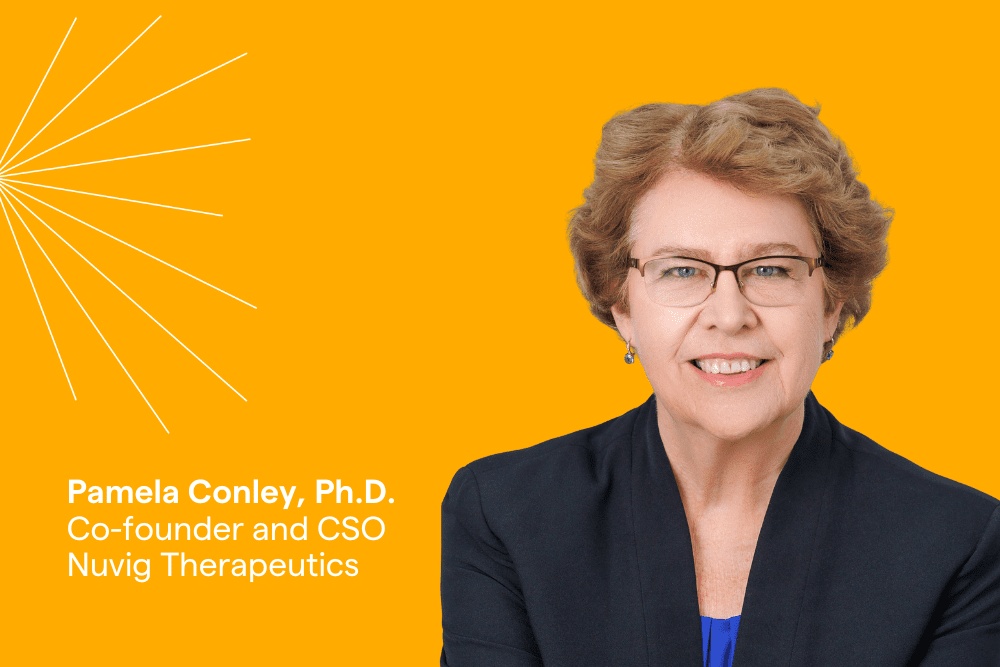
By January 4, 2023, the company had announced a different arrangement. Julie Anne Smith became chief executive and a board member; Conley would serve as chief scientific officer. The company’s board thanked Conley for leading Nuvig from inception. The documented change is straightforward. The founder stayed with the organization and took responsibility under a different title.
That detail deserves attention in its own right. Founding and running a company are often bundled into a single job description, as though the first signature must permanently determine the seating chart. Conley’s sequence allows a more flexible reading. A company can retain its founder’s scientific experience while assigning the chief executive role to another leader. The work can continue through a change in responsibilities.
In September 2025, Nuvig appointed David Woodhouse as CEO and James Mackay as independent board chair. Conley’s public welcome emphasized Woodhouse’s experience across science, finance and business development. The choice of qualities is revealing about the job itself. An organization needs several kinds of judgment at the table; scientific knowledge and financial knowledge have to participate in the same conversation.
There is no need to turn the changes into a drama about titles. The actual sequence is interesting enough: founding CEO, scientific leader, continued participation in a company adding other leaders around her. It shows an enterprise with a history, rather than a founder portrait frozen on launch day.
The arithmetic of a growing company
Nuvig announced a $161 million Series B on December 5, 2024. Sanofi Ventures, Blue Owl Healthcare Opportunities and Norwest Venture Partners co-led the round. Returning shareholders participated alongside new investors. Added to the publicly announced Series A, the two rounds total $208 million. That sum describes company financing, and the distinction matters whenever a founder’s name sits beside a large dollar figure.
$208M combined · company capital across these two rounds
More capital increases what an organization can undertake. It also makes prioritization more consequential. A financing round creates room for plans, while leaving the team responsible for deciding which plans deserve that room. Money is unusually good at attracting attention. It is less helpful when asked to chair a meeting or resolve a disagreement about the next piece of work.
Conley’s own account of the early organization included growth from three people at the end of 2021 to about twenty in 2024. Her description was economical: “we all wear multiple hats.” The figure belongs to that moment in the company’s history. It gives a human scale to the financing announcements: a relatively small group carrying a wide range of responsibilities.
A launch is one date.
THE LONG VIEW
A career has many more.
The years before founding also return here. People who have worked together bring shared context into a new organization. That context does not remove the need for decisions; it gives decisions a history. A long career can furnish a founder with more than credentials. It can furnish examples of collaboration, and a sense of how different jobs fit together.
The people around the patents
In May 2026, another part of Conley’s company-building work came into view. She described a continuing relationship with Sabrina Poulos and her team, who had advised on Nuvig’s patent portfolio since the company’s inception. Conley linked that relationship to keeping intellectual-property strategy in step with the company’s science.
Her statement ended with a practical commitment: “We look forward to continuing to work with the Antheros team for Nuvig’s IP needs.” It is a quieter piece of company news than a funding round. It also supplies a useful connection between a scientific career and a founder’s responsibilities. Ideas enter an organization; advisers help it decide how those ideas should be protected.
The patent relationship gives the profile another set of people to account for. Company building involves collaborators whose names may appear far from the principal headline. The founder’s job includes choosing relationships that can last as the organization changes. In Conley’s account, continuity with the advisers is part of the plan.
Leave another chair available
Conley has also advocated mentorship and more women role models in biotechnology leadership. Her stated advice includes the unornamented instruction to “work hard at it, educate yourself.” It fits a career whose public milestones include successive kinds of responsibility, rather than one abrupt arrival.
The two chemistry teachers at the beginning and the leadership roles later on give that position a particular resonance. Encouragement can arrive before a student knows the names of the jobs she might eventually hold. A visible scientific leader supplies another example of where continued study can lead. The distance between the two is filled by years of work.
Conley’s story leaves room for that distance. The founder emerges from the researcher’s career. The company keeps developing after the founding CEO changes titles. The wider circle includes fellow scientists, executives, investors, directors and patent advisers. At its center is a person who has continued finding new responsibilities for an education in biochemistry. A launch is one date. She has given the story many more.