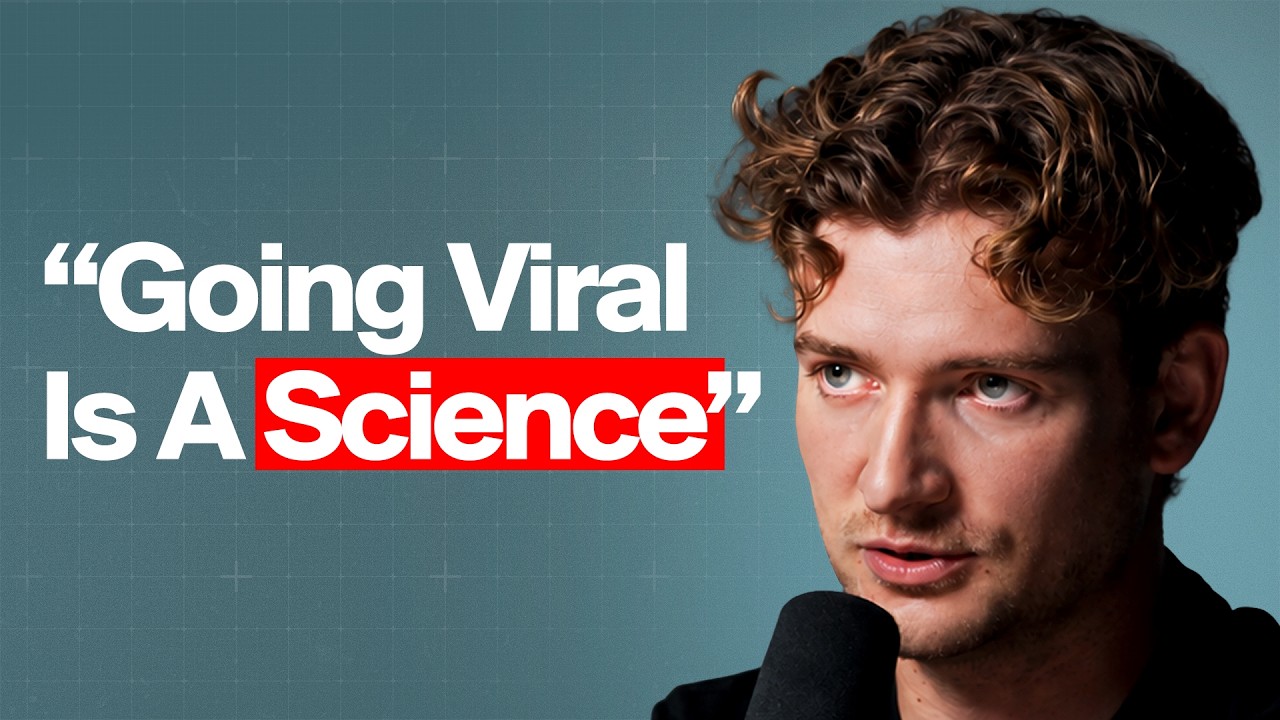
The most revealing number in Paddy Galloway’s YouTube system is not 50 billion, the career view count the Irish strategist says his work is approaching. It is 100. That is how many ideas he wants before a creator chooses one video to make. The glamorous version of virality happens after upload, when the line on a dashboard bends skyward. Galloway’s version begins earlier, in a spreadsheet crowded with concepts that will never be filmed. His argument, delivered to Open Residency host Mark Brazil, is blunt: luck gets too much credit because viewers never see the discarded work.
Watch on YouTube →“Virality can be engineered,” he says. “It’s actually a lot more predictable than people think.” That confidence rests on nearly two decades on the platform. Galloway says he uploaded his first video in 2006, at age 10, and has posted every year since. He has run dozens of channels and now advises a roster that has included Red Bull, the Philadelphia Eagles and MrBeast. In the interview, he reduces the platform to three verbs: people must click, watch and leave satisfied. Miss the first, and the finest film in the world sits untouched.
The idea is the ceiling
Creators often diagnose an execution problem when the limitation arrived before production. Galloway imagines three circles: all the viewers available in a market, the smaller ceiling imposed by the chosen idea, and the portion reached by the execution. A gorgeous video cannot travel beyond an idea that only a few people care about. The practical question is not merely, “Is this interesting to me?” It is, “Why would most people in this niche want this?”
His favorite evidence comes from apparently small subjects. An astrophotography channel making technical reviews for a few thousand viewers reframed its subject as a comparison: the Milky Way shot with different cameras or across radically different amounts of time. Galloway says the broader format drew millions. The expertise did not change. Its doorway did.
The opposite boundary is the floor: the loyal viewers who would watch even if the title were simply “Video One” beside a face. Growth happens in the space between. The idea raises the ceiling; execution determines how close the video gets. A creator who confuses a loyal floor for a broad market eventually wonders why the channel has stopped moving.
Three audiences walk into every upload
Galloway calls his audience model CCN: core, casual and new. Core viewers are the ride-or-die regulars. Casual viewers dip in when a subject interests them. New viewers have no relationship with the creator and no patience for unexplained history. The strongest upload must give all three a reason to stay.
Core
Reward the people who know the channel and would watch almost anything.
Casual
Offer a familiar through-line strong enough to turn occasional interest into habit.
New
Make the premise legible without requiring a previous episode or an inside joke.
The tension matters. Serve only the core and the topics become intimate but tiny. Chase only strangers and the channel becomes a jumble of unrelated stunts. Galloway’s advice is to begin narrow, establish a recognizable promise and expand outward in adjacent steps. He says Red Bull’s challenge was not a shortage of spectacular material; it was finding a through-line among sports whose fans overlap less than an organization might assume.
“Every video I’ve worked on that’s had 10 million views … you can always just say them in one second and people are like, I get it.”— Paddy Galloway
That is the glance test. A viewer moving through a home screen gives a video about a second. Complexity is fatal. The best ideas can be compressed into one sentence and contain a question that the viewer must click to answer. “Going to five NBA games in 50 hours” works because the challenge, effort and uncertainty arrive together. The click feels less like opening a file than unpausing a scene already in motion.
One idea survives the funnel
Galloway’s team draws ideas from three wells. Internal ideas are past winners worth repeating with a twist. External ideas are outliers from the same niche or an adjacent one. Innovation is the genuinely new material, powerful but hard to systemize. For smaller creators, he suggests keeping radical experiments to roughly one upload in five while building most of the calendar on patterns supported by evidence.
The idea gladiator
Filtering requires rules. Is the concept feasible? Can it become a clear title and thumbnail? Does it have a plausible path to the channel’s target viewership? Does it overlap enough with what the audience expects? Galloway says his team may develop 200 to 500 ideas for a client in a month and show only five. The final 10 receive rough titles, thumbnail sketches and a logline. Then comes a useful, slightly terrifying test: if your career depended on one of these, which would you choose?

This is why outlier research is not passive scrolling. Galloway keeps playlists for strong ideas, titles, thumbnails and introductions, then blocks three to five hours a week to study them. One reference may wait years before finding its use. The familiar thumbnail of a creator knocking on a millionaire’s door, he recalls, was assembled from several sources: a cooking video’s composition, another business creator’s title and a short-form street-interview premise. Originality arrived as combination.
The package is half the game
Once an idea wins, Galloway writes titles first — at least 10 — because the title clarifies what the thumbnail must add. Then comes a thumbnail brief prepared before the shoot, not after it. His team specifies angles, expressions and compositions, captures many source images and develops at least three genuinely different options. Changing a shirt color does not count.
The reason for the effort is nonlinear return. A small creative edge can unlock a much larger audience. Galloway describes a web-design video that was receiving about 1,000 views a day. After his team helped replace the thumbnail, he says it rose to about 40,000 daily views within a day. The new image was not 40 times prettier. It only had to cross enough viewers’ click threshold for YouTube to widen distribution.
His title rules sound almost old-fashioned: use the fewest words that keep the idea interesting; choose universal language; make the title and thumbnail complement rather than repeat each other; optimize for human curiosity before search software. “I found the cheapest 911 GT3” improves when a contradiction appears: nobody will buy it. Now the mind needs the missing reason.
After the click, keep the promise
A title and thumbnail are a contract. Galloway’s introduction formula has three parts, usually delivered in less than 45 seconds:
- Deliver on the promise. Show or restate what the viewer clicked for immediately.
- Create intrigue. Open useful questions with the least context required to understand them.
- Flow into the story. The best introduction disappears; the video simply feels as if it has begun.
The details can arrive later. Galloway calls this drip-feeding context. A weak opening introduces every participant and explains every rule. A strong one supplies just enough information to orient the viewer, then moves. Retention curves reveal the cost of delay: he says he has seen videos lose most of their audience in the first 10 seconds when the opening failed to match the promise.
For diagnosis, he favors views and the shape of the retention curve. Click-through rate and average view duration matter, but isolated numbers can deceive. A lemonade stand may convert a high percentage of friendly neighbors while making fewer total sales than a lower-converting stand in Times Square. Likewise, a video’s rates can fall as YouTube finds a broader, less committed audience even while total viewing grows.
The algorithm follows the audience
Galloway’s least mystical observation may be his most useful: YouTube is “always right behind the audience.” Older videos resurface because people still click them. Longer programs dominate televisions because people sitting on a sofa prefer them there. The system is not inventing desire so much as measuring it at scale.
That makes YouTube attractive to brands and unforgiving of corporate habits. Galloway calls channels that merely store ads and announcements “Vimeo creators.” He credits Red Bull’s growth to its willingness to empower people who understood the platform. The company’s videos became audience products rather than internal messages wearing cinematic clothes. For a brand considering the same move, his warning is severe: do not start unless there is real appetite for an 18-to-24-month commitment.
AI, in his current workflow, accelerates the research but does not replace taste. His team uses tools such as Claude to interrogate outlier data and Gemini to explore thumbnail concepts. Writing is harder. AI may carry the work most of the distance, he says, but the decisive remainder is still human: judgment, specificity and the instinct to know which question will bother a stranger enough to click.
The playbook ends where it began, with consistency. A single viral hit does not impress Galloway as much as the ability to repeat one across niches and years. The public sees the breakout. The strategist sees the playlists, rejected concepts, thumbnail briefs, expectation-setting and postmortems underneath it. Virality, in that telling, is not lightning in a bottle. It is a weather station built by someone willing to record every cloud.