The invoices were back. Oz Alon had seen them all over his father’s house when he was a child: paperwork escaping the office and finding its way into the rooms where a family was supposed to live. Years later, married and running a business of his own, he recognized the arrangement. Different household. Familiar filing system.
Alon owned a bar in Tel Aviv. His wife, Naama, designed websites. Both understood the pleasure of serving a customer and the less photogenic business of sending an agreement, requesting payment and keeping track of what happened next. Technology had advanced considerably. The paperwork seemed to have acquired squatters’ rights.
That domestic recognition helps explain HoneyBook, the company Alon co-founded in 2013 and still leads as CEO. Its work concerns the stretch between someone wanting a service and the person providing it getting paid. For a photographer or designer, that stretch can contain an unreasonable amount of unpaid administration.
Today the story includes venture investors, software and AI. Start with the invoices, though, and Alon becomes easier to understand. He had lived inside the problem before he had a company to explain it.
A regular walks into the founding team
Alon grew up in Kfar Rut, a small Israeli community he has described through memories of horses, freedom and a village of about 40 families. It is a childhood setting in which people are fairly difficult to treat as abstractions. Everyone has a name; several probably know what you did yesterday.
He met Naama in seventh grade. They began dating at 16. Their eventual working partnership had a long personal prehistory, including organizing parties together. Naama has described the care they took with those events: music, food, drinks and the apparently minor question of where guests could leave their coats.
A coat is a useful detail. A party can be excellent until somebody loses one. Service businesses depend on these small transfers of trust, and the Alons had experience with them well before they were designing software for other people’s customers.
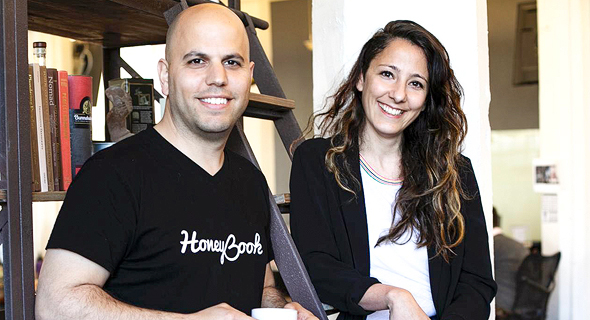
At Backy Bar in Tel Aviv, another relationship was taking shape. Dror Shimoni was a regular customer. He would become HoneyBook’s technical co-founder. The future founding team included a designer, a bar owner with legal training and a developer. Their knowledge came from different kinds of work, with customers providing some common ground.
Permission to change the idea
Alon studied law and business administration at the institution now called Reichman University and worked as a law-firm intern. Naama’s account of their leap into HoneyBook includes an evening when she told Oz and Dror they needed to commit fully. Each left a job. The idea received the attention that evenings and spare hours could no longer supply.
Yet commitment to the company did not mean loyalty to its first product. The early concept concerned wedding photographs. In his 2026 account, Alon described it as a wedding photo-sharing app. Talking to independent business owners in California revealed a wider field of trouble: printed agreements, payment chasing and trips to deposit checks.
The distinction mattered. Sharing photographs addressed one piece of an event. Helping a service provider manage a client relationship could follow that person through the work surrounding many events. It also reached beyond weddings. The founders had to let go of a product they had already spent time imagining and building.
Naama has spoken frankly about that attachment. Starting over required admitting the idea was insufficient, then using what they had learned. It is an awkward episode for a tidy founding legend. It is useful for understanding how the company actually developed.
- Tel AvivRunning businesses
Experiencing the friction - The first conceptWedding photographs
A narrower problem - CaliforniaCustomer conversations
A wider business workflow
Moving to Silicon Valley also meant learning how its people and institutions worked. In a conversation with investor Nadav Eylath, Alon recalled how remote the place had once seemed from Tel Aviv. Eylath became part of his practical education there. Advice arrived through relationships and repeated conversations, rather than a sudden transformation into a fluent technology executive.
Alon’s experience gives his interest in outsiders some substance. He has described receiving help from people who had no obligation to offer it, and wanting to extend that help to founders facing a similar learning curve. Being unfamiliar with a business community leaves a person with plenty to learn. It can also make them remember who answered.
The work behind the payment button
HoneyBook’s earliest payment system had an unusually involved chief executive. Alon personally moved money on behalf of members before the company automated the backend. The first payment was proof that the service could work, even while some of its machinery consisted of a founder doing the next necessary task.
There is something pleasingly unglamorous about this. A payment button promises a compact experience. Behind an early product, someone may be doing the labor the customer quite reasonably assumes has already been organized. The important question was whether people wanted the result enough to use it.
That work also kept the company close to the transaction. A payment belonged to a particular business, with a client and an obligation behind it. For someone selling services, money arriving reliably is part of being able to plan the next job. The administrative details have consequences outside the software.
By 2015, HoneyBook’s investor Norwest was describing a platform for event professionals to communicate with clients, prepare proposals, invoice and collect payments. Those functions belong together in a customer’s working day, even when software companies prefer selling them separately. A proposal becomes an agreement; an agreement produces an invoice; the invoice should eventually produce the happier sound of money arriving.
In his 2021 writing, Alon connected the problem to time. Service providers sell expertise, and delivering it uses hours they cannot simply manufacture in a warehouse. Making the surrounding work less cumbersome could leave more of those hours available. The point has a particular clarity when your own business once required opening a bar and serving whoever came through the door.
“The craft is yours.”
Oz Alon, on the work HoneyBook leaves with its members
Improving a room nobody entered
Alon can also supply an example of effort going in precisely the wrong direction. Early in HoneyBook’s development, the team changed a part of the product’s flow, expecting better conversion. Results barely obliged. Customers were failing to reach the stage the team had improved.
The renovated room was empty.
“We felt like idiots,” he recalled. The response was to favor smaller changes and feedback from users. The anecdote earns its place because it is specific enough to be embarrassing. Working hard on an invisible improvement is a recognizable failure, and a useful correction to the notion that dedication alone tells you where to spend the next week.
His view of leadership leaves room for other voices, too. In a 2024 mentoring conversation with Tom Nipravsky, the CEO of design-tool company Jux, Alon described preferring board meetings in which his team spoke more and he spoke less. The distribution of airtime is a small, observable expression of how a company works.

The customer’s voice has had a route into the room as well. HoneyBook marketing executive Dan Visnick described Alon receiving satisfaction emails directly and sharing them in meetings. That is a concrete habit: put the response to the work in front of the people doing it. A company can declare that it listens fairly cheaply. Making feedback part of the week takes some scheduling.
The money gets bigger. The question stays practical.
HoneyBook’s financing changed the scale of the undertaking. A $155 million Series D arrived in May 2021. In November, the company announced a $250 million Series E led by Tiger Global, at a valuation of $2.4 billion. Those figures describe a particular financing moment in HoneyBook’s history.
Round sizes in US dollars. November financing valuation: $2.4 billion.
The years around those announcements also make the earlier work look different. A platform intended to save somebody a trip to the bank had become an object of institutional investment. The useful connection between those scales is still the customer’s business: what happens after an inquiry, how expectations are set and whether payment follows without another round of chasing.
Alon’s more recent public agenda brings AI into that process. His CEO letter, updated in October 2025, described tools for meeting notes, email drafts, follow-ups and prioritizing work. These are recognizable jobs inside an independent business. The ambition is easier to assess when attached to an actual task than when left floating somewhere above the future of work.
By May 2026, he was still talking about practical systems and the risks of making work more complicated as a business grows. For HoneyBook, the enduring challenge is to make a new tool repay the attention an owner spends learning it. Busy people have good reason to be suspicious of another thing to manage.
Outside the company, Alon has expressed an interest in helping Israeli children become fluent in English, seeing a shared language as a way to widen opportunity. It is a fitting aspiration for someone whose own career required entering an unfamiliar business community and learning how to be understood there.
The bar, the abandoned photo idea, the manual payments and the empty room in the product all belong in the same life. Each involved discovering what another person actually needed. Alon’s career has given that question a much larger audience. Its first setting remains wonderfully ordinary: a house with too many invoices in it.
Keep the conversation going
Read Alon’s writing, follow his public profiles, or hear the longer conversations.