For an orthodontist, the moment a patient agrees to treatment ought to be a small triumph. Then comes the financial conversation. There is a down payment to discuss, a monthly amount to calculate, insurance to interpret. A clinically sensible decision has become a negotiation with the family budget. OrthoFi built its business around that awkward interval.
- Give patients a choice: a payment slider lets them explore terms within the practice’s limits.
- Do the unglamorous work: software comes with people handling insurance, billing, and collections.
- Watch the whole portfolio: more treatment starts matter only if the cash arrives.
The rule that needed a recession
In a 2015 account, co-founder Jamie Reynolds described the pressure on his Detroit-area practice when the economy weakened and carmakers shed jobs. He and fellow orthodontist Jeff Kozlowski were questioning a familiar rule: patients should finish paying before treatment ended. Loosening it seemed dangerous. Keeping it meant turning away people who wanted care.
They changed the terms and tightened the collection process. But there was a catch. A standard plan alongside an extremely flexible one strained cash flow. A broader menu became the answer: room for patients to choose, and a mix that could pay the practice’s bills.
“We went through some leaner times before we figured out the solution.”
Jamie Reynolds · co-founder · 2015
That experiment became a company founded in 2013, with David Ternan bringing the business leadership. The product launched in April 2014. The founders had found a problem that sat between several existing jobs: selling treatment, arranging payments, managing accounts, and dealing with insurers. Putting those jobs together was the opportunity.
A slider with an operation behind it
The most visible part of OrthoFi is Open Choice. A patient can explore a down payment and monthly payment instead of receiving one take-it-or-leave-it arrangement. The practice sets boundaries. The company describes risk profiling, including a soft credit check, as part of configuring that flexibility. Choice has a fence around it.
The useful question is what happens after the patient chooses. OrthoFi’s full offering includes intake forms, benefits verification, financial presentation, follow-up with undecided patients, insurance claims, payment processing, and collections. A patient can also accept a plan from home. The consultation no longer has to carry the whole burden of getting a decision.
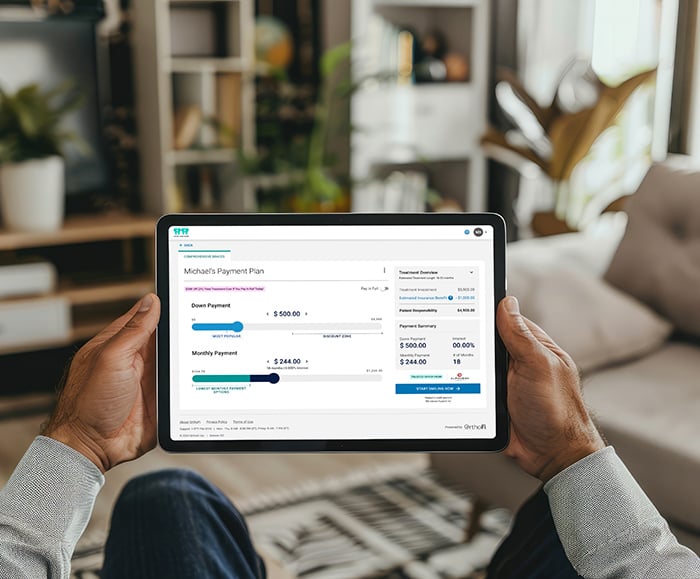
This is a business-to-business software and service company. Practices buy the system; patients encounter its forms, plans, payment portal, and support. The service component matters because a dashboard can display an unpaid balance indefinitely. Someone still has to resolve it.
The bill arrives before the smile
Orthodontic affordability has two clocks. The patient wants a manageable monthly payment. The practice has expenses that arrive sooner. A longer patient plan can make treatment possible while making the practice’s immediate cash position uncomfortable. The two clocks need some accommodation.
One concrete example is the Invisalign Flexible Payment Terms program offered to OrthoFi and OrthoBanc customers. It spreads the lab fee over ten equal ACH payments. In the company’s illustration, a $1,500 fee becomes $150 a month, beginning 30 days after ClinCheck approval. Those are supplier payment terms, separate from the patient’s treatment price.
The arithmetic explains why the supplier relationship belongs in the story. A practice cannot judge a lower patient deposit in isolation. It also needs to know when the associated costs will leave its account. Matching those timings can make a flexible plan more practical without changing what the treatment costs.
The Friday problem
At Cooper Orthodontics in Houston, Bryn Cooper had a name for the recurring work of digging through payment records: Financial Fridays. Her account describes tracking down payments, reconciling numbers, and verifying insurance. Growth made those chores more consequential. She chose OrthoFi rather than hiring another financial coordinator, saying outsourcing cost less than the hire.
In OrthoFi’s published case study, the practice reported 2.7% total accounts-receivable delinquency across its two locations in 2024, against a cited Gaidge industry average of 5.2%. The comparison is a vendor-published customer observation. It does not isolate how much of the difference came from the software, the service team, or the way Cooper ran her practice.
Unpaid balances, less of the balance
The more portable finding is operational. Financial work consumes attention even when a practice collects most of its money. Moving that work changes what the staff can spend its day doing. For an expanding practice, the question is whether the service absorbs additional volume more economically than another internal role.
Buying time, not just a login
OrthoFi’s portfolio divides the work into different products. OrthoFi covers the broad journey, including insurance. AcceptCare concentrates on financial presentation, in-house and third-party financing choices, follow-up, and reporting. OrthoBanc focuses on patient payment management, combining automatic drafts with support for missed payments and account questions. A practice should choose by the job it needs done.
AcceptCare connects patients to multiple lenders through one application and can also present practice-funded plans. Those arrangements have different economics: the practice may carry an in-house receivable, while an outside lender has its own terms. The distinction matters more than the attractive appearance of a monthly amount.
The alternatives are familiar: internal staff, payment processing inside practice-management software, and separate patient-financing providers. Ortho2’s Edge Cloud, for example, includes billing and payment capabilities and also integrates with OrthoFi. The market has overlapping tools and partnerships. OrthoFi’s position rests on connecting financial presentation to the ongoing work of collecting and resolving claims.
Accel-KKR invested in 2019. OrthoBanc joined forces with OrthoFi in December 2020, and the 2021 acquisition of Comprehensive Finance extended the business into general dentistry. These moves added reach and capabilities around the original financial problem. They also explain why a single present-day product count can obscure which part of the portfolio is being measured.

In January 2023, the company announced its millionth treatment start on the OrthoFi platform. The patient was at Ste. Marie Orthodontics in Opelousas, Louisiana. OrthoFi said it would cover the treatment fee. That milestone counted platform starts; the larger portfolio’s patient totals were a different measure.
What another practice can borrow
The practical lesson begins before a software purchase. Offer a meaningful range of payment arrangements, decide the limits deliberately, and track the mix patients actually select. A small deposit on one account says little about the cash generated by the whole practice. Equally, a busy consultation calendar says little about how many patients proceed.
A practice evaluating the model can compare kept exams, accepted treatment, same-day cash, overdue patient balances, insurance receivables, and staff time. It should also distinguish treatment booked from money collected. These measures answer different questions. Lumping them together makes almost any growth story sound more flattering.
The approach depends on a practice’s willingness to extend terms, its capacity to fund the timing gap, and reliable follow-up. More choice cannot cure an unaffordable total fee for every household. Nor does outsourcing eliminate the need to review accounts and understand financing terms. The vendor fee belongs in the calculation alongside payroll, collection losses, and cash timing.
OrthoFi’s interesting wager is that patient flexibility and financial discipline can coexist when they are designed together. The slider gets the attention. The quieter work is making sure the plan remains workable long after the consultation, when the patient has gone home and the next payment is due.