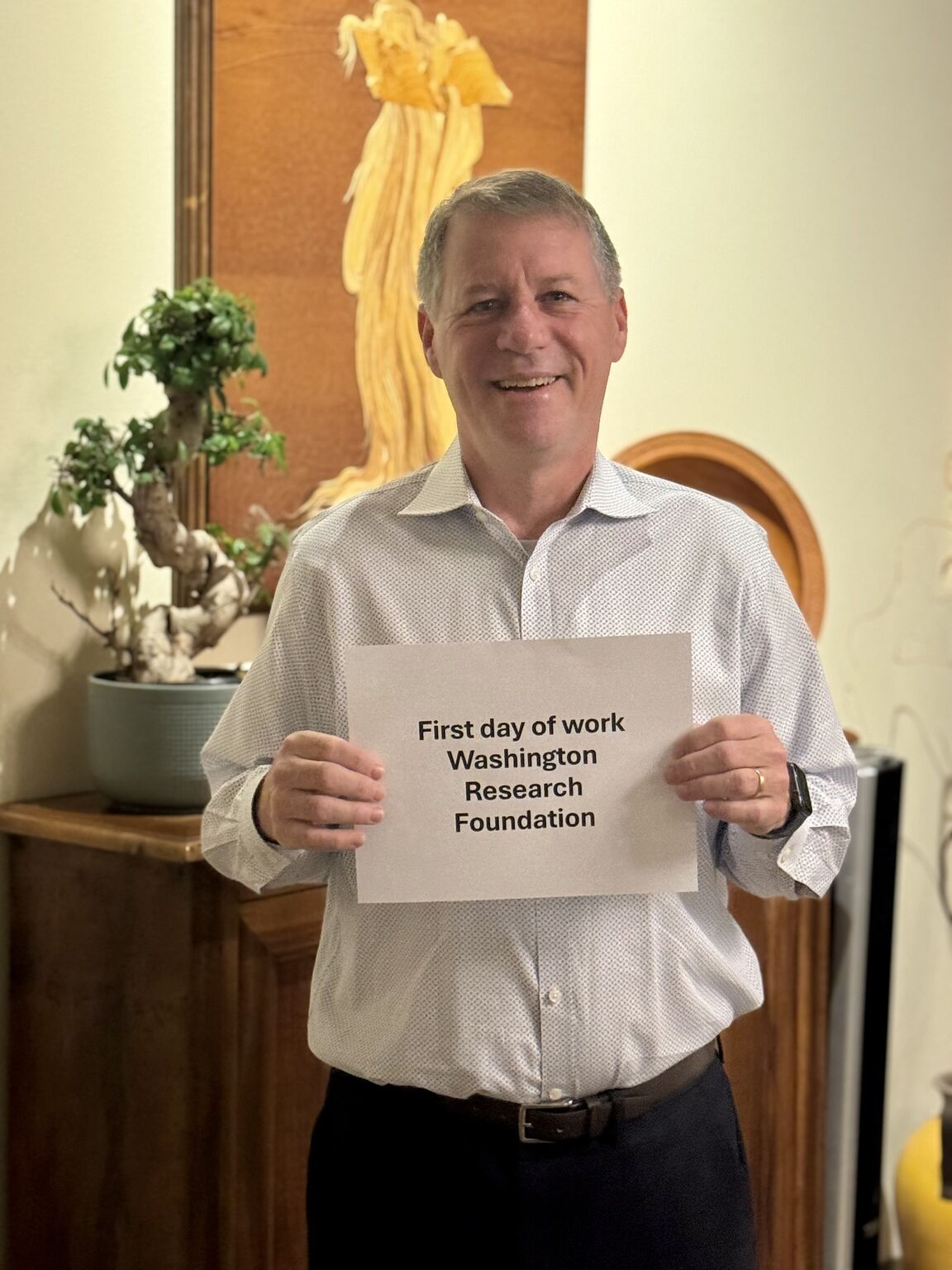
Orin Levine marked his first day as president and CEO of Washington Research Foundation by holding up a sheet of paper. The sign announced the occasion in large black letters. He smiled at the camera. There was something cheerfully schoolroom about it: an accomplished executive presenting himself as the new kid. Even the most imposing job title can be improved by a little stationery.
The photograph accompanied his October 2025 announcement that he had started work. His message expressed eagerness to learn from the foundation’s board, team, and partners. A first-day photograph usually records an arrival. This one also offered a clue to how Levine intended to behave after he had found his desk.
He had come through government, academia, and philanthropy. He had earned tenure at Johns Hopkins and held senior leadership roles at the Gates Foundation. WRF was an opportunity to bring that experience to Washington, where he and his family had made their home. The interesting part of the appointment lay in what he chose to do with all that experience: begin by asking questions.
There is an earlier entry in his record that makes a pleasing companion to this beginning. Between 1985 and 1988, Levine played lacrosse at Gettysburg College. He finished with 71 career assists. An assist is a small act of coordination with a measurable result. Someone else gets the goal. Your contribution survives in a quieter column.
The quieter column
In March 1988, Levine recorded six assists against Haverford. A month later, he repeated the figure against Scranton, in a game in which he also collected ten points. Those entries remain in Gettysburg’s record book. They describe a player who could make things happen around him, while reminding us that a career can contain useful particulars long before the polished biography begins.
The sporting comparison has its limits. A lacrosse statistic cannot explain decades of professional decisions. It can, however, give us a way to consider the work Levine now describes: placing support where another person can use it. The scoreboard has changed. The pleasure of making room for someone else remains a useful idea.
Levine graduated from Gettysburg in 1988 with a degree in management. He went on to earn his doctorate at Johns Hopkins in 1994. On a return visit to Gettysburg in February 2022, he spoke about college lacrosse, studying abroad, and moving into graduate school. He described carrying the lessons of his undergraduate years into his working life.
That combination matters in a profile of a research funder. Management and doctoral research bring different questions to the same table. How does a team work? What does the evidence establish? What would make the next step possible? Levine’s education gave him reason to spend time with both the people arranging the work and the people doing it.
Gettysburg lacrosse · 1985-1988
A contribution counted beside someone else’s goal.
A first day, after three decades
His professional career began at the Centers for Disease Control and Prevention in 1994. After five years there, he moved to the National Institutes of Health. In 2002, he joined Johns Hopkins. He left the university in 2012 as a full tenured professor, then worked in senior positions at the Gates Foundation. Each move brought him into a different kind of institution, with a different way of turning an intention into a decision.
WRF announced his appointment on August 19, 2025, naming October 6 as his start date. He succeeded Tom Daniel, who had led the foundation since 2022. A successor enters a story that already has characters, habits, commitments, and unfinished work. The title arrives on a particular day. Understanding the place takes longer.
Levine’s public account of his first six months described a deliberate decision to understand the organization before declaring a direction. He wanted to learn why people worked as they did and what Washington’s research community needed. For a new executive, listening can be an active choice about where to spend authority. It leaves space for the people already closest to the work.
He identified four reasons for taking the job: contributing to his home state, belief in innovation and its practitioners, continued learning, and the people he would work alongside. Together, they make the appointment sound personal without turning it into a sentimental homecoming. He was joining a team, accepting a task, and choosing another chance to learn.
An executive who keeps a coach
Ten days after his start, Levine published reflections on career transitions. Friends and colleagues had been contacting him about changes in their own lives. His first subject was coaching. He explained that working with coaches had helped him see more clearly, recognize blind spots, and move forward when he felt stuck.
He wrote that the value of a good coach lay in the questions they asked, rather than having every answer. The observation makes a modest demand on an executive: remain someone who can be helped. Experience is valuable, but it does not exempt its owner from confusion. A long résumé is a rather poor substitute for a well-timed question.
He named Henley Leadership Group, Hudson Institute of Coaching, Kerry Rockers, Julie Bernstein, and Lisa Colvin among the people and organizations he had found helpful. He suggested an initial conversation to judge the fit and invited readers to contribute their own recommendations. The practical detail gives the piece its character. He was passing along something he had used.
His account treats transition as work that deserves attention. A new position changes the questions other people ask you, as well as the questions you need to ask yourself. Levine’s willingness to discuss that process lends the first-day photograph another meaning: starting again is an activity, even for someone who has started many times.
Orin Levine · on coaching“A good coach won’t have all the answers, but they will ask the right questions.”
Where the phone cannot follow
In August 2023, Levine described spending a week alone in a remote Alaskan cabin. He enjoyed it. His explanation concerned the pace of thought: professional life rewarded his ability to respond quickly, while larger problems sometimes required more time. He credited more than seven years of work with a Henley Leadership Group coach with helping him recognize that distinction.
He mentioned brief meditations during the day and trips to remote Alaska as ways to make room for slower thinking. The attraction of the latter was partly practical. Cell phones could not reach him there, and life became simpler. A cabin offers an unusually firm reply to a calendar invitation.
His Bluesky biography supplies another outdoor detail: fly fisher. There is no need to turn the pastime into a theory of management. It is enough to know that the person convening conversations about research and capital also identifies himself with an activity requiring a river, a line, and time. The biography includes father and husband, too.
These particulars give scale to the public figure. Institutional biographies tell us which rooms a person has entered. A note about a cabin tells us that he sometimes chooses to leave them. Levine’s account suggests he values both responsiveness and the chance to let a difficult question remain open for a while.
Backing the work before the company
At WRF, he has described listening to researchers whose experiments were too speculative for industry, too small for many philanthropists, or a poor fit for conventional grants. The difficulty appeared at an awkward point: before the evidence was complete and before there was a company an investor could readily evaluate. A promising question could therefore be stranded between funding systems.
The foundation operates with grants and venture investment under the same roof. Researchers may encounter its fellowships and grants; founders may encounter WRF Capital. Levine wants those audiences to understand the whole arrangement. He sees its purpose in improving the chances that research becomes a company that stays and grows in Washington.
The arrangement has a history. WRF was founded in 1981 by Tom Cable, Bill Gates Sr., and Hunter Simpson to help research institutions commercialize and license inventions. The recently enacted Bayh-Dole Act allowed institutions to retain ownership of federally funded inventions. WRF’s founders built an organization around bringing those inventions into commercial use and returning proceeds to the institutions.
By Levine’s appointment announcement, WRF reported more than $182 million in cumulative grants and more than $445 million in licensing revenue earned for the University of Washington. WRF Capital had backed 132 local startups since 1996. These are institutional figures accumulated before his arrival. They describe the machinery he inherited, and the responsibility of deciding how to use it next.
The names that come before the headlines
One surprise of the new job was how much Levine enjoyed meeting early-career researchers. He described conversations with postdoctoral fellows committed to questions whose payoff might take a decade. Graduate students and undergraduates impressed him as well. His account places the person doing the work ahead of the eventual product or company.
He also pointed to entrepreneurship support, including gap funds at UW’s CoMotion and WSU’s Office of Commercialization, and the WSU-UW Collaborative Postdoctoral Entrepreneurship Program. Such programs address a practical transition. Knowing how to investigate a question and knowing how to build a venture require different experience. A researcher should have somewhere to acquire the second without surrendering the first.
His ambitions extend across Washington. He has named materials science, climate technology, agricultural technology, robotics, and artificial intelligence among the state’s research strengths. He has also described a geography reaching from Seattle to Spokane and from Pullman to the Peninsula. His aim is to help institutions and partners connect so research has more routes into use.
There is a useful restraint in that ambition. He has acknowledged that WRF cannot close the gaps alone. The work involves partners, institutions, and relationships. Its scale will depend on other people choosing to participate. That is a demanding assignment for an executive: act with purpose while remembering how much of the result belongs to someone else.
Back at Gettysburg, the assist occupied a column beside the goal. At WRF, the contribution may take the form of a fellowship, an experiment that finally gets funded, or a connection that helps a researcher attempt a business. Levine’s first-day sign marked his own beginning. The job he describes is full of opportunities to help other people make theirs.