Consider the awkward interval between deciding to move and being able to move. Your next job has a start date. Your next house has a seller. Your current house has a prospective buyer who needs a mortgage, an inspection, and perhaps a little more time. Everyone owns a piece of your calendar. You own the lawn mower.
The quick read
- The offer: sell directly, choose your closing date.
- The tradeoff: compare final net proceeds.
- The test: resell fast enough to make money.
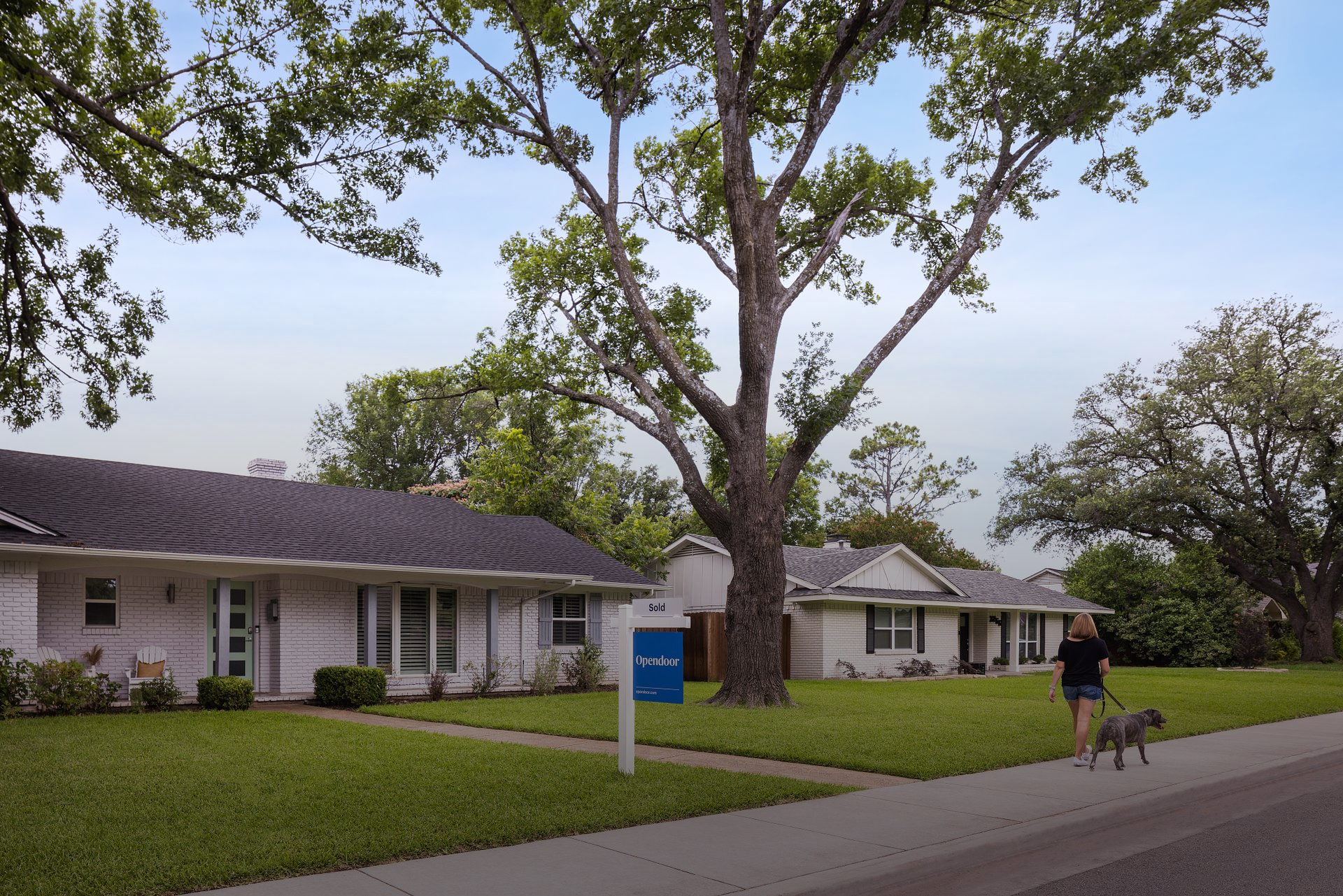
Opendoor’s proposition begins inside that interval. Enter an address, describe the property, and request a cash offer. If the home qualifies and the final terms suit you, the company buys it. You choose a closing date, generally between 21 and 60 days. Opendoor then prepares the property and sells it to somebody else. The waiting has changed owners.
This is iBuying: using technology to buy homes directly, at scale. A property portal introduces people. A brokerage represents them. Opendoor takes ownership. Its distinction is consequential: the company puts money behind its estimate, then lives with the result.
An algorithm meets the carpet
The founding team brought together Eric Wu, Keith Rabois, Ian Wong, and JD Ross. Public accounts commonly date the launch to 2014; the company also traces its beginnings to 2013. Their idea joined software’s appetite for repeatable transactions to a product that stubbornly refuses to be standardized. Two houses can have the same floor plan and very different roofs.
Opendoor describes a valuation system built from comparable sales, public records, property characteristics, and local conditions, with human review. An assessment helps turn a preliminary number into a final offer. The carpet matters. So does the neighborhood’s changing appetite for another three-bedroom house.
Its expertise therefore stretches beyond prediction. Somebody must assess condition, coordinate contractors, manage title and closing, and sell the home. Buyers can browse its inventory; sellers can use valuation and proceeds tools. The website also offers mortgage services. Behind the address box sits a substantial physical operation.
Read the number at the bottom
The likely customer has a timing problem: a relocation, a growing family, or a purchase that depends on unlocking equity in an existing home. Skipping staging and repeated showings can be useful. Whether it is worth the price depends on the actual offer and the seller’s alternatives.
Opendoor’s current consumer help center says its service charge varies by property, market, and conditions. There is no single published percentage to paste into everyone’s calculation. Standard closing costs also apply; repair adjustments can affect the final proceeds. Compare what reaches your bank account, alongside the time and obligations each route requires.
An offer is also a useful benchmark even when you decline it. Put it beside an agent’s estimate of a conventional sale, using the same assumptions about repairs and the closing date. A headline price cannot tell you how much another month of mortgage payments, or an overlapping move, will matter to your household.
That distinction has a regulatory history. In 2022, Opendoor agreed to a $62 million FTC settlement over allegedly misleading claims about sellers’ financial benefits. The FTC said many sellers received less than they would through traditional sales. Opendoor disputed the allegations and settled without admitting wrongdoing. In 2024, refunds went to 54,689 homeowners. Convenience and financial advantage require separate evidence.
The inventory gets a vote
For the business, revenue is an unusually noisy scoreboard. Opendoor records the resale value of homes, so billions in sales do not translate into software-like profits. The purchase price, repairs, financing, holding expenses, and selling costs consume much of that money. Every unsold home continues to carry costs.
In 2022, revenue reached $15.6 billion and 39,183 homes sold. Net loss was $1.4 billion; the year-end inventory valuation adjustment was $458 million. Those figures capture the danger of owning the thing you are trying to make easier to trade. A changing housing market can overwhelm a pleasing customer journey.
Capital helped build the machine. The 2020 public-market merger raised $970 million in net proceeds. Yet distribution matters too. A Zillow partnership, announced in 2022 and launched in 2023, let sellers request Opendoor offers through Zillow. An eXp Realty agreement put offers inside agents’ workflow. Potential competitors could also deliver customers.
The scale of the reset / annual revenue
Reported full-year revenue, USD. Includes home resale prices. Revenue is not profit.
The new rule: keep moving
In September 2025, Opendoor named former Shopify executive Kaz Nejatian CEO. Wu and Rabois returned to the board, and Khosla Ventures and Wu agreed to invest $40 million. The company’s current recruiting language is blunt: “This will be hard.” Its public pitch emphasizes fast shipping and testing in the open.
By September 2026, Nejatian was publicly challenging a habit of holding homes to defend margins. He said Opendoor historically sold at roughly 85% of market pace between its public listing and his arrival. The revised priority was faster clearance, including accepting weaker margins when conditions deteriorated. His compact explanation: “Time has a cost.”
The repair remains unfinished. Second-quarter 2026 revenue was $883 million, with a $162 million GAAP net loss and a $30 million adjusted net loss. In September, management pushed back an adjusted EBITDA profitability guidepost by roughly six to eight weeks after late-August housing weakness. Forecasts of future profitability remain forecasts.
On October 21, Nejatian also became president as Lucas Matheson stepped down into an advisory role. The leadership change adds another chapter to a business still being rebuilt.
“Time has a cost.”
KAZ NEJATIAN / SEPTEMBER 2026


One sale. Two kinds of certainty.
The product has changed too. Cash Now, More Later, formerly Cash Plus, provides money at the initial closing and a potential second payment after resale. Opendoor handles preparation and resale; additional proceeds depend on the sale price, fees, and costs. The first payment gives immediate liquidity. The second introduces an outcome the seller cannot know in advance.
Offerpad, local cash buyers, and a conventional agent-led listing give homeowners other routes. A seller with time and strong open-market demand may prefer to seek competing bids. A property outside Opendoor’s buying criteria may receive no offer. A seller who needs every dollar immediately should examine any deferred-payment option carefully.
The useful lesson travels beyond housing: put a number on the delay your customer wants to escape, then measure the cost of absorbing it. For homeowners, copy the comparison: final net proceeds, closing date, repair deductions, and remaining uncertainty. Opendoor’s bet is that enough people will pay to own their calendars again. Its challenge is making that calendar affordable to carry.