Most companies want to own the front door. OS National built a business in the hallway behind it - the place where a signed real-estate contract meets liens, legal descriptions, insurance, escrowed money, signatures, state rules and the unnerving possibility that somebody has missed something. It is not cinematic work. Nobody frames the title commitment. Yet a home sale does not become a clean transfer because the listing photos looked good. It becomes one because an operator makes hundreds of small facts line up on time.
That operator, in OS National's version, is part insurance agency, part project manager and part air-traffic controller. The Duluth, Georgia company handles residential and commercial title insurance, settlement and escrow. Around that core sit due diligence, document management, title cure, policy issuance, remote notarization, digital closing and services for lenders moving loans into the secondary market. A family buying one house can use it. So can an investor moving thousands.
01 / The jobMaking boring work reliably
A title company answers a deceptively large question: can this property change hands without an old claim, unpaid lien, boundary problem, forged document or recording error ambushing the new owner or lender? OS National searches the record, helps clear defects, coordinates funds and documents, and arranges the policy that protects against covered title losses. For commercial clients, the menu expands into easements, subordinations, workouts, foreclosures, loan modifications, defaults and co-insurance for large transactions.
The customer mix explains the architecture. OS National serves buyers, sellers, borrowers, agents and attorneys, but also community banks, credit unions, national lenders, mortgage servicers, REITs, private-equity firms and institutional investors. Those customers do not merely want accuracy. They want a predictable fee, a visible timeline and someone who answers the phone when County A requires one thing and County B requires another.
Its sharpest promise is almost aggressively untechnical: one point of contact. That person sits in front of a national platform and local expertise, absorbing the coordination cost the client would otherwise carry. The trick is not to pretend real estate has become uniform. It is to keep the uneven state and county rules behind a consistent customer experience.
The first things to fail in a closing are usually handoffs. A payoff arrives late. A name differs between documents. A lien needs to be released. A lender changes an instruction while the buyer is scheduling a move. None sounds dramatic in isolation, but the transaction is a chain: one unresolved exception can hold the money, the deed and the keys. OS National's operating idea is to make those dependencies visible early, route each exception to the right specialist and keep the customer from becoming the project manager.
That makes the company closer to enterprise infrastructure than a consumer app, even though consumers feel the result. Its client portal gathers information with step-by-step prompts. Underwriters and counsel handle the title questions. Escrow officers control funds. Closers coordinate signatures. Post-closing teams chase recordings, documents and policies after everyone else has mentally moved into the new kitchen. The interface is only the top layer; the useful product is the organization behind it.
“When we started OSN we wanted to build something better, and to work to do things differently to better serve our customers.”Jamie Wunder, co-founder, 2018
02 / The climbTwenty-two people, then a national map
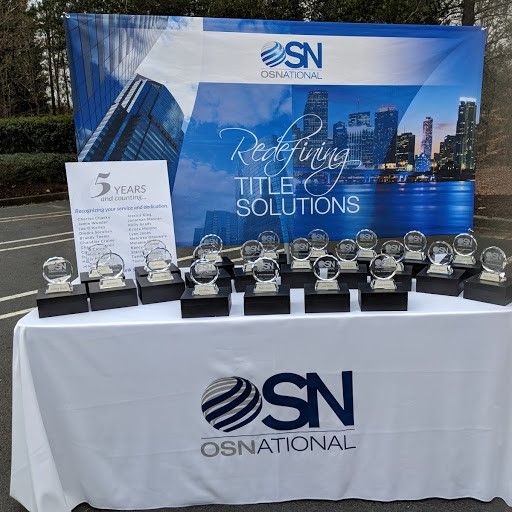
OS National dates its operating story to 2013, when co-founders Charles Chacko and Jamie Wunder started with 22 employees. The early thesis was service dressed in systems clothing: put the customer first, centralize what can be centralized and preserve local judgment where it matters. By its fifth anniversary in 2018, the workforce had passed 250 across four states. By the 2019 acquisition announcement, it had more than 500 team members in offices around the country.
Expansion came market by market. Texas arrived in 2016, followed by additional Dallas-Fort Worth offices and a Las Vegas operation. The company paired retail locations for local residential work with centralized national operations for lenders and investors. In 2018 it added Pavaso's digital-closing platform, giving customers a secure, collaborative route through documents and signatures. The current service stack also includes a client portal, electronic signing and remote-notary coordination where the transaction and jurisdiction allow them.
The scale claim that best captures the company is not its office count. OS National says it coordinated a $1.2 billion real-estate securitization involving more than 8,000 properties. That is a bulk transaction turned into a production line, except every unit is a parcel with its own record, exceptions and local government.
03 / The dealA customer becomes the owner
Opendoor began working with OS National in 2016. This matters because the eventual acquisition was not a blind bet on a pitch deck. For three years, Opendoor watched the company perform inside the exact workflow it wanted to improve. The problem was obvious: buying or selling a home online could feel fast until the customer hit a closing process crowded with documents, status uncertainty and handoffs among parties.
On September 4, 2019, Opendoor acquired 100 percent of OS National. The disclosed consideration was $41 million - $34.3 million in cash and $6.7 million in equity. Opendoor's filing said vertical integration would make the experience more seamless while reducing its transaction cost structure. OS National brought the licenses, underwriter relationships, customer relationships and closing muscle. Opendoor brought a large stream of transactions and an end-to-end consumer ambition.
What failed first was not OS National. It was the traditional handoff. Opendoor's case for the deal described buyers confused about status, overwhelmed by documents and frustrated by delays. The partnership changed its mind about where title belonged: after testing an external provider, Opendoor decided the closing layer was strategic enough to own. Acquisition was the conclusion of operational evidence.
“The real estate industry is being transformed before our eyes and we have a unique opportunity to be in the front seat of the change.”Charles Chacko, co-founder, 2019
04 / The economicsPolicies, fees and the price of certainty
OS National makes money when transactions move. The economic bundle can include an owner's or lender's title policy, endorsements, escrow and closing charges, loan-closing fees and specialized work such as diligence or post-closing. A 2023 affiliated-business disclosure showed broad example ranges: up to $5,000 apiece for owner and lender title policies, up to $1,000 per endorsement, up to $4,000 for escrow or closing and up to $350 for loan closing. Those are ranges, not a menu for every deal. Property value, location, regulation and transaction design move the bill, and customers remain free to shop for another provider.
The competitive field is split. First American, Fidelity National, Stewart and Old Republic bring enormous underwriting and distribution networks. Digital operators such as Doma sell a more software-forward experience. Local agencies and law firms sell proximity and jurisdictional fluency. OS National's position is the middle: national coordination with boutique, local service, reinforced by relationships with major underwriters.
That middle position is especially useful when the buyer of the service has national volume but the underlying assets remain stubbornly local. A portfolio investor does not want to manage dozens of title vendors, reporting formats and escalation paths. A homeowner does not care about portfolio efficiency, but does want a clear answer about tomorrow's signing. OS National attempts to serve both without confusing them: centralized controls for the institution, local knowledge and direct communication for the person at the table.
05 / The stealOwn the bottleneck, not the applause
There are five useful ideas here for builders outside title insurance. First, find the unglamorous step that can stop the glamorous purchase. Second, make accountability a product: one contact, one timeline, one owner of the mess. Third, centralize repetition but keep experts near exceptions. Fourth, introduce software where it removes waiting - intake, document collection, status and signatures - without pretending judgment has disappeared. Fifth, let a partnership prove acquisition logic before anyone writes the giant check.
OS National also shows the limits of “software eats everything.” Its value sits partly in portals and digital closings, but also in licenses, underwriter access, real-estate counsel and people who know why one line in a title report matters. The company did not turn closing into a button. It turned it into a managed sequence.
That sequence keeps expanding. At the end of 2025, Opendoor reported that OS National and its subsidiaries were licensed as title agents in 28 states, as escrow agents in six, and authorized for title-insurance business in five additional states that do not require entity or individual licensing. The consumer may never notice that regulatory lattice. Not noticing is part of the product.
The quiet payoff is a set of keys delivered when promised. Behind them is a company built around the proposition that details become valuable when everyone else would rather skip to the photograph.