Nine hours and eighteen minutes is an awkward length of time. Too long for a working day. Too short to forget about. For one application delivery controller vendor, it was the duration of a functional test job. The code could be ready while the answer to the important question - does it work? - remained stuck in a queue.
- Opcito builds software and the systems that release and run it.
- Its specialty is connecting cloud, testing, security and operations.
- Four homegrown tools tackle recurring testing and learning chores.
Three hours, sixteen minutes
Opcito’s October 2026 account describes a Robot Framework and Python solution, with cached roles, parallel execution and sanity checks. Functional runtime fell to six hours and two minutes. Nightly runtime dropped from twelve hours and twenty-two minutes to eight hours and forty-seven minutes. The framework also detected process crashes during execution.
These are company-reported results for an unnamed customer. Still, the specificity is useful. A shorter queue lets engineers examine a failure while the change is fresh in their minds. Finding crashes matters just as much as finishing sooner. A fast test that overlooks the broken process has merely delivered false confidence ahead of schedule.
The seat map has a backend
Consider another assignment: an intercity travel platform operating across the US, Canada and Mexico. According to Opcito’s July 2026 case study, its infrastructure used bare virtual machines, manual deployments and disconnected monitoring. Legacy carrier systems could fail without a caching layer to cushion the booking experience.
Opcito moved the platform toward Amazon’s managed Kubernetes service, EKS, automated releases with GitHub Actions, used Terraform to define infrastructure and introduced Valkey caching. It reports up to 40% lower compute costs through an AWS Graviton migration. That number concerns compute in this engagement, rather than the entire technology bill.
A passenger encounters the seat map. Behind it sit carrier APIs, deployment choices and decisions about what happens when another system stops answering. This is where Opcito fits: between the product people want to sell and the operational machinery required to keep selling it.
The purchase is engineering judgment
Opcito sells engineering services to software businesses and enterprises. An engagement can involve building a product, modernizing an application, securing a platform, automating delivery or maintaining a live system. Teams can complement an existing engineering organization. The purchase combines specialist knowledge with delivery capacity.
Its Clutch listing indicates projects starting at $5,000 and hourly rates of $25-$49. Treat those as directory figures when framing a conversation. The same listing includes a regulatory-technology customer that brought Opcito in after an unsatisfactory relationship with an earlier infrastructure agency. Assessment came before the proposed transfer of operational responsibility.
That sequence is worth borrowing. Ask a prospective partner to identify the failure, compare possible remedies and demonstrate one bounded improvement. A consultancy’s hours become easier to evaluate when everyone agrees on the result those hours should buy.
A fast test that overlooks the broken process has merely delivered false confidence ahead of schedule.
A separate July 2026 case makes the buying decision concrete. A self-storage SaaS provider wanted finer access controls, stronger security tooling and AI-assisted development. Opcito reports moving 150 repositories from GitLab to GitHub Enterprise in five weeks, preserving history while adding security scanning and Okta sign-on. The interesting unit of work is the whole transition: repositories, permissions and the people using them. Moving code alone would have left much of the original problem intact. For a buyer, that is a reason to define the finish line before counting migrated repositories.
Four tools for the recurring chores
Opcito also packages recurring work into its own accelerators. AssureAPI reads OpenAPI or Swagger specifications and generates positive and negative API tests. Missing fields, invalid inputs and boundary conditions become repeatable checks. Its command-line interface and HTML reports make it usable within automated build processes.
RestSequence addresses a different question: can several APIs complete a workflow together? Users import a Swagger collection, arrange calls and configure requests through a low/no-code interface. Product managers can explore a sequence without waiting for a complete user interface. Reusable scenarios can then join the release pipeline.
TestDash makes ongoing test execution visible, with pass/fail status, logs and historical views across releases and products. UpSkillo turns toward the employees: goals, challenges, evidence submissions, approval and rewards. The connection is practical. Each tool gives a repeated activity a structure people can inspect.
A company that has to keep learning
Chaitanya Jawale founded Opcito in 2015 with a small group of friends. The company’s memorial recalls a programmer whose command of Java earned him the nickname “Sir Java.” He led the business until his death in November 2022. Its tenth-anniversary gathering in 2025 began with a tribute to him.
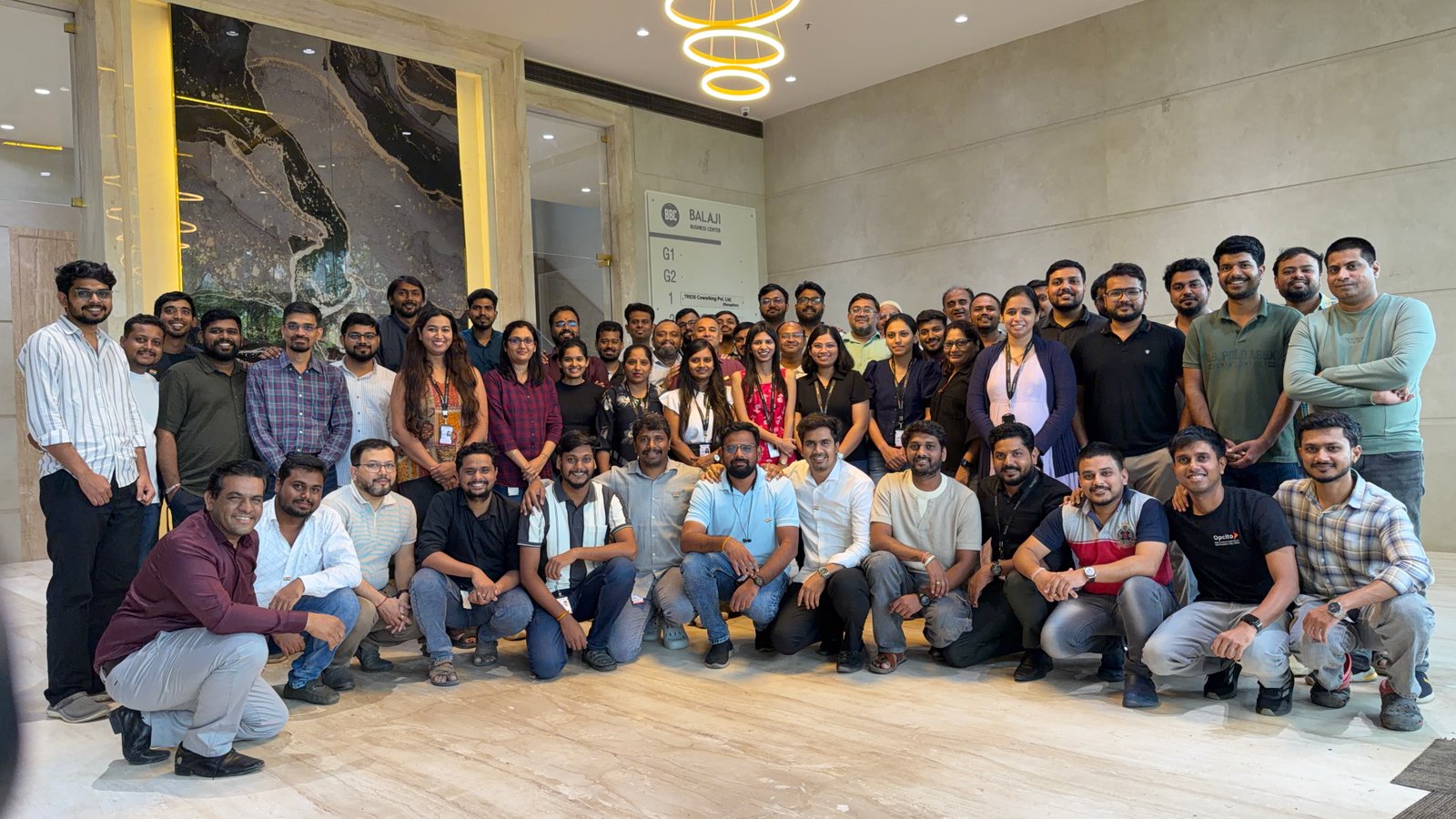
The careers page describes hybrid work, flexible hours, sponsored certifications and learning subscriptions. Great Place To Work lists the company among India’s Great Mid-size Workplaces for 2024. These details matter in a services business: the expertise a customer buys has to keep developing inside the people delivering it.
The Bangalore office opened in August 2025, with the announcement linking the move to existing customers, local talent and AI accelerators. Today’s service menu includes retrieval-augmented generation, agents, data engineering and agent quality assurance. The familiar questions follow the new technology: how do you test it, observe it and keep it dependable?
Borrow the brief
For a buyer, Opcito’s appeal is the breadth of work around a software product, supported by reusable tooling. The alternatives include building that expertise internally or combining separate development, cloud and QA specialists. The useful comparison is who will own the interfaces between those jobs.
Start with one stubborn delay. Record its duration, frequency and consequences. Agree on a pilot, measure the outcome and require a handover the internal team can maintain. Specification-driven API tools need usable definitions; a container migration needs applications worth migrating. If those conditions are absent, fix the brief first. The engineering partner should help you make that decision.