Olivier Pomel and Alexis Lê-Quôc had done the sensible things. They were friends. They had worked together for years. They had hired their own teams and tried to keep unpleasant people out. Pomel ran development; Lê-Quôc ran operations. Yet the developers and the people responsible for keeping their software running ended up pointing fingers at one another. A hiring policy could remove a jerk. It could not make two departments see the same problem.
That small organizational defeat became the starting point for Datadog, which they founded in New York in 2010. Give people a shared picture of what their systems are doing, they reasoned, and perhaps they could solve problems together. Underneath the servers, charts and alerts lay a surprisingly familiar ambition: make work with other people less exasperating.
Pomel has since acquired the conventional biography of a technology chief executive: founder, public-company leader, investor. The interesting continuity is his suspicion of a comfortable explanation. A company can agree that its product is wonderful for months before a customer spoils the meeting. Pomel prefers to arrange that meeting early. “You run towards the bad news,” he says. There are more glamorous operating principles. This one has the advantage of being useful on a Tuesday.
“You run towards the bad news.”
Olivier Pomel
Before the dashboards, a moving picture
His first experiments were more visual. Growing up in France with a mother who taught school, Pomel had access to a school-oriented computer at home. A Commodore Amiga later drew him into programming. He was fascinated by the European demo scene, where programmers coaxed elaborate graphics out of machines with limited resources. Making a computer display something remarkable was an invitation to understand what happened underneath.
At École Centrale Paris, he worked on the early VLC project, originally intended to stream video across a campus. The media player would eventually travel far beyond that setting. Pomel describes his contribution carefully, crediting the students and programmers who followed him for the software’s subsequent success. An early author can help start something without claiming every accomplishment of its later life.
That distinction suits his career. He graduated in 1999, worked at IBM Research in the United States and took software engineering jobs at internet startups. At Wireless Generation, an education software company, he built data systems for teachers and grew an engineering team from a handful of people to nearly 100. By the time he started Datadog, he had experience both writing software and getting a roomful of other people to write it.
He also had an unusually long working relationship with Lê-Quôc, whom he had met at Centrale. They had seen one another in settings much less ceremonial than a co-founder photograph. That history mattered: their disagreements between development and operations were problems they could examine together, rather than evidence that the person across the table had become an enemy.
- 1999Graduates from Centrale Paris
- 2002–10Builds at Wireless Generation
- 2010Co-founds Datadog in New York
- 2019Takes Datadog public on Nasdaq
Six months with nothing to demonstrate
Two engineers starting a company might reasonably celebrate by writing code. Pomel and Lê-Quôc spent their first six months talking to potential users instead. Even that restraint did not guarantee the right product. Their initial alpha was too general, and the carefully selected companies invited to try it produced less useful feedback than expected. A wider beta let interested users find them. The founders had to revise both what they were building and how they learned.
Their own account of the company’s beginnings makes an important distinction between the platform they imagined and the problem customers would pay to solve. Datadog began with an ambition to combine real-time data from different places. Watching early users revealed a more immediate need: understanding infrastructure as it moved into the cloud. Infrastructure Monitoring launched in 2012. A large technical possibility had acquired a specific job.
There is something appealingly unromantic about that sequence. An origin story usually improves with every retelling until the founders appear to have foreseen the entire market. Pomel leaves room for the awkward alpha and the incomplete understanding. The cloud offered an opening, and customer behavior helped determine where to enter. An engineer’s willingness to revise the design became as consequential as the design itself.
A database, a suitcase and a city
The name came with baggage of its own. At their previous employer, a troublesome Oracle database was called Datadog17. The founders borrowed the name as a working codename, dropped the number and kept the memorable part. Neither founder had a dog. One of enterprise software’s canine brands therefore owes something to a database people would have preferred to avoid.
Raising money was less charming. Pomel remembers trips to California with a rolling suitcase, moving between investor meetings and waiting in coffee shops. Building infrastructure software in New York did not make the pitch easier. Investors could see a crowded monitoring market and an inconvenient address. The founders still had to persuade someone that their particular understanding of the problem was worth financing.
New York was where they lived. It also put them near customers whose businesses extended beyond the technology industry. Pomel has described the value of that proximity: buyers had practical problems, and useful software had to earn its place in their work. Geography, initially a fundraising objection, helped keep the conversation grounded.
Datadog went public on Nasdaq in September 2019. The date supplies a clean milestone for a timeline, although it cannot describe the daily work that preceded it. The path from an awkward fundraising meeting to an opening bell consisted of many less photogenic decisions about customers, costs and whether a product was ready to charge for.
The revealing moment is the price
Pomel’s product-development process includes a scene every polite collaborator would rather postpone: the bill. Customers can enjoy discussing a new tool, attend meetings and offer suggestions without having decided that it is worth buying. Datadog works with design partners early, then introduces pricing to discover whether enthusiasm survives a dollar amount.
He has described some partners disappearing at that point. The silence contains information. A feature might be interesting without solving an expensive enough problem. Others keep using and paying for it. Wider testing and broader availability expose the product to further rounds of the same question. Each stage gives the company a chance to learn before it commits more people and time.
The method helps explain how he thinks about building several products inside one company. Existing relationships create access, but affection for the first product cannot establish demand for the next. Every new team needs evidence of its own. A familiar logo on the invoice does not relieve a new product of the obligation to be useful.
Early monthly contracts served a related purpose. Customers could leave quickly, so poor adoption could not hide behind a distant renewal date. That choice made revenue less comfortable and feedback more immediate. Pomel still argues for making failure visible while there is time to act on it. A contract can buy a company time; it can also buy time to misunderstand what is happening.
Looking closely, keeping his hands off
Scale creates another kind of distance. A chief executive can receive a beautifully prepared report that bears only a passing resemblance to what a customer or employee experienced that morning. Pomel samples individual conversations and problems to compare the official account with the underlying detail. He asks questions throughout the organization, including below the executive team.
He draws a boundary around what follows. Asking a question does not authorize him to bypass the managers responsible for the answer. Telling their teams what to do would quietly strip those managers of responsibility. His leadership has evolved toward hiring people he regards as peers, then letting them run their areas. Curiosity and restraint have to occupy the same office.
Outside work, he applies a rather literal version of restraint to his phone. It is usually silent; when he is off work, he sometimes leaves it elsewhere. He makes room to think and spend time with family. For someone whose company helps customers notice events immediately, he has a practical appreciation for the value of an interruption that never arrives.
More software, more questions
AI now supplies Pomel with another round of questions about what customers need to see. As systems incorporate models and agents, their behavior becomes harder to inspect using old assumptions. He has stressed the need to measure what those systems actually do. More autonomy increases the importance of understanding outcomes, costs and mistakes.
The business is already operating at a different scale from its early monitoring product. In the second quarter of 2026, Datadog reported $1.12 billion in revenue, up 36% from a year earlier, and about 4,720 customers generating at least $100,000 in annual recurring revenue. Those are company measures, not a personal scorecard. They show how many organizations now entrust part of their operational picture to the business he helped start.
His interests also extend beyond Datadog. In October 2026, developer infrastructure company Namespace named him among the angel investors in its $42 million Series B. Namespace builds coding, build and test environments, including infrastructure for AI agents. The investment puts him alongside another team working on the machinery behind software development, a subject that has occupied much of his adult life.
Pomel’s public ambition remains closely attached to building: products, technical systems and the organization that produces them. The work changes as the company grows, but the original difficulty remains recognizable. People need to understand what is happening before they can decide what to do. Somewhere between the campus video player and the public company, he made a profession of asking for a clearer picture. Preferably before everyone agrees the picture looks fine.
Keep the conversation going
Explore Datadog and its engineering blog, or follow Pomel on LinkedIn and X.
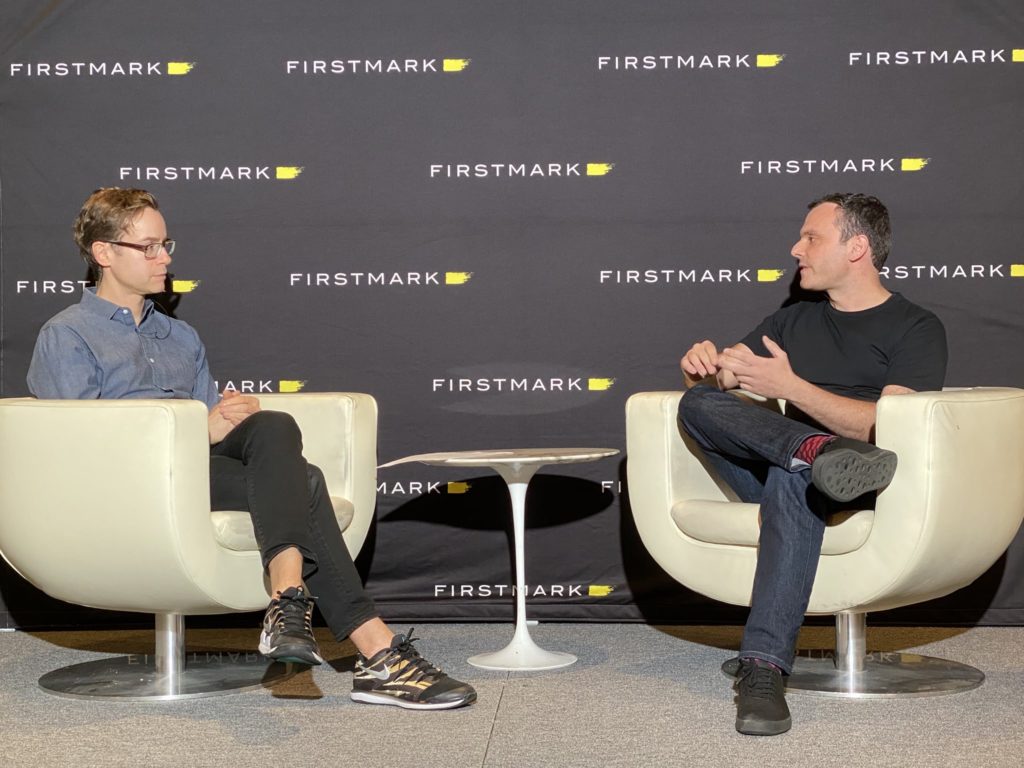
- Watch: the 2020 Data Driven NYC conversation with Matt Turck
- Watch: Pomel on AI, product development and observability
- Read: suitcases, fundraising and Datadog’s early years
- Read: how Pomel’s leadership changed as Datadog grew
- Listen: Pomel and Eléonore Crespo on operating in the AI era
- Latest: Namespace’s October 2026 funding announcement