Before Ohad Maislish became a chief executive, he had to talk himself out of becoming a chief technology officer. He wanted to keep building the product. The other job sounded like a possible interruption. Then he remembered an argument by David Ring, eToro’s CTO, for putting product-minded people in charge. Maislish decided to take the CEO seat and find someone he trusted to take the other one.
That person was Omry Hay, whom he had met at eToro years earlier. A few calls, some coffee-shop meetings, a handshake: env0 had its founding partnership. “This was the minute that env0 became a reality,” Maislish recalled. It is a pleasingly modest beginning for a company concerned with the machinery behind cloud computing. No launch countdown. Just two people agreeing who would do what.
Years later, he would help build another piece of that machinery, OpenTofu, with companies competing for the same customers. This time, the arrangement involved giving a shared project an independent home. His career offers an interesting question: how much control should a builder keep, and how much must he let other people have?
A teenager with a head start
Maislish began his bachelor’s studies at 14 and joined Microsoft Israel as a developer at 17. His subsequent work took him through technical and management roles at VMware, eToro and Ravello Systems. That history matters because the problems he later chose to tackle were problems encountered from inside software teams. He had experience with the tools, the people using them and the work required when something refused to behave.
There is another early memory that gives the career a more tangible beginning. In 2002, he saw VMware Workstation run Linux on a Windows machine. He remembered being astonished. A computer could contain a second operating environment without requiring a second physical computer. For someone watching software swallow the server room, this was a memorable demonstration.
By 2007, he was working at B-Hive Networks, a startup later acquired by VMware. In his account of the cloud’s evolution, virtualization gives way to cloud services, then to the growing practice of describing infrastructure in code. The progression keeps changing the engineer’s job. The machines become easier to summon; coordinating them becomes a larger undertaking. The server room has disappeared from sight, but its responsibilities have remained stubbornly employed.
The video had to count
Before env0, Maislish co-founded Capester, a venture dealing with an entirely different sort of infrastructure: public space and municipal enforcement. Its app allowed people to submit videos of violations to local authorities. The difficult part was making the recordings usable as evidence while preserving the submitter’s anonymity.
The founders worked with legal and digital-security specialists to build an authentication system. An authority would receive the footage and decide what action to take. The app itself could not issue a ticket. That distinction was central to the product: collecting something useful required respecting the institution that would use it.
Capester received seed investment in October 2014, and the team spent 18 months developing the app to meet evidentiary standards. Maislish also founded Arno Software, a cloud infrastructure services business. These ventures make his route to env0 less tidy than a straight march through cloud software. They also put a practical question in view: once software makes an action easy, what gives other people confidence in its result?
Who gets to act, who sets the rules, and who can trust the result?
The cloud needed a front door
At env0, that question became a product for teams managing Infrastructure as Code. Instead of creating a server or database through a series of clicks, an engineer can define the required resources in files. Tools such as Terraform translate those definitions into working infrastructure. Yet a company still needs decisions about access, approvals, spending and shared workflows.
Maislish’s early ambition extended beyond a small circle of DevOps specialists. Developers, sales engineers and customer-service teams might all need environments. He wanted them to be able to provision those environments themselves within the company’s policies. The person who needs the resource should have a usable way to obtain it; the people responsible for the cloud should retain meaningful oversight.
In a December 2020 demonstration, he divided env0’s users into administrators and the people consuming infrastructure. He also laid out a multi-framework approach. Terraform was prominent, but customers should be able to choose their technology. The demonstration covered policies, costs and limits, including plans for budgets at the user, team and project level. The interface was addressing an organizational negotiation as much as a technical operation.
The people who backed the company recognized that negotiation. Snyk co-founder Guy Podjarny introduced Maislish and Hay to boldstart’s Ed Sim in December 2018 and joined as an investor and adviser. Sim described cloud environments as a team undertaking, with several stakeholders needing a way to coordinate. Maislish’s connection to that network came with experience of doing the work, rather than merely spotting an appealing market from a distance.
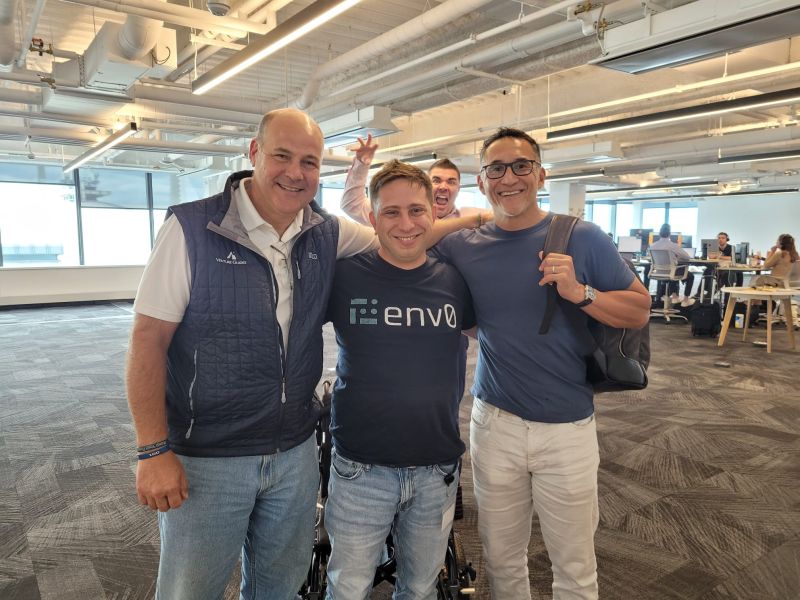
A photograph from a 2024 gathering in Boston captures that relationship rather well. Maislish stands with Benjamin Nye and Sim, while Steve Corndell makes a cheerful intrusion behind them. Maislish’s accompanying message credits Corndell with improving photographs through funny gestures. Investor relations can apparently accommodate a photobomb.
Money for the unglamorous middle
Microsoft’s venture fund, M12, led env0’s $17 million Series A in June 2021. The announcement put total funding at $23.8 million. Maislish summarized the company’s intention with an analogy: “env0 is doing to IaC frameworks what GitHub did to Git.” He was pointing to the management and collaboration layer around an underlying tool.
M12 had already participated in the seed extension in July 2020. Its investment account emphasized the founders’ technical backgrounds and previous experience working together. It also highlighted capabilities including custom workflows, cost monitoring and policies built with the Open Policy Agent. Those features addressed the connective work required to make a tool useful across an organization.
In March 2023, env0 added $18.1 million, bringing the Series A to $35.1 million and total funding to $41.9 million. Venture Guides led the extension. The company reported 450% growth in 2022 and named new customers including PayPal, VMware and BCG. The figures describe a company gaining adoption; Maislish’s explanation remained about scaling the work without abandoning compliance.
Then the terms changed
In August 2023, HashiCorp changed Terraform’s license from the Mozilla Public License to the Business Source License. A tool that supported many other businesses now came with a different set of terms. For Maislish, the question of who controlled a shared foundation became immediate.
Within hours, he bought the domain opentf.org. He later said he still kept the purchase email as a memento. The first response was a public manifesto, rather than new code. The organizers asked HashiCorp to reconsider the change for Terraform. They subsequently proceeded with a fork and worked with the Linux Foundation to give it a neutral home.
The foundation announced OpenTofu on September 20, 2023. Support included env0, Spacelift, Scalr, Harness and Gruntwork, among others. Its launch came with pledges from more than 140 organizations and 600 individuals, and a commitment to at least 18 full-time developers over five years. Companies selling different products had a reason to support the same underlying project.
The name added some levity. The initiative had begun as OpenTF; the Linux Foundation suggested moving away from the Terraform-associated abbreviation. OpenTofu supplied a distinct identity and an opportunity for a joke about everyone being vegan. Maislish promptly clarified that he was kidding. Infrastructure software had acquired a food mascot without requiring anybody to change their lunch.
“It’s very important to gradually and carefully build credibility with the community.”
Ohad Maislish, discussing OpenTofu’s first stable release
Rivals at the same workbench
OpenTofu reached its first stable release on January 10, 2024. The release included testing support, updates to the S3 state backend and a provider and module registry. Almost 60 contributors had helped during the preceding months. The work extended beyond preserving old code: a new project needed its own infrastructure, release process and reliable route for contributions.
In a discussion marking that release, Maislish explicitly credited env0’s competitors. Spacelift, Scalr and Harness were partners on this project. He treated delivery as a way to earn credibility, and he acknowledged the importance of software elsewhere in the ecosystem embracing OpenTofu. A fork could exist on a repository page; a functioning alternative required other people to use and support it.
He also drew a boundary around his own authority. He was a co-founder and supporter, rather than a member of the technical steering committee. Questions about the roadmap belonged in the project’s governance forums. It was a concrete example of the independence the organizers had promised: a founder did not get to substitute his preferences for the process.
State encryption arrived in OpenTofu 1.7. Maislish wrote about it in June 2024, noting how long users had requested the capability. Infrastructure state can contain sensitive information; encryption gave teams another way to protect it. For him, this was evidence that community input could lead to features, and that the project could develop beyond the circumstances that had produced the fork.
He explored a larger possibility in another essay: whether OpenTofu might help infrastructure configuration evolve toward a widely shared standard, drawing on Kelsey Hightower’s comparison with HTTP. Maislish stopped short of predicting that outcome. He welcomed the possibility created by neutral governance, established technology and a participating community. The aspiration was an ecosystem that could keep developing without depending on one vendor’s decisions.
Who rehearsed the undo?
In May 2025, env0 announced that Maislish would move to its board, with Steve Corndell appointed CEO. The founder remained involved in long-term direction while handing over the executive role he had once debated taking. He subsequently joined Eon as a principal solutions architect, returning to work close to customers and cloud systems.
By 2026, his public conversations were concentrating on data recovery. In Eon’s Cloud Cuts series, he joined Alex DeBrie and AWS’s Vikas Panghal to discuss DynamoDB and Keyspaces, including how to recover a record without restoring an entire table. Another announced session with Luca Berton, scheduled for October 7, examined the gap between successful infrastructure automation and recoverable data.
That is a fitting question for someone who has spent years helping people act on infrastructure. What happens after the action? Can the team recover what matters? A successful command is only part of the working day. Maislish’s career keeps returning to the people, rules and arrangements surrounding it. First came the coffee-shop agreement about who would build what. Now the conversation includes who has rehearsed getting it back.