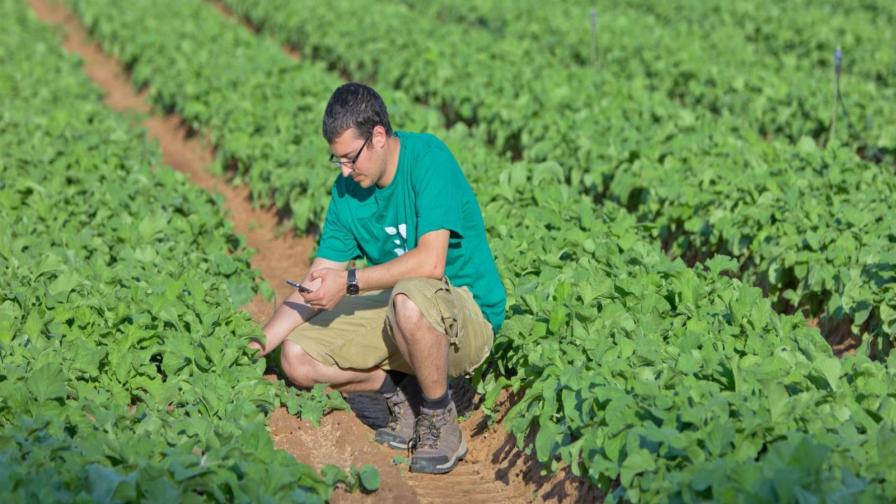
Before a field could be turned into pixels, probabilities and prescriptions, it had to be walked. Ofir Schlam learned this in northern Israel, where his family had grown cotton and wheat for four generations. At dawn, he would go into the cotton looking for pink bollworm, the sort of creature whose importance is wildly out of proportion to its dimensions. The job required patience, a notebook and the humility to accept that a whole field might hinge on evidence small enough to miss.
That early task supplied a durable education in agricultural risk. Trouble begins locally. Timing matters. Looking is expensive. A grower cannot treat every acre as suspect, but cannot afford to overlook the acre where a problem is beginning. The arithmetic is particularly unforgiving in farming, where small movements in yield can become large movements in profit.
Years later, Schlam would approach the same problem from the air. Taranis, the company he co-founded in 2015, came to use satellites, drones and low-flying aircraft to photograph fields, while machine-learning models sorted the images for weeds, insects, disease and nutrient deficiencies. The distance from a boy in a cotton row to an aircraft looking for a damaged leaf seems enormous. In Schlam's story, it is a straight line drawn through better instruments.
The first apprenticeshipTwo kinds of evidence
Schlam moved early in formal education, too. He began university-level mathematics and computer science at 16, and completed his bachelor's degree at Bar-Ilan University at 19 with summa cum laude honors. Public biographies also credit him with a master's degree in cryptography. The subjects sound remote from cotton, yet they trained the same reflex: a faint signal becomes valuable only when it can be separated from noise.
He then spent nine years in an elite technological unit, beginning as a software engineer and moving into project and research leadership. In his last role before Taranis, he managed a department of 15 software engineers working on classified projects. Details of the work remain, appropriately, unavailable. The visible consequence was an education in building systems where uncertainty could not be treated as a charming feature.
His professional profile records two Creative Thinking awards in 2008 and a Joining Hands award in 2013 for collaboration. It also lists a mentoring role, begun in 2009, with a program encouraging high-school students to learn programming. The combination is revealing without requiring mythology: the engineer valued both invention and the people required to make invention useful.
The useful wrong turnA forecast could warn. It could not point.
Schlam founded Taranis with Ayal Karmi, Eli Bukchin and Asaf Horvitz. Their early proposition centered on disease prediction using weather. It was sensible. Weather determines whether many crop threats flourish, and a sufficiently granular forecast could help a farmer prepare. The young company combined forecasting, models and field reports in pursuit of warnings tailored to particular places.
But sensible is not synonymous with sufficient. A forecast could indicate that conditions favored disease; it could not reliably show whether a specific plant was already affected. Satellite imagery supplied reach but often lacked the resolution and frequency the team wanted. The founders had built a good view of risk and discovered that customers needed a view of reality.
This was the productive wrong turn. Rather than defend the original idea, the team moved down in altitude and up in detail. Drones promised sharper pictures. Aircraft offered a way to cover substantial areas. Specially designed imaging equipment would have to remain stable at speed, capture plants clearly and feed an analysis system quickly enough that the answer arrived before the field had changed.
“We didn't know how it was going to be done... but we followed this protocol, and it just took time and got done.”Ofir Schlam, on building the early system
Money was no abstraction during this phase. Schlam has recalled that the founders were living from their savings before a seed round closed in February 2016. The story is less glamorous than the usual garage legend. A garage is only inexpensive real estate. The meaningful part is what happens when a team permits evidence to overrule the pitch deck.
The aerial paradoxFly high enough to see an insect
The engineering challenge contained a rather good joke: use an aircraft to inspect a leaf. Taranis developed imaging hardware for drones and small planes, then used computer vision to interpret the resulting abundance. The aircraft could cover ground faster than a scout. The camera could preserve fine detail. Neither mattered, however, unless the software could turn a flood of pictures into a short, credible list of places deserving attention.
From flight line to field decision
That demanded another kind of fieldwork. Agronomists had to label symptoms so the models could learn what weed pressure, insect damage or nutrient deficiency looked like crop by crop. In 2018, Schlam said the image database held about two million tagged symptoms. By the 2022 financing announcement, Taranis described a crop dataset containing more than 200 million AI data points. The camera collected evidence; agricultural judgment gave it meaning.
Schlam has been consistent about the purpose of all this machinery. A colorful picture is not the product. An adviser needs evidence that can support a conversation with a grower, narrow a scouting route or justify treating one part of a field rather than the whole thing. The critical interval is not simply from flight to report. As he explained in a discussion of mobile agriculture, it runs from the moment something happens in the field until someone acts to resolve it.
Growth, measured carefullyScale without losing the leaf
By 2020, the company described in Schlam's PrecisionAg award citation had grown from three people in a garage to 100 employees, with 19,000 customers and 20 million acres under management. Those figures capture reach, not the messier work beneath it: flight operations, cloud infrastructure, crop-by-crop training and the slow accumulation of trust across seasons.
Taranis expanded through agricultural retailers and crop-protection companies, organizations already woven into growers' decisions. It entered the United States, Brazil, Europe and other markets, and moved its global headquarters to Westfield, Indiana, while maintaining operations in Tel Aviv and Brazil. The geography joined Israeli software and imaging expertise to the commercial networks of row-crop agriculture.
Funding followed. A $30 million Series C in 2020 brought total capital at the time to $60 million. In September 2022, Taranis announced a $40 million Series D and said the new round brought total funding to $100 million. Schlam framed the case in practical terms: growers faced rising costs and needed crop intelligence at scale to improve productivity and yield. The grand language of feeding the world was translated into the decidedly less grand question of which patch needs attention on Tuesday.
Changing chairsThe founder after the CEO title
In January 2021, Schlam handed the CEO role to Bar Veinstein and continued as president and a board member. Taranis later appointed Opher Flohr chief executive in 2023. Founder transitions invite easy drama, but the public record suggests a conventional division of labor inside a company attempting to mature. Schlam welcomed operating experience for the next growth phase while staying close to innovation, product direction and partnerships.
The shift also placed an interesting punctuation mark in his story. Founders are often encouraged to identify so completely with the top title that giving it up can look like disappearance. Schlam did not disappear. As president, he spoke for the 2022 financing, signed the company's 2023-24 environmental, social and governance report, and publicly celebrated a multi-year Syngenta collaboration in 2024.
His stated ambitions have remained attached to the original problem: expand geographically, teach models to recognize more crop conditions and connect intelligence more directly to agricultural machinery. The ideal endpoint is not merely an alert. It is a system in which a detected problem can inform a precise response with fewer intermediate steps, less blanket application and a shorter wait.
What the machine preservesThe old job survives
Artificial intelligence is sometimes described as a machine for making expertise unnecessary. Taranis makes more sense as a machine for rationing attention. Agronomists still define symptoms. Advisers still weigh context. Growers still decide. The software changes where those people look first and how much ground their judgment can cover.
This may explain the coherence of Schlam's otherwise unusual résumé. Cotton farming, cryptography, classified engineering, aerial hardware and crop software all reward close observation under uncertainty. Each asks a version of the same question: which tiny piece of evidence matters enough to change the next move?
The boy in the field could inspect only the row in front of him. The founder can ask a fleet, a camera system and a bank of models to inspect millions of acres. Yet the standard of usefulness has barely changed. Somewhere, there is still a leaf. Something has happened to it. Someone needs to notice in time.