In October 2008, Ofer Ben-Shachar took a job he had already held. He became chief executive of the business descended from Noosh, the company he had founded ten years earlier. He had spent the intervening years on its board, helped arrange a merger and pursued other ventures. Returning meant taking responsibility again for something that had continued to change while he was elsewhere.
The timing gives the scene its edge. This was 2008, hardly a season when the business world was running short of surprises. Yet the announcement concerned an unusually practical enterprise: software and services for buying and managing print. Somewhere beyond the financial headlines, companies still needed to get their materials specified, ordered and delivered. Paper had declined to cancel its appointments.
The chair he left, the company he kept
Ben-Shachar’s first stretch as Noosh CEO ran from its founding in 1998 to 2002. Mike Gardner succeeded him, bringing experience in enterprise sales, marketing and customer care. Ben-Shachar stayed as chairman. The distinction matters: handing over the operating job did not end his involvement with the company he had started.
A founder’s biography usually makes departures seem definitive. Someone starts a company, sells it and moves along. Ben-Shachar’s connection to Noosh took a less convenient shape for the résumé. He remained involved through the 2005 merger with Newline Management, then returned to run the combined business, NewlineNoosh. The beginning and the comeback belonged to the same continuing relationship.
His career offers another measure of continuity, too: people who had worked with him once turned up again, or said they would. That is an interesting credential in an industry with ample supplies of funding announcements and considerably fewer candid accounts of what happens afterward. To understand the return, it helps to start with the earlier company, when the web itself was still becoming a workplace.
- 1995Co-founds NetDynamics
- 1998Founds Noosh
- 2002Hands over CEO role; stays chairman
- 2008Returns as NewlineNoosh CEO
Before the brochure, the browser
In 1995, Ben-Shachar, Doron Sherman and Zack Rinat started NetDynamics. Rinat later recalled an introduction through his wife and connections at the Jewish Community Center. The venture began with sublet space, volunteer employees and no outside money. A connection from Harvard Business School led Rinat to investor Mark Gorenberg of Hummer Winblad Venture Partners.
The account is appealing for its ordinary ingredients. There is no need to supply a theatrical garage. Introductions, a borrowed foothold and people prepared to work on an uncertain idea are quite enough. The technology concerned application servers, helping make the internet useful for corporate applications. It placed the founders close to the machinery through which businesses were learning to operate online.
Ben-Shachar brought an engineering background to that work. Washington State University’s February 1987 commencement program lists him among its computer science master’s graduates. At NetDynamics he served as chief technology officer and chairman. His connection to software building therefore preceded the better-known sequence of company formations and executive titles.
Sun Microsystems acquired NetDynamics in 1998. Ben-Shachar had already left earlier that year. The sequence resists a polished exit scene: the acquisition and the founder’s departure were separate events. In the same year, he founded Noosh, shifting his attention to another enterprise problem. The internet could connect businesses; now there was the question of what those businesses could accomplish together once connected.
When the market changed its mind
Noosh’s territory was print procurement. The work involved buyers and suppliers exchanging job requirements, estimates and bids, with communication extending to other participants in production. A print job carries decisions along with it. What is being made? Who is making it? Which version has been approved? The finished object can look wonderfully simple after everybody has stopped arguing about it.
This was a setting where software could give a common structure to work spread across several organizations. Noosh’s early customers included General Electric, Bank of America and Wells Fargo. Accel records its initial investment in 1999. The company was building during an era when businesses were trying to move transactions and relationships onto the web at considerable speed.
Then the market changed. In 2000, Noosh withdrew its planned public offering and reduced its workforce. Its marketing executive, Dave Hannebrink, explained the cuts as part of a focus on large customers. Those decisions belong in the founder’s story alongside the customer wins. A company can have recognizable clients and substantial backing while still needing to reconsider how it spends and sells.
The operating figures tell another part of that year. Noosh reported customer transaction volume of $3 million in the first quarter of fiscal 2000 and $24.1 million in the fourth. These were purchases processed through the service. They should be read as activity on the platform, rather than money the company itself booked as revenue. Keeping those two ideas separate makes the growth useful to understand.
In 2001, Whirlpool selected Noosh for collaborative procurement. Its creative and publishing operation had been exploring ways to coordinate advertising, design and printing partners for years. That history gives the contract some texture: the customer arrived with experience of the problem and of other tools. Selling enterprise software meant entering an existing working life, complete with previous attempts to improve it.
A search box and a difficult ending
Ben-Shachar’s next chapters included angel investing and RawSugar, where he was CEO and co-founder. The search venture put him alongside engineering leader Frank Smadja. It also reunited him with Bill Lazar, who had worked at NetDynamics. Moving between companies did not mean starting every professional relationship from scratch.
The technical interest was in organizing and finding information through topics. Ben-Shachar is one of five named inventors on a search-interface patent filed in 2005 and granted in March 2009. Its design allows a search to suggest topics that help a user refine the results. The topics do not have to begin in a fixed hierarchy. It is an engineer’s response to the familiar experience of knowing roughly what you want and discovering that the search box expects greater precision.
The business had a harder outcome. In December 2006, Lazar confirmed that RawSugar had run out of money and laid off its staff. He described disappointment that the product had failed to attract the active use needed for its next funding milestone. His account leaves room for both the quality of the team and the failure of the venture to secure its future.
What he said about Ben-Shachar was warmer. After working with him across two companies, Lazar would work with him again. That judgment came in a post about an ending, when there was little promotional advantage in offering it. It cannot change what happened to RawSugar. It does tell us something about how one colleague remembered the person who led it.
“would join him again in a heartbeat”
Bill Lazar, former NetDynamics and RawSugar colleague, 2006
A different company at the same address in his life
Meanwhile, Noosh had continued. Ben-Shachar and Peter Faucetta Sr. helped facilitate its merger with Newline Management in 2005. When Ben-Shachar returned as CEO in 2008, Faucetta continued as board chairman. The returning founder stepped into a business shaped by another company’s experience and by years of customer use.
That makes the comeback more substantial than a familiar name reappearing on an organization chart. Combining software with managed services introduces another set of working relationships. Customers need a system, but they also need the people and processes around it to function. The role had acquired new responsibilities since his first tenure, even as the underlying print-management problem remained recognizable.
In 2010, Cendris Print Management chose the Noosh system after evaluating requirements spanning the life of a print job. These included quoting, sourcing, delivery visibility, reporting and integration with other business systems. The detail is revealing. Enterprise software earns its place through the unromantic particulars that surface when somebody actually has to use it.
By 2014, Ben-Shachar was arguing that smaller service providers could use integrated project and procurement tools to serve large enterprise customers. That position extended the original coordination problem beyond a single buyer. Suppliers also needed ways to manage demanding work. A network of companies cannot become easier to work with solely by tidying one company’s desk.
HH Global acquired Noosh in 2021, with Mark Tiedens serving as CEO at the time. The business Ben-Shachar founded had reached another ownership chapter. Today its public site describes marketing execution across cost, quality, timing and supplier relationships. The vocabulary has broadened from print buying, while the business still addresses the practical task of getting many participants through a shared piece of work.
The other lane
There is a more cheerful way to meet the competitive side of Ben-Shachar. In July 2022, AnChain.AI co-founder Victor Fang described him as a rival at Palo Alto Masters swimming. Fang credited their competition with pushing his own technique and effort. Both had swum competitively as teenagers. Their celebration took place over dim sum, a sensible provision for people who have been working hard in water.
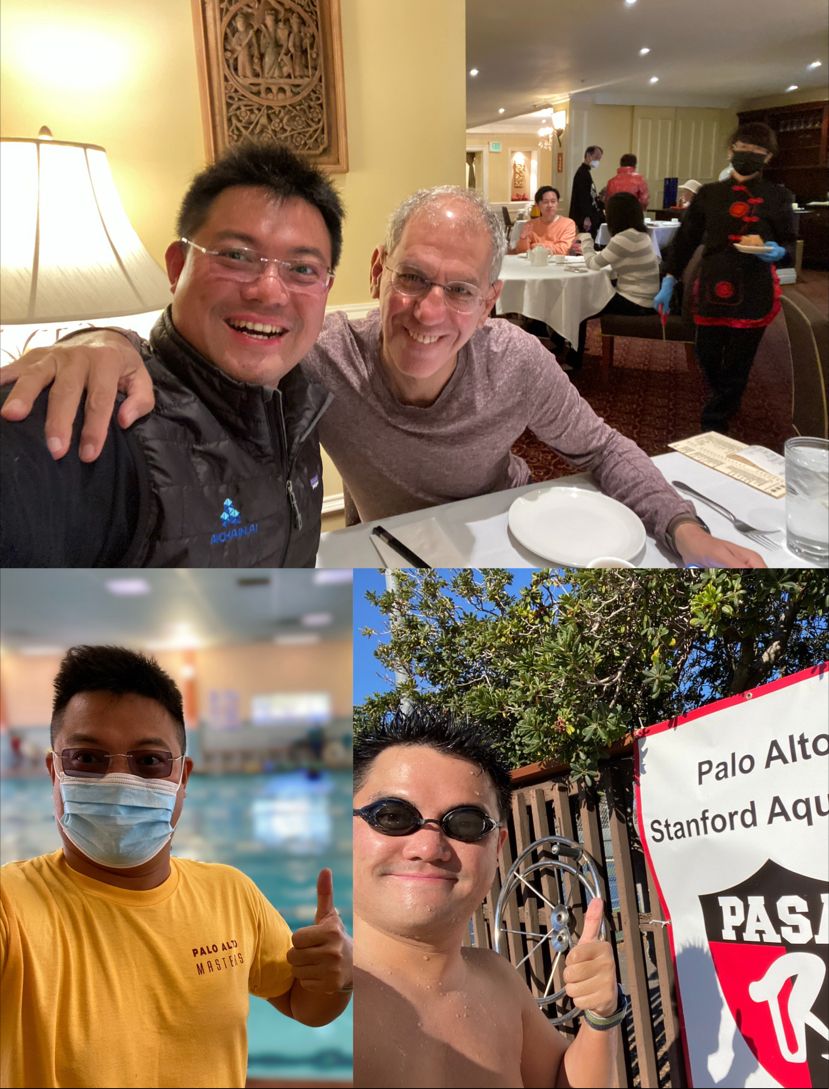
Another public glimpse places Ben-Shachar in the ordinary civic life of Palo Alto. In 2021, he urged the city council to keep downtown streets open to pedestrians and bicycles. His name also appears among the signatories of a cycling advocacy letter in an April 2025 city agenda packet. The local details put a home city around the international business career.
The restaurant photograph supplies an apt final scene. Here are two entrepreneurs enjoying a rivalry that gives them a reason to improve and another reason to meet. Ben-Shachar’s working life has involved acquisitions, succession, a failed venture and a return to an earlier responsibility. Alongside those events run the longer relationships: colleagues willing to try again, partners who keep working together, a friend in the next lane. They make a career feel inhabited.
Follow the connections
- Ofer Ben-Shachar on LinkedIn ↗
- Facebook profile ↗
- Noosh website ↗
- Zack Rinat: Who Dares, Wins ↗
- The 2008 return to NewlineNoosh ↗
- Bill Lazar on RawSugar’s ending ↗
- Noosh’s fiscal 2000 transaction figures ↗
- The 2001 Whirlpool agreement ↗
- Topic-directed search patent ↗
- Victor Fang’s swimming story and photograph ↗
- HH Global’s 2021 acquisition announcement ↗
- Palo Alto cycling advocacy, April 2025 ↗