Before there were billions of transactions, there were logos. Oban MacTavish was in Vancouver, helping fintech founders with the sort of work that pays the bills between companies: pitch decks, market research, whatever needed doing. Their complaints kept returning to the same subject. The transaction data was bad. He and Cooper Hart began with a small proposition: give a payment a recognizable merchant logo. MacTavish worked in Photopea, a free image editor. Somewhere inside a future financial infrastructure business was a person doing the digital equivalent of cutting out pictures.
The beginnings are instructive because the finished product looks so effortless. A familiar name beside a purchase can conceal considerable labor. Someone has to establish which business took the money. Someone has to connect that business to a record a computer can use. For MacTavish, each apparently small task led to a larger question about what a bank actually knows.
A restaurant job, then a different kind of stake
Finance arrived early. MacTavish grew up in Vancouver and spent part of his childhood in San Francisco. Around thirteen or fourteen, he began paper trading, rehearsing stock-market decisions without putting money at risk. At sixteen he took a restaurant job so he could buy real stocks. Many teenagers use their first wages to purchase something they have been admiring. His purchase happened to be a stake in a business.
He studied finance at the University of British Columbia. Summer work at a Bay Area software company gave him another view of how businesses operated. The conventional route was available in his imagination: investment banking, perhaps followed by a hedge fund. He chose to help start a company after graduation instead. Choosing investments had given way to the considerably less tidy activity of creating something worth investing in.
That first venture was Hubly, software for wealth managers. His responsibilities included business strategy and distribution. It offered an education that a finance syllabus could only approximate: persuading people to buy, working with co-founders, deciding how a company might make money. He eventually left and began consulting. Hubly belonged to his experience; it did not have to be the destination of his career.
There is an appealing lack of inevitability here. The teenage investor did not march directly into payments infrastructure with a master plan. He followed an interest in businesses, tried building one, then listened to other founders describe a problem. The detour supplied the next idea.
The friend who could write the code
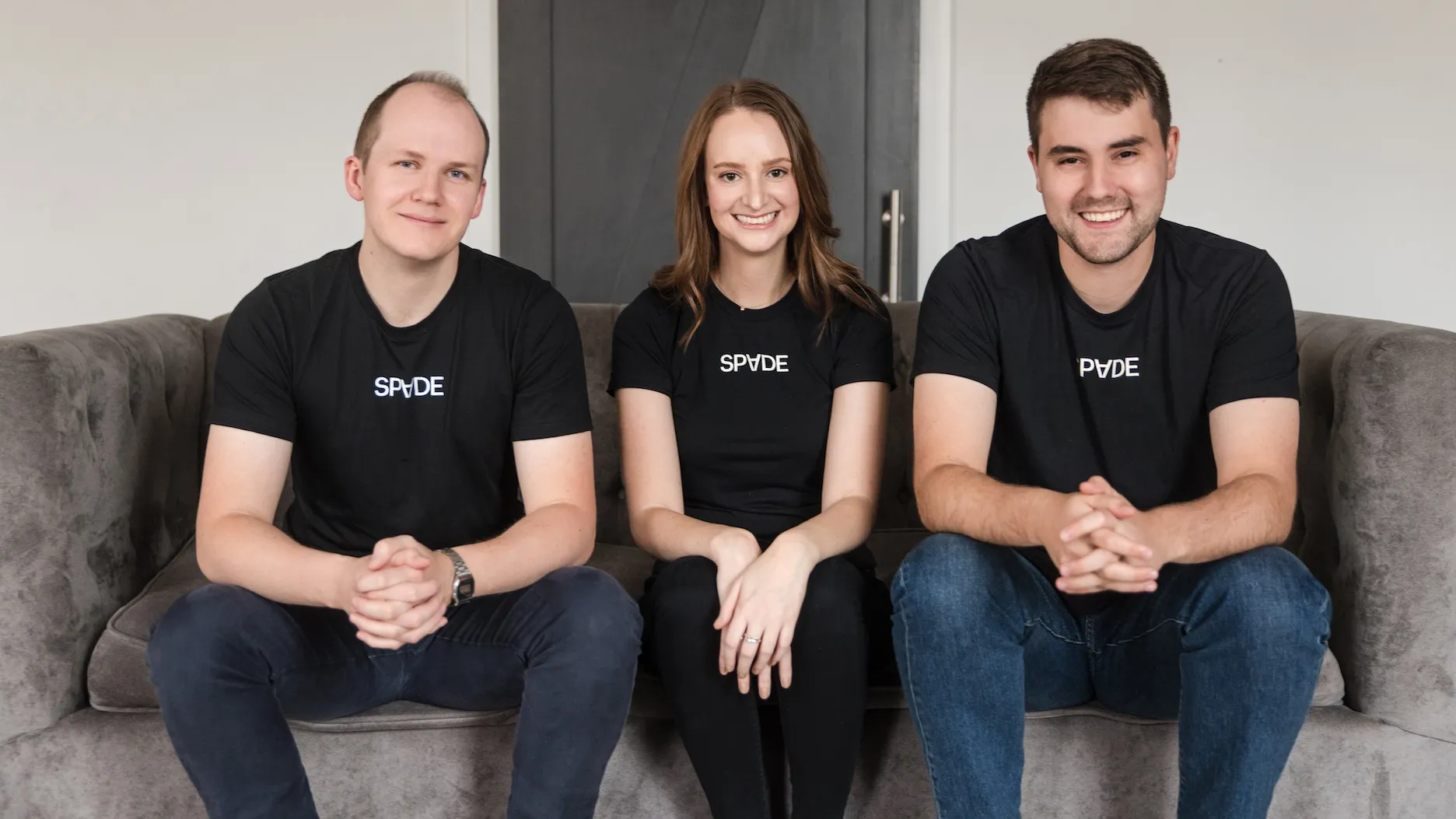
Hart was already part of the story. He and MacTavish had taken programming classes together in high school, including Advanced Placement Computer Science. Hart pursued mathematics and computer science; MacTavish pursued finance. Hart became an early engineer at Hubly and, later, Spade’s technical co-founder and CTO. Tess Bloch joined them as a co-founder and became COO.
Asked about finding a co-founder, MacTavish has joked that attending high school together is a convenient method. It is also rather difficult advice to act on retrospectively. He readily acknowledges the luck involved. “There is some dumb luck,” he says. The friendship explains how the two knew each other. Their different disciplines help explain what they could do together.
MacTavish is equally willing to puncture the idea that every technology CEO must secretly be a production programmer. He has tried coding and leaves the serious technical work to others. That candor gives the partnership its proper proportions: a person can understand a problem, sell a solution and help build a company without pretending to possess every skill inside it.
A merchant is more than a line of text
Spade was founded in 2021 and joined Y Combinator’s Winter 2022 batch. The company’s central choice was to build an understanding of merchants and match transactions against it. A logo was one visible result. The business identity underneath it could support much more consequential work.
The distinction becomes clearer when you consider the journey of a card payment. Several organizations pass information along. The descriptor has limited room. Names are shortened; categories can be broad; location fields may contain something other than a useful location. A transaction can successfully move money while leaving the recipient surprisingly difficult to identify. The payment system has completed its job, and an accountant’s detective shift is just beginning.
Spade’s approach required a substantial collection of business records. Its early team researched merchants and built matching rules. Breadth became a practical constraint. MacTavish’s team had scraped roughly half a million to a million locations before working with SafeGraph to obtain access to millions more. Owning a useful answer did not require personally collecting every fact that went into it.
“We had our own data but it was just not as broad as we needed.”
Oban MacTavish
That admission is a small window into his work. The question was whether the data would serve the customer. A vendor relationship could improve the answer. There was little point in making a virtue of doing everything the hard way once the hard way had stopped being useful.
Category code
Partial context
Category
Location, when available
Rewards
Accounting & analysis
When the customer became a bank
By December 2023, MacTavish was describing a push toward larger American bank customers. Spade had announced a $10 million Series A led by Flourish Ventures. Selling a bank on infrastructure presents a different challenge from convincing a founder to try an API. The product has to fit an institution’s operating needs, and the consequences of a mistake extend beyond an unattractive screen.
The applications help explain the move. Mercury used Spade’s merchant information for its corporate card program, including transaction categorization and spending controls. A business can distinguish different kinds of expenditure more reliably when the merchant behind the charge is consistently identified. A card restricted to particular merchants also needs something more dependable than a passing resemblance between two names.
In February 2025, Spade announced a partnership with Stripe Issuing to supply enriched merchant data. Names, logos, categories and locations could reach people building card products through an existing platform. For MacTavish, this was distribution with a technical consequence: the useful information could become part of someone else’s everyday workflow.
The unifying idea is simple enough to survive the industry vocabulary. Identify the business properly, and several jobs become easier. A reward can go to the right purchase. A finance team can spend less time untangling an expense. A risk team can examine better evidence. The plainness of the result is rather the point.
Spade’s reported p99 enrichment latency in March 2026. A processing measure, rather than the total time a payment takes.
The next question costs $40 million
On March 24, 2026, Spade announced a $40 million Series B led by Oak HC/FT. MacTavish and Bloch described a company moving beyond returning enriched records toward tools that help customers act on them. The capital would support the team, merchant coverage and the platform’s capabilities.
Spade reported 470 percent revenue growth in 2025 and peak daily processing volume of 1.9 billion transactions. Those are company figures, and the distinction between a peak and an ordinary day matters. They nevertheless describe a very different operating problem from editing the first logos. Growth creates its own workload: keeping a service dependable while more customers put it inside their decisions.
MacTavish’s current interest in AI follows from that foundation. He wants banks to use their information to understand customers and offer more relevant products. In October, Spade introduced Predictions, a product suite built on a transaction foundation model. His stated market includes institutions that cannot devote the resources of a giant bank to developing such tools internally.
It is a larger promise, with a familiar dependency. Anticipating what might happen next depends partly on understanding what has already happened. A model supplied with a confused account of a purchase begins with a confused account of the customer. MacTavish has found a new audience for an old insistence: establish what the transaction means.
There is still dinner to make
Away from the company, MacTavish likes cooking. He has described making a meal while his wife handles dessert, and remembers having more time in college for elaborate experiments and long braises. Work and walking the dog impose less romantic limits on the available hours. Even a person professionally occupied with milliseconds must occasionally wait for dinner.
His reading offers another clue to his interests. He has recommended Edward O. Thorp’s A Man for All Markets, drawn to its account of a life spent taking on varied, difficult challenges. The attraction is easy to understand alongside his own movement from investing to software and then payments. Different fields present different rules to learn.
MacTavish describes payments as a human-created environment, with participants responding to rules and incentives. He also emphasizes curiosity about why those arrangements exist. “I really try to remain curious,” he says. An outsider can spot something awkward. Understanding why it persists requires a longer conversation.
That is a useful place to leave him: interested, still learning, with another question to ask. Spade’s ambitions now reach well beyond a logo. Yet the first task remains recognizable. Work out who took the payment. Make that knowledge useful. Repeat until the customer can stop thinking about the machinery and get on with the day.