There is a small comedy in the modern IT department. It can tell the marketing team which campaign won, and finance which product lost money. Ask it how many outages followed last month’s software changes, how much those outages cost, and which team absorbed the work, and the answer may be scattered across half a dozen systems. Numerify was founded to collect those pieces before another meeting ended with a spreadsheet promised for Friday.
- Numerify sold cloud analytics built specifically for enterprise IT teams.
- Its software joined service tickets, development work, assets, and financial records under common definitions.
- Named customers included Netflix, InComm, the University of San Francisco, and later McDonald’s.
- After roughly $88 million in reported funding, Digital.ai acquired the company in 2020.
The cobbler’s children, finally measured
Gaurav Rewari had managed analytics products at Oracle. There, he had seen the appeal of prebuilt business intelligence: connectors, models, and reports delivered together, instead of a visualization tool placed on top of a long and expensive integration project. As business software moved into the cloud, the source systems multiplied. Rewari and fellow founders Srikant Gokulnatha, Sadanand Sahasrabudhe, and Pawan Rewari saw an opening.
They considered several business functions before choosing IT. The decision had a pleasing irony. Technology teams had spent years bringing data discipline to sales, marketing, and finance, but their own planning, building, and running lived in different tools. A service desk knew about incidents. A development platform knew about changes. A finance system knew the budget. A monitoring product knew a server was struggling. None alone knew the business story. Rewari later described the situation as the cobbler’s children having no shoes.
“It was as if the cobbler’s children had no shoes.”Gaurav Rewari, describing IT’s analytics gap in 2019
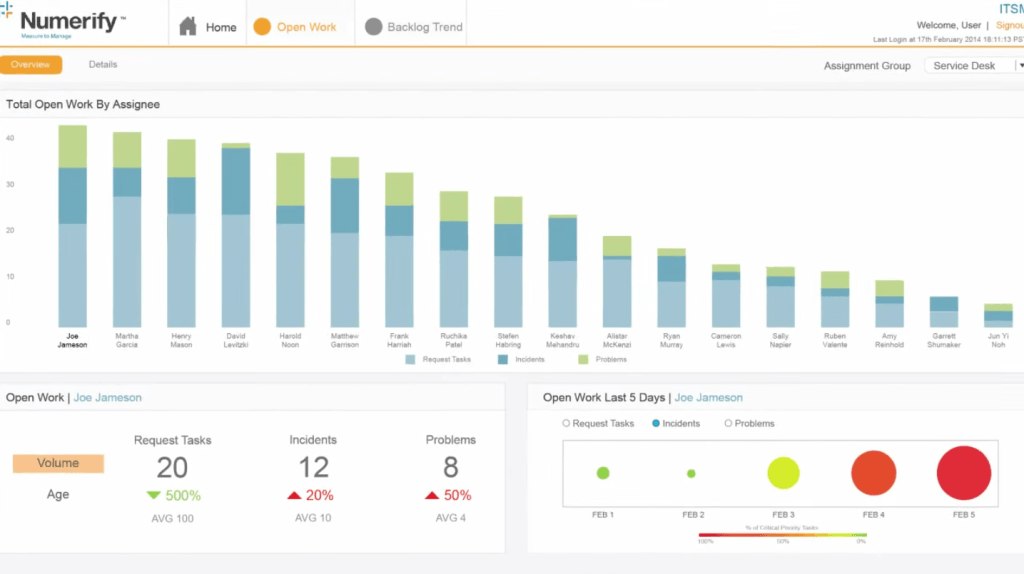
Numerify’s answer was Numerify360, a cloud platform with packaged analytical applications. It brought records from those operational systems into a shared model, then supplied metrics, dashboards, and eventually predictive analysis. A manager could trace an ugly stack of service tickets back to a change, compare one application’s incidents with its cost and usage, or see whether a provider was meeting a service commitment. The software did not repair the system itself. It gave people a better account of where to start.
The plumbing was the product
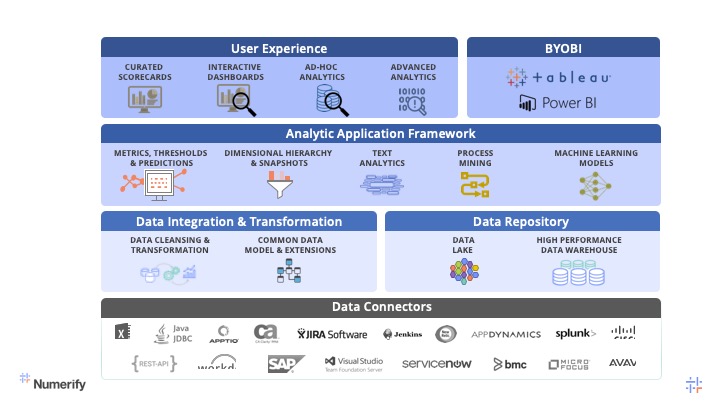
A typical BI tool could draw a handsome chart from clean data. Numerify’s wager was that cleaning and joining the data was the expensive part. It shipped connectors and a common vocabulary for IT concepts such as incidents, problems, changes, assets, and projects. Its applications arrived with ready-made measures for service delivery, project portfolios, development, and asset management. Customers could extend the model where their own processes demanded it.
tickets
changes
cost
→ decision
That mattered in organizations whose systems changed through acquisitions, vendor swaps, or a new software release. A useful incident report should survive the replacement of the service desk tool that produced it. Numerify’s approach separated the definition of an IT object from a particular source application. It was an unglamorous advantage, which is often where enterprise software earns its keep.
The earliest public proof was practical. In 2014, Numerify named more than a dozen enterprise customers, including Netflix, the University of San Francisco, InComm, and Spansion. Netflix said it had moved from painful manual reporting to presenting and validating data within weeks. InComm called it a natural extension to its ServiceNow environment, useful for trend analysis and for escaping heavy Excel manipulation. These were customer statements in a company announcement, not independent performance trials, but they reveal the job buyers hired it to do.
A ticket is never just a ticket
Consider a wave of password resets after a software update. The service desk sees a busy morning. A manager sees rising labor cost. Employees see lost time. If each system is read alone, the response may be to hire more agents or close tickets faster. Read together, the records can suggest a less theatrical fix: change the update process. Numerify’s pitch was to connect that cause to its operational and financial consequences.
Its 2019 Continuous Service Optimization release focused this idea on IT service management. It promised to find drivers of incident volume, costly escalations, and service risk, with the company claiming actionable insights in six weeks. That was a vendor target, not a guarantee. The payoff would depend on usable source data, stable definitions, and staff willing to change a process after a dashboard exposed it.
Numerify also made room for machine learning. It analyzed change risk and service health, using the combined history to predict which actions might cause trouble. The 2018 round of $27.5 million, led by DAG Ventures, was explicitly earmarked for more enterprise customers and more AI capabilities. By then the company said software subscription bookings had more than doubled over the preceding year. Numbers such as these describe momentum, though they do not reveal revenue or profit.
The bill for a better picture
The company raised an $8.25 million Series A, $15 million Series B, $37.5 million Series C, and $27.5 million final round: roughly $88 million in all. Those are Numerify’s financing costs, not what a customer paid. Public subscription prices are not established here. For a buyer, the real comparison was between an enterprise subscription plus integration work and a custom analytics project staffed with engineers, consultants, and a patient CIO.
A Numerify-commissioned Forrester Consulting study in 2019 modeled a 214 percent return over three years and payback in less than three months for its interviewed customers. That figure is best read as a scenario built from selected deployments, not a promise to every IT department. The underlying question remains useful: do fewer incidents, less manual reporting, and better vendor oversight return more than the subscription and implementation cost?
Start with one recurring operational question. Link the ticket, change, and cost records needed to answer it. Agree on a definition of the service before drawing charts. Measure whether the answer changes a decision.
The acquisition completed the argument
In June 2020, Digital.ai bought Numerify alongside testing company Experitest. The buyer described Numerify’s analytics engine as a central part of its value stream platform, joining data across the software delivery lifecycle. Financial terms were not disclosed. McDonald’s, named in the announcement as a long-standing Numerify customer, said it intended to explore the broader platform. Numerify’s standalone brand gave way to Digital.ai, but the logic of its product was enlarged: connect development and operations data to the business result.
That logic also marks the limits of the idea. If records are incomplete, if one department calls the same application by a different name, or if the team has no authority to fix what the analysis finds, a more elegant dashboard will simply report confusion in better type. Numerify’s distinctive insight was to treat the shared data model as the thing to buy. The amusing part is that IT already knew how valuable that was. It had been building it for everyone else.