The most dangerous spreadsheet in a community bank is rarely the one with an obvious error. It is the handsome one: the monthly report that arrives on time, uses the familiar colors and quietly disagrees with the report reviewed two doors down. A loan can be current in one system, past due in another and buried in an email attachment by lunch. The bank has data everywhere. What it lacks is a shared version of now.
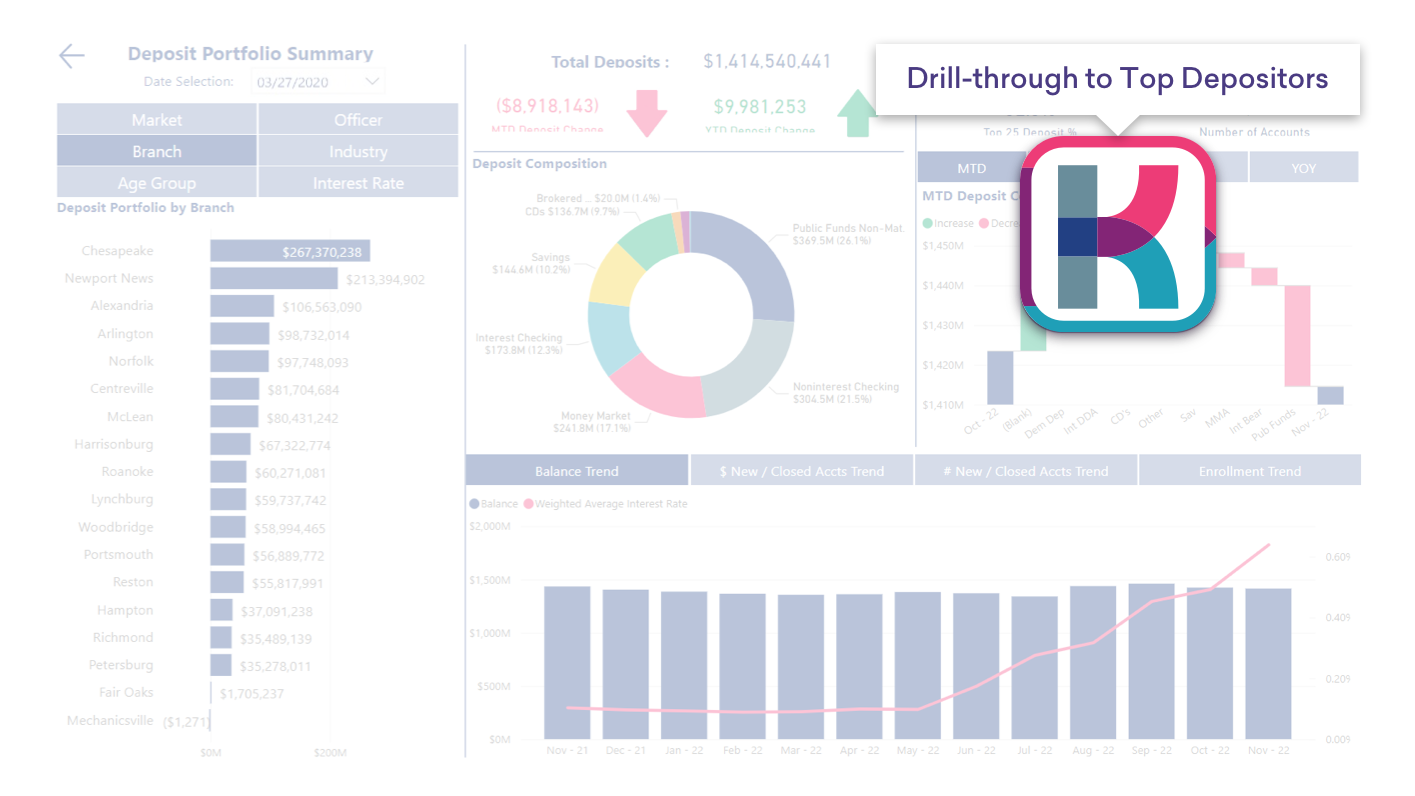
KlariVis built a company in that gap. The Roanoke, Virginia, software maker pulls information from bank cores and ancillary systems, cleans and organizes it, then serves it through interactive dashboards and recurring reports. Executives can follow deposit movement. Lenders can monitor past dues and concentrations. Finance teams can work from current balance sheets. Boards can receive reports without sending the staff on a monthly scavenger hunt.
This sounds like business intelligence, and it is. The difference is specificity. KlariVis does not ask a community bank to invent its data model from scratch or teach a general-purpose dashboard what a loan officer needs to see. The product arrives with banking logic, integrations and hundreds of prebuilt views. Its promise is less “look at this chart” than “everyone can finally argue from the same number.”
The failure came before the company
Founder Kim Snyder did not discover the problem from a fintech pitch deck. She met it as the CFO of a publicly traded community bank. Her team competed with national institutions while running lean. The bank's core held one part of the truth; lending, finance and customer systems held other pieces. Producing an answer meant exporting files, matching fields, writing reports and hoping a definition had not drifted.
The first thing that failed was not the bank. It was the reporting workflow. Manual work could generate pages of information but still leave managers waiting for an actionable answer. Snyder initially treated that frustration as a local defect - a “my bank” problem. Conversations with other bankers changed her mind. The same maze appeared almost everywhere: siloed systems, stale reports, fragile spreadsheets and a dangerous dependence on the employee who knew how the workbook worked.

Snyder founded KlariVis in 2019 and launched it nationally in January 2020. Six months later the company closed a $2.5 million seed round, largely from Roanoke-area angel investors. In January 2024, after reaching its 100th customer, it raised an $11 million Series B led by Blueprint Equity. By 2026, KlariVis said it had completed more than 150 financial-institution implementations.
“Having KlariVis makes us feel like a big bank even though we get to be small.”Jill Castilla, president and CEO, Citizens Bank of Edmond
What KlariVis actually does
A useful way to understand the platform is as a translation layer. Banks rarely get to wipe away their technology estate and begin again. KlariVis connects to the systems already there, consolidates the records and applies consistent definitions. It then distributes that cleaned information through executive, sales, credit, finance and board-reporting views. The company says it works across bank cores and allows unlimited users within an institution.
Its 2025 Transactional Intelligence release, developed with FinGoal, moves deeper into the messiest part of the ledger. A raw transaction description is often cryptic. Enrichment can identify the merchant or channel, group behavior and show whether money is moving to a competitor. A banker can then spot a payroll shift, an external loan payment or a pattern of outflows and decide whether a customer conversation is warranted.
The proof is in changed routines
Software case studies are usually polished until they squeak. The useful KlariVis claims are the ones tied to a habit. FVCbank's published case study says implementation finished within 90 days and employees could begin working in the platform after ten minutes of training. The bank reported a 75 percent reduction in past-due loans, 60 hours a month removed from ad hoc reporting and ten hours a month saved compiling board reports.
Benchmark Community Bank offers a second, different test. It put KlariVis in place before a core conversion, which meant reporting did not have to go dark while the underlying system changed. An American Bankers Association case study credits the bank's wider operating changes with roughly 40 basis points of margin expansion. The careful reading is that a dashboard did not manufacture margin by itself. Faster visibility helped humans make and measure a series of pricing, deposit and balance-sheet decisions.
That distinction matters. KlariVis is not an autonomous bank manager. It shortens the distance between a signal and a person empowered to act. If the lending team reviews past dues daily instead of monthly, a deteriorating account becomes a conversation sooner. If deposit outflows are visible by customer and branch, retention stops being a quarterly autopsy.
Where it sits in the market
KlariVis sells vertical SaaS to banks and credit unions. It does not publish a rate card; sales run through demos and proposals. The package is broader than a software login: integration, implementation, banking-specific content and continuing support are part of the proposition. Unlimited users reduce the temptation to ration access to a small analyst group.
The alternatives include internal data warehouses, Microsoft Power BI or Tableau projects, core-processor reporting and bank-focused vendors such as Abrigo, Syntellis Axiom, nCino and Q2's analytics products. KlariVis's wedge is not that nobody else can draw a deposit chart. It is the accumulated judgment about which data to reconcile, which views bankers repeatedly need and how to get an institution using them without a three-year construction project.
The timing is favorable and awkward. Banks want AI, predictive tools and natural-language analysis. Those features are impressive until the same customer exists three ways across the source systems. In July 2026 KlariVis named Marcos Souza chief data and analytics officer and moved Guy DeCorte into a dedicated chief AI officer role. The division is revealing: the company is pursuing AI while arguing that clean, governed data must come first.

The playbook worth stealing
A bank does not need to buy KlariVis to copy the best operating idea behind it: treat analytics as a decision system, not a museum of charts. Start with a recurring decision and work backward to the minimum trustworthy data. Then make the view available to the person who can act, on the rhythm at which action is useful.
The cost question should also be framed broadly. A subscription is visible. The hours spent reconciling files, the delay before a risk reaches a lender and the key employee who alone understands a report are less visible. KlariVis wins when a bank can attach those costs to an operating result. “We need better data” is weak. “We spend 60 hours a month producing reports that arrive too late to change the outcome” can fund a project.
KlariVis will not rescue a bank that refuses to reconcile definitions, assign data owners or change its meeting habits. Clean delivery is useful only if managers trust the numbers and employees have permission to act on them.
It may also be a poor fit for an institution with a mature internal data platform, specialized modeling needs and the team to maintain them. And transaction insight without clear privacy, security and governance controls is a liability, not an advantage.
From dashboards to an intelligence layer
KlariVis is already testing what comes after the single-bank dashboard. In early 2026 it analyzed more than 225,000 Coinbase-related transactions across 92 community banks. Among the institutions where transaction direction could be determined, the company reported $2.77 leaving for every dollar returning. The analysis moved KlariVis from helping one bank understand itself toward using anonymized, cross-institutional patterns to show what no single community bank could see alone.
That is the larger bet behind the new data leadership: turn a collection of cleaned bank records into an intelligence layer for smaller institutions. It is technically and politically harder than dashboards. The data must be protected, comparisons must be responsible and the conclusions must survive scrutiny. But the advantage is clear. A $5 billion bank cannot reproduce the view of a network on its own.
For now, the company's most convincing achievement remains more ordinary. It found a painful workflow, learned it from the inside and packaged the fix so another bank would not have to become a software company. The chart is what users see. The product is the confidence to make Tuesday's decision on Tuesday.