In Greenhouse’s setup guide for Noon AI, a recruiter encounters a small disagreement. The software wants to reject a candidate. The recruiter thinks the candidate deserves a conversation. There is a button for overriding the decision, followed by a request for an explanation. In that unglamorous exchange sits the interesting part of Noon’s proposition: a recruiting system can learn something useful from being told it is wrong.
- The work: find candidates, evaluate fit, send outreach, and arrange interviews.
- The twist: feedback teaches the agent what each hiring team values.
- The buying decision: test shortlist quality and time saved on a real role.
A job description looks precise until two people start interpreting it. How much experience counts as enough? Does a prestigious employer matter more than an unusual career path? Which missing qualification is fatal? Noon, the New York recruiting platform operated by Portal Inc., puts those judgments into a continuing feedback loop. The pitch is software that keeps looking while the recruiter does something else.
A rejection becomes an instruction
Noon calls its sourcing system Autopilot. A team defines a role, separates must-haves from preferences, and reviews the people the agent finds. The current product description says thumbs-up and thumbs-down decisions calibrate recommendations for that specific role. Change the criteria and previously sourced candidates are evaluated again. Strict requirements stay strict; secondary filters can loosen when the pool runs low.
The distinction matters. A location requirement and a preference for someone from a particular kind of company should behave differently. Treat both as rigid and the shortlist may vanish. Treat both as optional and the shortlist may become useless. Noon’s design gives the team a way to express that difference, then correct the agent with examples.
One rule. A different shortlist.
Everyone shown meets the required skill. Toggle the location rule to see how a must-have changes eligibility.
That does not settle whether a preference is sensible. A model learning from recruiter decisions can learn the team’s blind spots too. The practical discipline is to make the criteria explainable before asking software to repeat them. A thumbs-down accompanied by a useful reason teaches more than a hiring manager’s unexplained feeling that someone is “not quite right.”
The shortlist has somewhere to go
Finding a person is one task. Getting a reply is another. Noon’s outreach agent reads a candidate’s background, drafts a personalized introduction, and runs email and SMS sequences. Its Coordinator handles questions and books interviews through Calendly. The product suite also includes a voice interviewer, interview transcription, inbound application screening, and searches of the candidates already sitting in an applicant tracking system.
Network sourcing adds a nicely human wrinkle. Noon maps professional connections and points to the colleague who could make an introduction. The October 13, 2026 changelog describes teammate-overlap information and a way to ask colleagues about candidates through Slack. An automated search can therefore end with an old recruiting move: asking someone whether they know somebody.
- 01Define
the bar - 02Find +
evaluate - 03Contact +
schedule
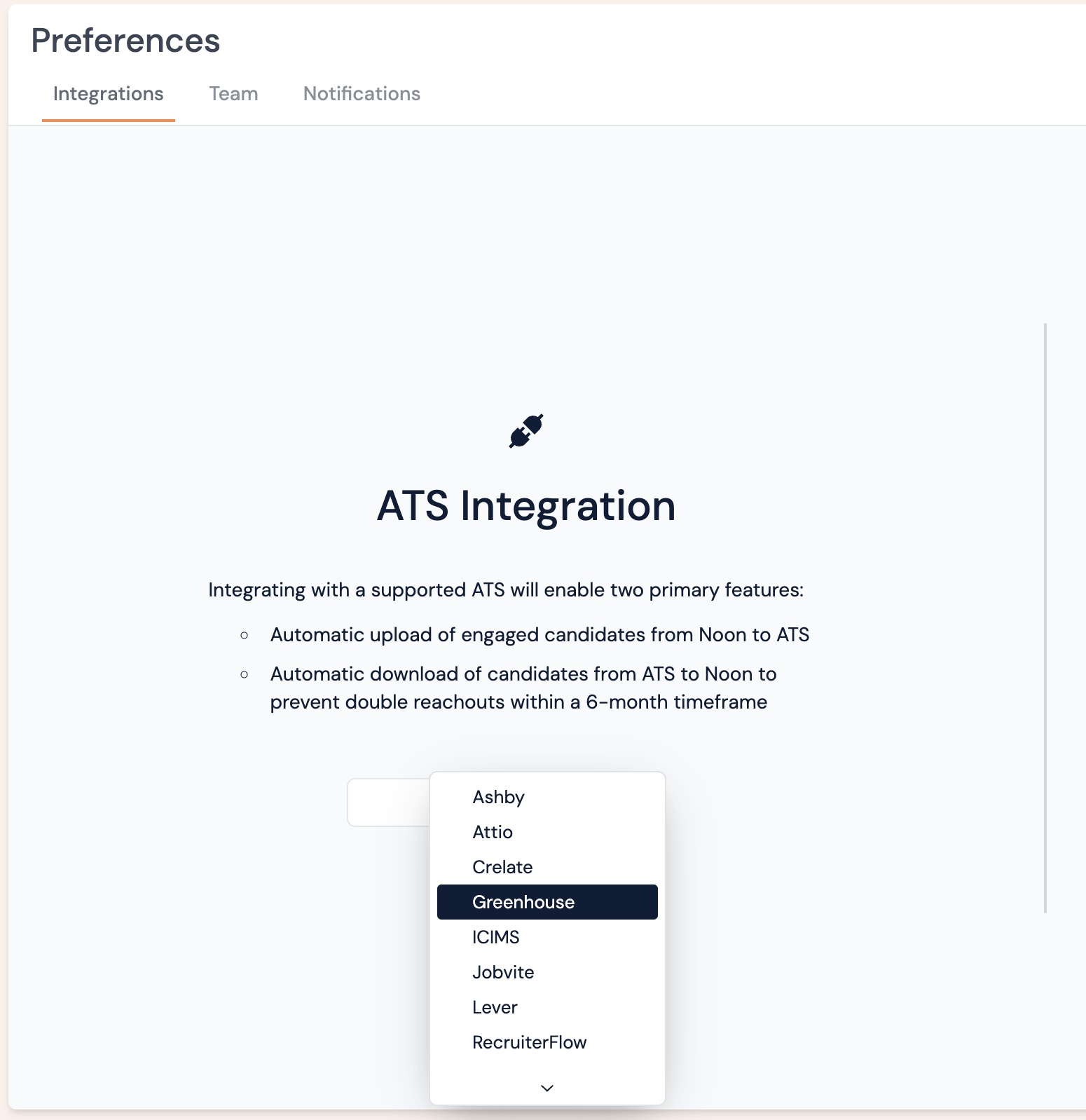
These connections explain where Noon fits. The existing ATS remains the recruiting record. Noon does the searching and follow-through around it. Greenhouse documents the integration, Gem lists Noon as a technology partner, and Cluen announced an Encore connection in May 2026 for executive search users. For a buyer, the consequence is straightforward: candidate history should travel with the work.
The audience spans internal talent teams, founders, staffing firms, and executive search businesses. In a public post, Counsel Health’s Michael Brown described automating most sourcing and initial outreach through Noon, integrated with the company’s ATS. His account said this covered work that would otherwise have required a dedicated sourcer in the first month. That is one team’s experience, with a particular workload and hiring setup.
“I’d say this replaced what would’ve been a dedicated sourcer need in month one.”
Michael Brown / Counsel Health
The price of an hour back
Noon sells a quoted subscription. Its pricing page advertises one plan with unlimited seats, sourcing, contacts, enrichment, and agents. The contract still matters: the terms retain fair-use provisions and allow limits in an order form. The comparison with recruiter-operated search tools such as LinkedIn Recruiter is therefore partly about how much work the subscription performs after the search begins.
The company’s 10× guarantee makes the economics unusually explicit. It measures estimated recruiter time saved over an annual subscription, valuing that time at $60 an hour. It is a labor-saving calculation. A filled job and a successful employee are different outcomes, and should be measured separately.
recruiter hour saved
Time saved × $60 = modeled labor value.
The guarantee target is 10× annual subscription value, capped at $1 million.
Eligibility requires active use: a user logging in on three separate days each week, a new role or search each week, and working integrations. Two nonqualifying months are permitted; a third ends eligibility. A team facing a long hiring freeze should read that closely. The guarantee rewards sustained use, and the subscription’s value depends on having useful work for the agent.
Give it a role you already understand
The sensible test starts small. Choose a difficult role your team knows well. Write down the requirements that cannot move. Review a batch together and explain disagreements. Track the share of candidates worth contacting, the replies that become interviews, and the recruiter hours spent getting there. Compare those results with the process you already use.
Noon’s appeal rests on making recruiting judgment reusable. That requires a team willing to articulate its judgment, enough reliable information to evaluate candidates, and a hiring process that can act on the results. If those pieces are missing, faster sourcing can simply produce a faster pileup. The promising moment remains that little disagreement in the setup guide: someone explains why a candidate deserves another look, and the next search has a chance to improve.