Most startup origin stories depend on a flash of insight, two exhausted friends and an origin myth polished long after the fact. Nobody Studios would prefer a process diagram. The California venture studio starts with problems, runs cheap tests, builds products and recruits operators around the survivors. Its stated ambition - 100 companies in five years - sounds like bravado until you notice that quantity is also the experiment. More attempts create more evidence. More evidence should make the next attempt less naive.
The studio is not a conventional venture fund. It does not mainly wait for founders to pitch finished ideas, write minority checks and observe from a board seat. Nobody Studios says it creates companies from inside the studio, often owning more than 80 percent at the beginning, then supplies shared technology, product, marketing, operations and fundraising. Leadership can be added as a venture becomes more autonomous. The parent remains a large shareholder and seeks a return when companies spin out, raise, generate cash or sell.
That distinction explains the odd breadth of the portfolio. Evalify scans intellectual-property data for patent risk. Ovationz books speakers for short virtual appearances. Sleep Glide promises individualized sleep recommendations. Webdelics teaches people about psychedelics and plant medicine. LootHoundz helps identify forgotten collectibles. This is not a neat sector thesis. It is a claim that the same machinery can repeatedly cross from problem to product, even when the customers and regulations change.
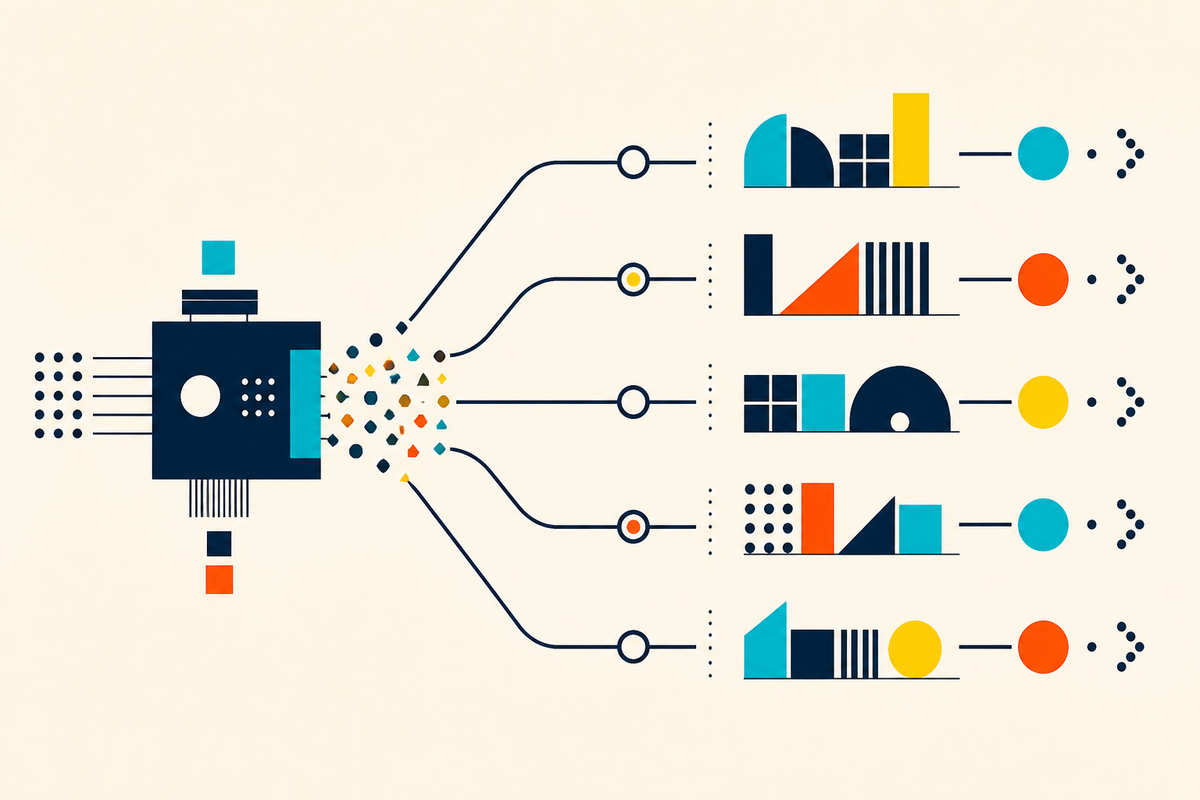
The product behind the products
The useful way to understand Nobody Studios is to stop treating each portfolio company as the main event. The studio itself is the product: a reusable collection of people, software, judgment and distribution. A traditional startup pays to assemble those pieces once. A studio hopes to amortize them across many ventures, preserve the lessons when one fails and move talent to the next promising problem.
The repeatable venture loop
Founder Mark S. McNally reduces the selection test to three questions: Is there a market? Can the team build something that solves the market's problem? Does it know how to sell? The formulation is almost aggressively ordinary. That is its strength. It makes a venture answerable to customer behavior before anyone falls in love with the story.
Is there a market? Can we build a product that solves that market's problem? And do we know how to sell it?Mark S. McNally, founder and Chief Nobody
In 2026, the studio added a more explicit sensing layer. Its AI Partner Network counted 56 selected consultants, engineers, product leaders and operators across 186 documented projects. These people work close to customer problems in health care, financial services, compliance, logistics and other fields. Their repeated observations can become venture leads. The network is less interesting as a community total than as an information advantage: client work produces signals, signals create hypotheses, and the studio can test those hypotheses with shared resources.
The cleanest proof is a patent check
Evalify is the portfolio company that best explains the current thesis. Early patent diligence can involve long searches, specialist attorneys and five-figure bills. Evalify uses AI and a large intellectual-property corpus to produce a preliminary freedom-to-operate analysis. Nobody Studios said in July 2026 that work previously requiring 10 to 20-plus hours and more than $10,000 could be completed in about 15 minutes for $249.
The qualifier matters: preliminary analysis is not a legal opinion. But the product does not have to replace a patent lawyer to be useful. It can help a founder, investor or patent professional decide where expensive attention is justified. That is a classic software wedge - compress the first pass, lower the price of asking and reserve expert time for ambiguous cases.
Evalify came through Adjacent Possible, an intellectual-property venture studio that joined Nobody Studios in 2023. By 2026, Evalify had formed a working advisory board of patent, legal-technology, AI and go-to-market specialists. The group was described as hands-on, opening doors to law firms, partners, investors and potential acquirers. It is a small example of the parent studio's promise: technical IP, commercial access and company infrastructure arriving as a package.
Evalify
AI-assisted patent-risk screening for founders, investors and IP professionals.
Ovationz
An on-demand marketplace for booking speakers and talent for virtual sessions.
Sleep Glide
Personalized sleep recommendations developed with UCLA researcher Dr. Gina Poe.
SweatOptions
A micro-equity platform meant to make stock-option value and reporting more visible.
Webdelics
Educational content about psychedelics, plant medicine and mental health.
LootHoundz
A consumer concept for identifying and valuing coins, cards and collectibles.
A crowd with a cap table
Nobody Studios also experiments with who gets to own the factory. Its Republic Regulation Crowdfunding campaign closed in April 2023 with $771,105 from 904 investors. The offering used a Crowd SAFE with a $30 million valuation cap. That cap was a future conversion term, not a priced valuation. Campaign materials also reported $3.5 million in earlier angel and founder financing.
Those investors did not buy shares in Evalify or Ovationz directly. They bought an equity-linked claim on Nobody Studios, the parent. The potential upside is spread across the studio's ownership in multiple companies; so is the complexity. Portfolio companies can dilute, fail to raise, change direction or never exit. Parent-level investors depend on the studio's capital allocation as much as any particular product.
| Question | Traditional seed fund | Nobody Studios model |
|---|---|---|
| What gets backed? | Outside founders and existing companies | Companies originated and built inside the studio |
| Investor position | Limited-partner interest in a fund | Equity or equity-linked interest in the parent company |
| Early ownership | Usually a minority stake | Studio says it often begins above 80 percent |
| Core work | Select, finance and advise | Ideate, validate, build, staff and finance |
The crowd is meant to do more than fund. Nobody Studios calls its approach “crowd-infused,” inviting people to contribute ideas, test products, recruit, advise and become early customers. The name is a sly piece of cultural engineering: employees, investors and collaborators are “Nobodies.” It lowers the temperature of founder worship while giving a scattered group a shared identity.
There is tension in that structure. Community suggests distributed agency; a parent studio with a very large founding stake suggests concentrated control. Both can be true. Strong ownership lets a studio merge ideas, swap teams and stop weak projects without negotiating with a patchwork of lead founders. It can also make founder autonomy and incentives more delicate. The model works only if operators believe their share of the upside matches the responsibility they carry.
Where the factory fits
Nobody Studios sits between a venture fund, an accelerator and a product company. Atomic, High Alpha, Science Inc., Hexa, Pioneer Square Labs and Betaworks are closer comparisons than a conventional VC firm. Accelerators such as Y Combinator mostly help companies that already have founders. Agencies can build software quickly but usually optimize for client fees. Nobody Studios takes formation risk itself and gets paid through ownership.
Its difference is the combination: broad sector range, parent-company crowdfunding, global contributors and an increasingly AI-assisted development process. The studio says it favors businesses that can validate cheaply, reach revenue early and avoid years of capital-heavy prototyping. That naturally points toward software, marketplaces and technology-enabled services. It also explains the emphasis on “speed to liquidity,” a strategy of seeking useful, acquirable companies rather than waiting a decade for every venture to become enormous.
Speed is not automatically an advantage. A team can validate the wrong proxy, confuse curiosity with demand or use AI to produce polished software before understanding the workflow. Broad portfolios also strain domain expertise. Health, legal services, financial tools and psychedelic education each bring rules that do not disappear because a prototype arrived quickly. The studio's challenge is to make its reusable system rigorous without pretending every market is reusable.
This is why the least glamorous part of the model matters most: the kill gate. Nobody Studios has to stop weak ideas early enough that speed saves money rather than accelerates waste. It must then preserve what was learned and move people without turning them into interchangeable parts. A startup factory cannot be judged by how many objects roll off the line. It is judged by whether customers keep using them, whether revenues become durable and whether outside buyers eventually agree on their value.
The romance is not in having more ideas. It is in learning which ones deserve another week.
The portfolio is still an experiment, and public financial results are limited. Yet Nobody Studios has made the experiment unusually visible: a crowdfunding round, a named pipeline, public operating questions and a portfolio that shows both focus and sprawl. Its most consequential product may never have a consumer logo. It may be the institutional memory that lets the next company begin with fewer illusions than the last.
That is the wager behind the peculiar name. Nobody has to be the lone genius if the system can collect better signals, run cleaner tests and give more people a rational way to participate. Lightning still helps. Nobody Studios is building the grounding wire.