On a Friday evening in Pittsburgh in early 2014, Nilam Ganenthiran had a problem that would have been familiar to many salespeople: the customer wanted to see the product. His particular complication was that the product did not exist. Several small grocers were interested in Instacart, provided they could first try its retailer analytics dashboard. He had promised them access early the following week.
Waiting for a flight connection, he called co-founder Brandon Leonardo, drew screens in a black notebook and sent photographs of the pages. By Sunday, there was a working dashboard. On Monday, the prospective customers could try it. Ganenthiran later wrote that much of that weekend’s work survived in the retailer analytics product for years. An airport notebook had enjoyed a surprisingly respectable second career.
Today he runs Beacon, a holding company acquiring software businesses and bringing AI into their products and operations. The technology has changed. The awkward conversation at the beginning of the work remains recognizable: somebody has to ask a customer what would make this useful, then do something with the answer.
A checkout counter before a cap table
Ganenthiran’s first introduction to grocery economics came at sixteen, as a cashier at Food Basics. He credits the job with teaching him how groceries fit into people’s daily lives. A checkout is an unusually direct place to meet the customer. The transaction has a price, the basket has a purpose, and neither can be improved by a particularly handsome presentation.
He studied at York University’s Schulich School of Business and later earned an MBA at Harvard Business School. Work at Procter & Gamble gave him a view of the brands and systems behind the shelves. At A.T. Kearney, he worked with grocery clients. By the time a mutual friend introduced him to Instacart founder Apoorva Mehta, he had encountered the industry from several sides.
He kept in touch with Mehta for about a year before joining. The decision had a domestic audience as well as a professional one. He and his wife, Sangeetha, had a three-month-old daughter. Leaving a good consulting job for an eleven-person startup required imagining a future that was still some distance from being a sensible career choice.
When Instacart went public in 2023, he recalled that conversation: if the venture worked, it could change how their daughter bought groceries. He had joined in December 2013, among the first dozen employees. The infant in the story provided a longer planning horizon than the next financing round. It is a rather effective antidote to thinking exclusively in quarters.
The parking lot was part of the product
At Instacart, Ganenthiran had to persuade grocers that letting a young technology company into their business would be worthwhile. Those retailers already had customers, routines and reputations. A new delivery service arrived with possibilities, along with plenty of reasons for an established operator to ask difficult questions.
His pursuit of Wegmans included drives from Toronto to Rochester and telephone calls from the parking lot, asking whether he could come in. The relationship developed over roughly two years. Understanding what mattered to Wegmans helped him shape an offer and a product that could work for the grocer. The waiting was doing commercial work, even when it probably looked like waiting.
His rule for customers and recruits is plain: “I’m never going to lie to you.” He also wants the arrangement to make sense over time and the relationship to survive a change of employer. These are inconvenient principles for a salesperson measuring success only by the signature at the bottom of today’s contract.
“I’m never going to lie to you.”
Nilam Ganenthiran, on customers and recruits
In his writing on enterprise sales, he describes building momentum with smaller local grocers while maintaining conversations with larger chains. Paying customers supplied evidence that the business worked. He also argues for flexibility in contracts and leaving the other party room to prosper. A successful customer becomes part of the case for the next one; squeezing that customer can make the next conversation harder.
There is a dry streak in the advice. Sometimes, he observes, the executive blocking a deal eventually leaves. Patience can therefore have a rather unromantic explanation. You keep working elsewhere, keep the relationship alive, and allow the organization on the other side of the table to change.
When the biggest customer changes sides
In 2017, Amazon bought Whole Foods, then Instacart’s biggest customer. The deal put an important retailer inside a formidable competitor. Ganenthiran has described how Instacart concentrated on signing other major North American grocers. A relationship that had helped the company learn its business also exposed how much depended on one customer.
The episode puts some pressure on the pleasant word “partnership.” Partnerships operate inside markets. Ownership changes, incentives change, and a company can discover that yesterday’s comfortable concentration has become today’s urgent diversification problem. Ganenthiran’s account gives the relationship philosophy a harder edge: knowing customers matters, and so does understanding the exposure that comes with them.
His responsibilities grew alongside the business. He became vice president of business development and strategy in 2015, senior vice president of business development in 2016, and chief business officer in March 2017. In November 2019 he became president. In 2021 he moved into a strategic advisory role before leaving; he later worked as a partner at D1 Capital.
His personal site now places executive, investor and founder experience under one title: Captain, Crew, & Capital. Each position looks at the same company with different obligations. The customer needs delivery. The team needs direction. The investor needs a return. Ganenthiran’s writing repeatedly returns to the trouble that starts when one participant assumes everyone else sees the same thing.
A medallion, four H’s, and a delayed competition
In his home office, Ganenthiran has kept an Instacart medallion bearing the company’s Every Minute Counts value. He has also written about how values there took time to formalize, then drifted as the business grew and made compromises for speed. At Beacon, he and co-founder Divya Gupta began by talking about their personal principles.
They chose Humility, Honesty, Hunger and Horizon. The last points toward building over decades. The first allows for being wrong on the way to an answer. Ganenthiran says the practical test comes when a company is willing to decline an attractive customer, hire, partnership or investor because the values do not fit. That is where the words acquire a price.
Stay willing to revise an answer.
Earn trust through repeated dealings.
Take responsibility for the work.
Build with decades in mind.
A separate essay finds him at his children’s tae kwon do competition, running three and a half hours late, considering an emergency meeting about an early Beacon acquisition. He had promised himself he would avoid the exhausting “code-yellow” approach used at Instacart. Here he was, reaching for it again.
His eventual conclusion was to make concentrated problem-solving a normal habit, rather than wait for an emergency to authorize it. The scene is useful because it catches a manager revising his own instincts. Corporate doctrine is usually presented after it has been tidied up. This version still has a delayed sports schedule attached.
Buying the door that customers already open
Beacon, founded in 2024, acquires established software businesses serving essential industries. Its portfolio includes software used for campground bookings, youth sports, construction and education. Ganenthiran’s proposition begins with the relationships those providers already have. Customers use their systems to get real work done; a new capability can arrive through a familiar doorway.
Beacon describes itself as a permanent owner. Its offer to founders combines shared engineering, operating support and capital with continuity of brands and customer relationships. Central teams can take on administrative work and help develop products. The appeal is understandable for a founder who knows the market well but has more things to build than people available to build them.
The model also creates a demanding assignment for Ganenthiran. Every acquisition brings another set of expectations about service, software and ownership. Central expertise has to become useful in businesses with different workflows. A campground operator and a construction company can both want better technology without wanting the same thing from it.
Customers + industry knowledge
Engineering + AI + operations
Keep customer relationships close to the business. Bring more resources to the work behind them.
In June 2026, Beacon announced a $225 million Series C led by General Catalyst and HarbourVest. Mark Schaaf, formerly Instacart’s CTO, joined as COO/CPO; Goutham Buchi joined as CTO after serving in that role at AngelList. Ganenthiran was assembling people who had operated technology businesses at scale, alongside the founders whose industries Beacon needed to understand.
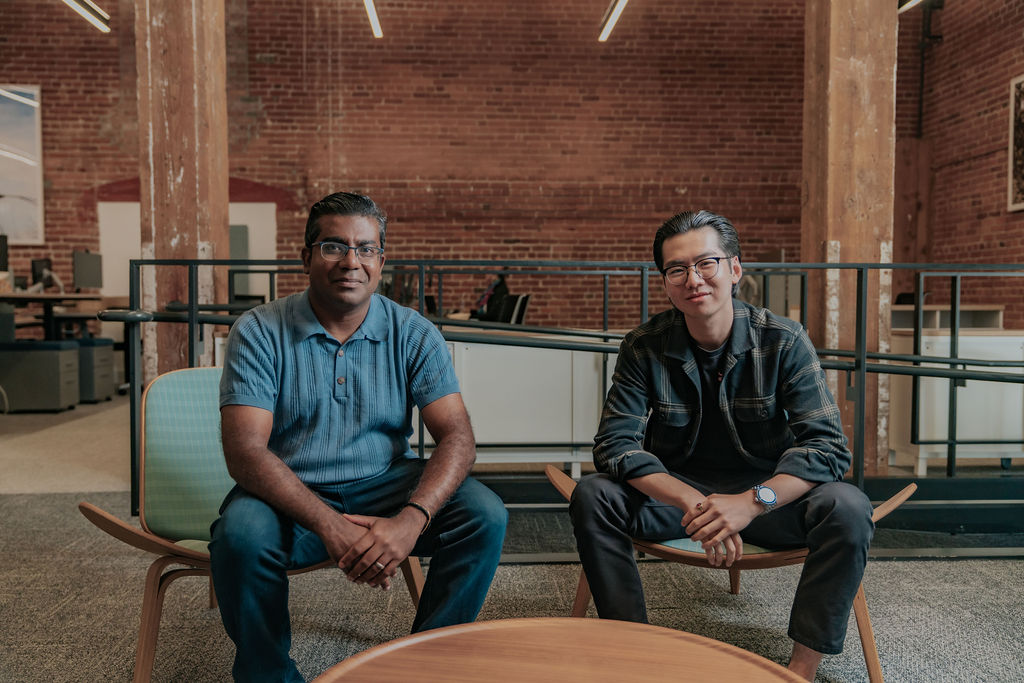
That September, Beacon acquired Haize Labs, adding expertise in AI evaluation, guardrails and reliability. Leonard Tang became VP of AI Research. The connection to customer trust is practical: businesses need confidence that new systems will behave dependably. The acquisition puts technical work behind a concern Ganenthiran has been expressing in public interviews.
The easier days keep moving
Ganenthiran’s recent writing has become more insistent about change. In a May 2025 essay on organizational design, he argues for fewer layers, quicker decisions and leaders who remain directly involved in the work. He treats organizational structures as temporary arrangements. That view asks quite a lot of anyone who has only just learned where their name sits on the chart.
In August 2026, he described a hope he once held at Instacart: become profitable, become established, then enjoy an easier phase. “I no longer believe those easier days are coming.” His argument is that AI will keep changing what customers expect and how companies can deliver it. He sees reinvention becoming a continuing responsibility, even when current results look reassuring.
That leaves a productive tension in his story. He wants relationships that last for decades and organizations capable of changing quickly. The grocery cashier, the retailer negotiator and the software buyer all have to live with the customer’s judgment. A promised dashboard must eventually load. A contract must work for both sides. An acquisition must earn its place in the customer’s day.
Asked years ago about his favorite Blue Jays, Ganenthiran named Joe Carter, Roy Halladay and John Olerud. Asked to choose between a burrito and a burrito bowl, he chose the burrito. There is something welcome about those definite answers beside the sweeping questions now occupying him. Some decisions can be settled without redesigning the organization.