The modern phone camera has been asked to do some curious work. It scans restaurant menus, recognizes faces, deposits cheques and translates street signs. Nikunj Malpani looked at that pocket-sized piece of precision engineering and saw an instrument waiting for a new assignment. At NeoDocs, the company he co-founded in Mumbai, a phone photographs a specially designed test card. Software reads the card's colour and turns it into a result. The choreography is brief. The engineering behind it is anything but.
That contrast suits Malpani's career. His public biography can be made to sound tidy: IIT Bombay, Bain & Company, startup founder, Y Combinator. The lived version is less symmetrical. It includes hostel maintenance, college theatre, consulting rooms, manufacturing questions, investor calls and the problem of making one camera see what another camera sees under completely different light. A founder who once worked in slides now runs a company where chemistry, pixels and packaging must agree before the customer taps a screen.
The campus apprenticeship
Malpani entered IIT Bombay in 2013 and graduated four years later with a B.Tech. His public profile lists a 9.02 score and a result in the top 0.87 percent of the Joint Entrance Examination Advanced. Those numbers establish the academic machinery. The more revealing details live at the edge of the transcript.
He served as marketing head of the institute's Entrepreneurship Cell. As maintenance secretary for Hostel 7, he received IIT Bombay's Organization Color, an award for exceptional organizational work. He also performed in Fitrat, Hostel 7's entry in the 2014 Main Dramatics General Championship. The play finished second among 13 hostels; Malpani won the title “Gem of the GC” for his performance. Before there were customers to persuade or teams to coordinate, there were audiences, committees and a hostel whose practical inconveniences did not care about anyone's job title.
The combination is more useful than it first appears. Engineering teaches a person to respect constraints. Organizing teaches that constraints usually come attached to people. Theatre teaches that attention must be earned. Startup leadership is greedy enough to demand all three.
A clean framework meets a messy world
After IIT, Malpani joined Bain & Company. He has written warmly about that period, crediting senior colleagues with sharpening his ability to solve problems and work across sectors. Consulting gave him structure, mentors and a close view of large organizations. It also handed him a line he still repeats: be a problem solver, not a complainer.
Then came the more expensive version of the lesson. During the pandemic, Malpani started NeoDocs with two fellow IIT Bombay alumni, Anurag Meena and Pratik Lodha. Malpani and Lodha had known each other longer; Meena, two years their senior on campus, brought experience from earlier medical-technology ventures. Lodha contributed software, artificial intelligence and machine-learning expertise. The three arrived at a shared question: could advances in phone cameras replace part of the work performed by dedicated readers?
NeoDocs was established in 2020. By the following year it had joined Y Combinator's Summer 2021 batch and announced pre-seed backing from Y Combinator, 9Unicorns and Titan Capital. The startup's proposition was unusually easy to draw and unusually hard to perfect.
The user sees three actions. The company sees a stack: custom cards, camera calibration, algorithms, app design, quality systems, manufacturing and distribution. A white light in one room is blue in another. Phone cameras process colour differently. A convincing demonstration can tolerate surprise; a reliable product cannot. When Malpani told The Economic Times in 2024 that NeoDocs could standardize results across lighting conditions and phone cameras, he was describing the removal of a thousand small excuses.
Three founders, one translation job
Malpani's title is CEO, but his visible role is translator. He has to move between the engineer's precision, the clinician's caution, the investor's pattern recognition and the customer's impatience. The company sits where physical and digital systems meet. Neither side gets to be decorative.
He once compared the work of building NeoDocs with a business-school education. Pitching to clients, customers and investors became his version of group presentations. Managing senior specialists and blue-collar workers taught him how trust changes across a team. The observation contains a useful bit of founder realism: the company is not merely the product being sold. It is also the school in which the founders are still enrolled.
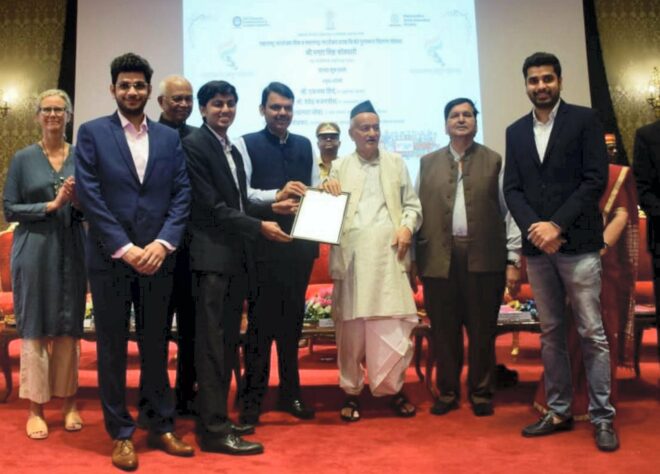
The public milestones accumulated. NeoDocs was selected among Maharashtra Startup Week winners in 2022. The founders took their work to the Indian Science Congress in Nagpur. Investors including Prana Ventures and Titan Capital backed the company. In February 2024, NeoDocs announced a $2 million seed round led by Omidyar Network India, with participation from Gemba Capital, 9Unicorns, Y Combinator, Soma Capital and VentureSouq. Malpani said the company was expanding its partnerships, product work and international presence.
He also appeared on the finale of NDTV's Banega Swasth India in August 2024, where he demonstrated the smartphone-based approach on television. The same year, NeoDocs appeared in Forbes' 30 Under 30 Asia Healthcare & Science coverage. In 2025, Malpani was listed as an author on a clinical-evaluation abstract presented at the American Society of Nephrology's Kidney Week. Each venue demanded a different language. The object on the table remained a card and a camera.
The long road inside a short demo
Founders like phrases that fit on a slide. Malpani's stated ambition certainly does: “To create a personal lab on every individual's phone.” It is memorable because the phone is familiar and the lab is not. It also creates a demanding standard. A lab is trusted infrastructure, not an app icon with good manners.
NeoDocs' path has therefore been less about inventing a theatrical future than converting a series of stubborn present-tense problems. Can a card be produced consistently? Can an image survive the variety of phone cameras? Can the workflow be understood without a technician hovering nearby? Can a useful reading travel through an interface without losing its seriousness? Each conversion reduces friction for the person using the product and adds responsibility for the team building it.
The 2026 move offered a neat circular image. At the start of the financial year, Malpani announced that NeoDocs was moving into an office at Aspire IITB Research Park, on the campus where the founders had once been students. He called the journey surreal and thanked the institution for the space to build. Founders are usually photographed leaving places: the college gate, the corporate lobby, the old career. Here was a return, except with colleagues, manufacturing questions and payroll.
Around the same period, the company completed a grant-backed project at IITM HTIC MedTech Incubator focused on making one of its test kits cheaper to produce. Malpani described the brief as “unglamorous but important.” It is a revealing phrase. The glamorous version of technology is the demo. The important version is cost reduction, reproducibility and all the other nouns that rarely trend.
An operator in public
Malpani's public voice mixes gratitude with operating detail. He names collaborators. He thanks institutions. He posts hiring needs across partnerships, finance, supply chain and operations, a list that quietly explains what kind of company NeoDocs has become. The camera model may get the clever sentence. Somebody still has to keep inventory moving.
His college record supplies an amusing prehistory. The dramatics prize suggests comfort onstage. The maintenance role suggests comfort when the spotlight is aimed at a leaking tap. The Entrepreneurship Cell sits tidily between them. Years later, NeoDocs asks him to perform a similar range at larger stakes: explain the vision, manage the machinery, keep the cast moving in roughly the same direction.
There is a temptation to tell founder stories as a single leap from safety into uncertainty. Malpani's is more interesting as a chain of translations. IIT converted aptitude into range. Bain converted range into method. NeoDocs converted method into a physical-digital system that refuses to stay inside one professional category. Even the company's core interaction is a translation: colour into signal, signal into information, a common phone into specialized infrastructure.
The pocket-sized lab remains an aspiration, not a finished sentence. That is precisely why it gives the work shape. The phone is already there. The card is small. The user's patience is finite. Everything else must become more rigorous while appearing less complicated. For Malpani, the useful trick is not making difficulty disappear. It is carrying the difficulty on the company's side of the screen.