The engineer took three months to find and one week to leave. There, in the unflattering arithmetic of startup life, is the beginning of Amit Singh's second company. Singh and his co-founders were then building Memer, a consumer social app aimed at regional-language internet users in India. They wanted their first engineer. Their standards were exacting, their channels were exhausted, and one founder spent those three months sourcing full time while the other two interviewed candidates for half their working hours. They eventually made the hire. Seven days later, they were back where they started, except now with a story too irritating to ignore.
Most company origin stories improve with polishing. This one improves by refusing it. The comedy of effort and outcome explains Weekday more neatly than any market-size slide could. Professional networks could show the founders a sea of résumés, yet the part they wanted was harder to locate: credible context about who was actually good, supplied by people who had worked alongside them.
Singh carried that frustration into Weekday, founded with Chetan Dalal and Anubhav Malik in 2020 and accepted into Y Combinator's Winter 2021 batch. The first version centered on engineers recommending friends for jobs and getting paid when those recommendations led somewhere. It treated a reference not as the ceremonial phone call made after a decision, but as useful information before a company had spent weeks interviewing.
“We want to solve the problem of lack of trust in the hiring process.”Amit Singh, 2023
An investor learns where the spreadsheet ends
Before he was the founder inside a financing story, Singh helped judge them. After earning a Bachelor of Technology at IIT Bombay in 2015, he spent roughly three years at Kae Capital, an early-stage venture firm. His essays from that period show a young analyst testing the vocabulary around him. He questioned casual uses of “network effects,” wrote about the emerging vernacular internet in India and compared startup fundraising to the perilous politics of a popular television fantasy.
That habit of pulling apart a familiar phrase matters. Recruiting has its own comforting nouns - profile, pipeline, candidate, fit - that can make the process sound more certain than it feels. Singh's later argument at Weekday was that the profile tells a recruiter who exists, but social data and references help decide whom to trust. It is the sort of distinction an investor might admire and a hiring manager might need by Friday.
He was already building before venture capital. At IIT Bombay, his Cloud Labs project won first prize and $3,000 at MIT Global Startup Labs in 2013. The team created a way to access physical laboratory hardware remotely through an Android app. A later project, Aahaar, proposed sensor-equipped cold-storage trucks matched with food producers, drivers and markets through an app. It won the 2014 Thought for Food Challenge and its $10,000 prize. Both ideas joined software to an awkward real-world handoff. Weekday would eventually do something similar with professional identity and human judgment.
The irritation-to-product pipeline
The useful distance between Memer and Weekday
Memer was not a detour erased from the founder biography. The consumer social company was acquired by ShareChat, and it left Singh with a sharper sense of whom he understood. In a later reflection, he wrote that Memer served new internet users who consumed regional content, often did not speak English fluently and were just getting smartphones. Singh was not that user. A choice about a button, format or onboarding flow demanded interviews and tests because instinct could not safely fill the gap.
Weekday felt different. Singh had been a hiring manager and an engineer. He knew why he wanted references early, what level of detail helped and why a founder might prefer paying after a successful hire. He described decisions becoming faster and more intuitive, while carefully allowing that plenty of founders succeed by building for others.
The lesson is less romantic than “follow your passion,” which is probably why it travels better. Familiar pain does not make a founder correct. It reduces translation. Singh could test Weekday's decisions against a memory that still stung: three months, one hire, one week.
Recognition arrives between versions
Forbes India included Singh in its 2022 30 Under 30 list for Enterprise Technology, when Weekday was still close to its original shape: a Chrome extension through which engineers could recommend friends for roles at Y Combinator companies. The magazine described the young business as venture-backed and profitable. Recognition froze one moment in a product that was already changing. The referral loop was the visible mechanism; trust was the more durable thesis underneath it.
The following year brought a larger public marker. Weekday announced $2.2 million in seed financing led by Venture Highway, joined by angels. Singh, Malik and Dalal had spent two years refining the product before leaning into sales. That patience looks consistent with the team history on Weekday's own site: frustration in 2019, a company in 2020, Y Combinator in 2021, then a commercial push after the founders had lived with the problem long enough to distinguish a feature from a foundation.
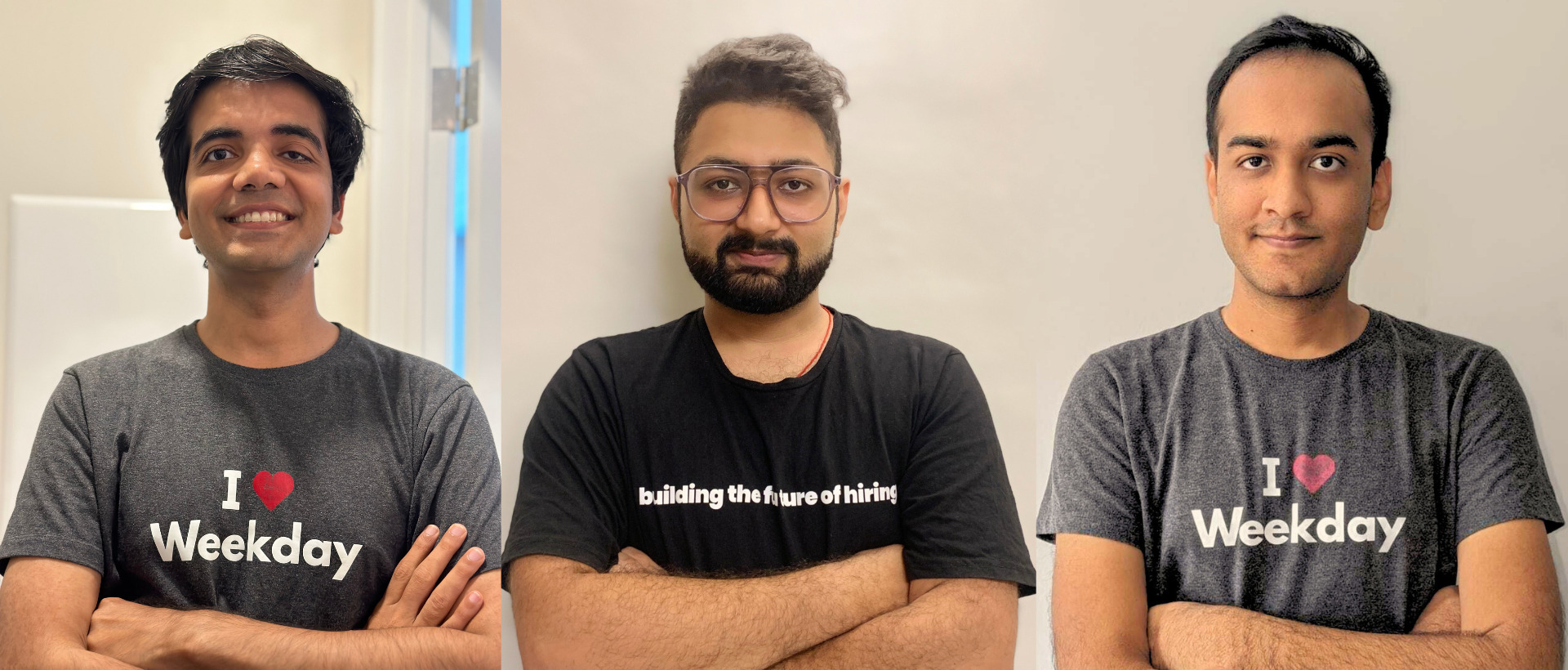
The co-founders also brought different titles to the work. Singh became CEO, Dalal took the product brief as CPO, and Malik led technology as CTO. Their earlier company gave them a shared failure rather than merely a shared résumé. Hiring had consumed all three founders' attention at Memer, which meant Weekday's founding question did not belong to a lone evangelist. It had witnesses.
Putting the back channel on the main road
When Weekday announced a $2.2 million seed round led by Venture Highway in 2023, the company had built a database of more than 800,000 engineers and said about 120 companies had used the service. Singh framed references as the missing trust layer. Candidates traditionally supplied their own referees late in a process, after everyone had already invested time. Weekday sought a broader network of professional reviews and recommendations earlier.
The product kept moving. Weekday now describes itself as an AI recruiter that searches a database of more than 250 million people in the United States and India, identifies possible candidates and runs outbound campaigns. Its company story puts the purpose in gentler language: use AI for repetitive work so recruiters have more time for meaningful human interactions. Automation, in this telling, should clear the paperwork from the table rather than take the meeting.
Singh's public 2025 recap supplied a set of operating markers. Weekday had reached seven-figure revenue profitably, he wrote, with more than 600 customers, including over 50 Y Combinator companies. Its software had sent 416,000 candidate reachouts, and its website drew 4.6 million visits. These are company-reported figures, useful less as trophies than as a view of how far the original reference marketplace had stretched.
A company that prefers verbs
Weekday's published values offer a small window into Singh's operating temperament. “We try first and then discuss” is one. “Value for time” is another, explained as seeking a high signal-to-noise ratio. The language favors experiments over committees and useful evidence over decorative motion. It also rhymes with his account of building a product for a problem he knows personally: when the feedback loop is close, a team can move before certainty arrives.
There is continuity with the investor who questioned buzzwords and the student whose teams built working prototypes. Singh's career has moved through analysis, consumer software and recruiting, but each phase involves signals. Which startup story deserves belief? Which social behavior can become a product? Which candidate is more than a polished page?
His public conversations have expanded with the company. On The Weekday Show, he interviews hiring leaders and recruiters about how they evaluate talent. In a recent discussion with Adarsh PK of Enterpret, Singh highlighted a practical change in search: begin with patterns among a company's strongest hires rather than generic job titles. Where did those people come from? Which backgrounds repeat? What career paths tend to work? It is analytics applied to hiring, but with the useful humility that the answer may already be hiding inside the team.
The ambition behind the database
Singh has used a provocative shorthand for the destination, calling Weekday what LinkedIn should have been. Read only as competition, it sounds like the standard small-company dare aimed at a large incumbent. Read alongside his interviews, the more interesting aspiration is specific: make trust visible sooner, so employers can remove some of the defensive hoops built into hiring.
That goal has tension built into it. A larger database creates reach; personal references create context. AI creates speed; recruiting remains a consequential exchange between people. Weekday has to hold each pair together without allowing the first term to flatten the second. Singh's own preferred framing - AI that makes hiring more human - is a promise that will be tested in ordinary moments: whether an outreach feels relevant, whether a review feels credible, whether an interview begins with curiosity rather than suspicion.
The bad one-week hire did not hand Singh a finished answer. It gave him a durable question. Six years into Weekday's story, the company is still asking how software can help strangers make a confident decision about one another. The database has grown. The outreach is automated. The most important part of the pitch remains disarmingly old-fashioned: before you hire someone, it helps to know what it was like to work with them.