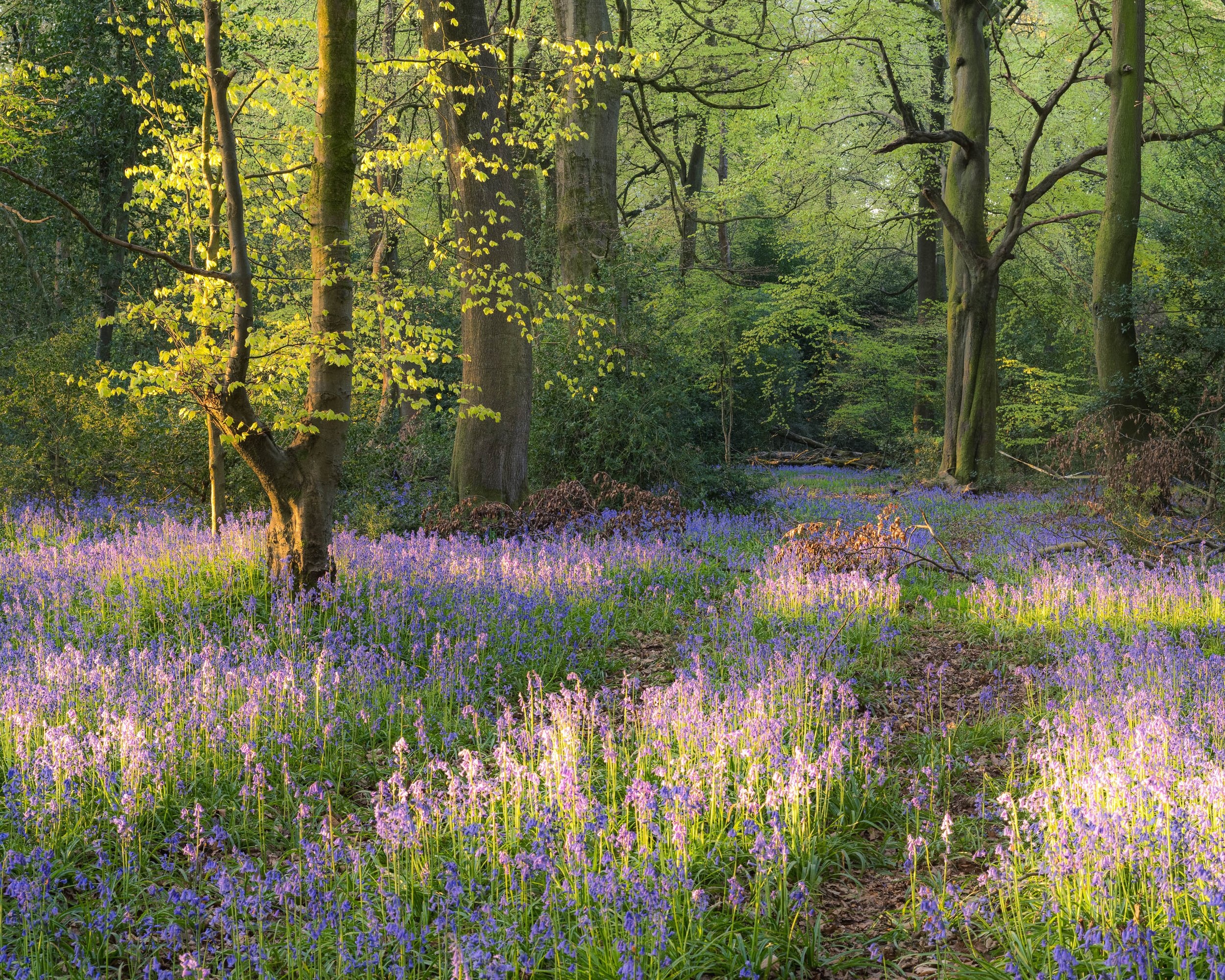
Nigel Danson walked past the picture before he found it. In the bluebell woods of the Home Counties, he initially dismissed a scene whose trees seemed awkwardly arranged. On another pass, he saw a composition he liked. Elsewhere that week, a fallen, curving branch helped hold the picture together. He worked on that frame around five times in a morning, trying it in different light. The finished photograph might suggest a quiet moment of certainty. Getting there involved rather more reconsideration.
He described those visits in April 2026, near the end of his project to photograph every county in England. In Kent, he almost decided against another morning of bluebells. He thought he had enough pictures of them already, and he expected no fog. He went out anyway. As the sun rose, fog moved into the woodland from a field.
There is a good deal of Danson in that small decision. He makes plans, pays attention to conditions and revises his judgment when a place offers something different. His working life has taken a similar turn: from founding an intranet software company to making photographs, teaching and publishing books. These days, going back is a substantial part of going forward.
Before the footpaths, the intranet
Danson’s earlier business dealt with another kind of complicated arrangement: people trying to work together inside large organisations. He founded Interact, whose company history begins in 1996 in a small office near Carrington, Greater Manchester. Its intranet software would grow into an international business.
By March 2015, Interact had earned a place among the Northern Tech Awards’ 50 fastest-growing technology companies. Its ranking reflected turnover growth between 2012 and 2014. Danson, then founder and CEO, described a workforce approaching 100 people, expansion in the United States and Australia, and a New York office. Development, marketing, sales, implementation and support were all part of the operation.
September 2016 brought a move to San Francisco, where he headed the company’s new regional headquarters. Interact had opened its first American office in New York in 2014. Now it had a presence on both coasts. Some 750 companies were using its software; enterprise customer revenue had doubled between 2015 and 2016. Simon Dance, the long-serving chief technology officer, had been appointed UK CEO.
Danson’s pitch put the people using the intranet at the centre of the product. The purpose was to help them communicate, collaborate and find what they needed. It was a business with customers, colleagues and considerable momentum. In June 2017, he returned to Britain and chose to make photography his profession.
Greater Manchester
San Francisco
Return to Britain
An education in looking
There had been cameras long before there were corporate offices. Danson began taking photographs at 11 and became absorbed by developing black-and-white film in his parents’ attic. The process interested him as much as the result: an image appearing on paper in the half-dark. He now works digitally, while retaining an affection for that earlier way of making a picture.
His education also supplied a more technical acquaintance with light. He completed a physics doctorate and worked in the space industry designing optical coatings before establishing his software business. His LinkedIn profile lists doctoral study at Loughborough University from 1992 to 1995. The thesis concerned controlling the properties of reactively sputtered thin films, a subject unlikely to fit comfortably into a video thumbnail.
He describes an analytical approach to photographs, considering form, patterns and the reasons for including an element in a frame. Yet he also wants an image to preserve the feeling of being somewhere. Those interests sit together comfortably. Understanding why a composition works can help a photographer recognise the moment when it does.
“Photography for me is about the connection with nature”
Nigel Danson
He is a Nikon ambassador, with a camera history extending from film through the D100 to the Z system. Equipment supplies the means to work; the changing relationships between light, weather and landscape supply the pictures. He can return to the same trees without expecting them to give him the same image.
The world within an hour
Danson has photographed in Iceland and Antarctica, and Iceland is a particular favourite. His book Close to Calm, however, draws its boundaries much nearer home. It brings together years of work made within an hour of where he lives. Based in Cheshire, he has the western Peak District within reach and has repeatedly photographed its landscapes.
The book’s premise gives familiarity a practical value. Repeated visits bring knowledge of seasons, weather and the direction of light. A location becomes a place whose possibilities the photographer has had time to learn. The distance travelled to reach it says little about how much there is to see.
There are other hands in this apparently solitary pursuit. Artist and friend Allie Pottinger contributed artwork to Close to Calm. Photographer Mads Peter Iversen wrote its foreword. Danson points to Iversen’s work around his home in Denmark as another example of finding photographs in nearby landscapes. A shared interest gives the collaboration its sense of purpose.
His visits to The Roaches offer a less tidy, and therefore useful, picture of how this works. In August 2025, he brought together images from different years: heather under dark clouds, blue skies, a camera covered in ice. The same location had required several appointments. The weather had evidently declined to provide everything in a single sitting.
A country, a campervan, a deadline
Discovering England sets a different boundary. Danson travelled to every English county in a campervan he converted himself. The conversion alone took 18 months. The vehicle made the photographic journey possible, while adding a sizeable construction project before the first county could be crossed off.
He also imposed a limit on how long he would spend in each county: no more than four days, if he could manage it. The constraint sits intriguingly alongside his enthusiasm for return visits. It asks him to make decisions in places he cannot study indefinitely. Familiarity has its advantages; a deadline has its own instructions.
the campervan
as a target limit
A journey to photograph every county in England, now collected in a signed and numbered book.
The project also brought him into contact with people who shared his interest in landscape photography. He describes those encounters as part of the journey’s value. The book collects its surprises, including pictures made on days when he had doubted the usefulness of going out.
The bluebell week belongs to that larger trip. He deliberately scheduled the Home Counties for the flowering season, then found more than his planning could guarantee. The project contains both kinds of effort: arranging to be in a promising place, and staying responsive once there.
The picture is finished on paper
Danson’s books give this work a life beyond a screen. Seascapes follows the meeting of water and land, with attention to the erosion and movement that continually alter the coast. Alongside the images, he explains why he made them, how he composed them and the cameras and settings he used.
The physical choices are equally deliberate. Seascapes has 128 lithographically printed pages, 200gsm silk art paper and an ocean-blue linen cover. Discovering England uses a linen-covered case with foil titles and embossed line art. These are objects designed for looking through at a pace the reader chooses.
His photographic interests have already ranged across books on vistas, woodlands and the sea. When discussing his bookshelf, he has picked work by Ansel Adams, Michael Reichmann, Bruce Percy, William Eggleston and Alex Nail. Making books also means spending time with books made by other people.
Teaching carries the process in another direction. On YouTube, in workshops and through courses, he shares the decisions behind his images. His woodland eBook addresses planning, lighting, composition and common errors. His composition guide considers foregrounds, colour and depth. The finished photograph becomes something a viewer can examine, question and learn from.
Some company on the path
There is a social side to the business of looking. Danson has invited fellow professional photographers to submit work for him to share through a video, Instagram and his newsletter. The invitation covered different kinds of photography and products, from prints to courses. Having an audience creates opportunities to direct some attention towards somebody else.
Then there is Pebbles, his English Springer Spaniel and occasional companion in the vlogs. In his account, she had eaten three microphone windshields and knocked over the tripod and camera twice. Even an experienced company founder must occasionally discover that a colleague has misunderstood the equipment policy.
His published principles include photographing subjects he loves, getting outside, visiting new locations and returning to old ones. That last instruction is only two words: “Revisit locations.” It leaves plenty of room for work. A woodland can be walked again. A frame can be reconsidered. In Kent, on a morning he almost skipped, the fog arrived.
Keep exploring
The photographs, the films and the earlier software chapter.