The Lab Didn't Need Another Scientist. It Needed an Operating System.
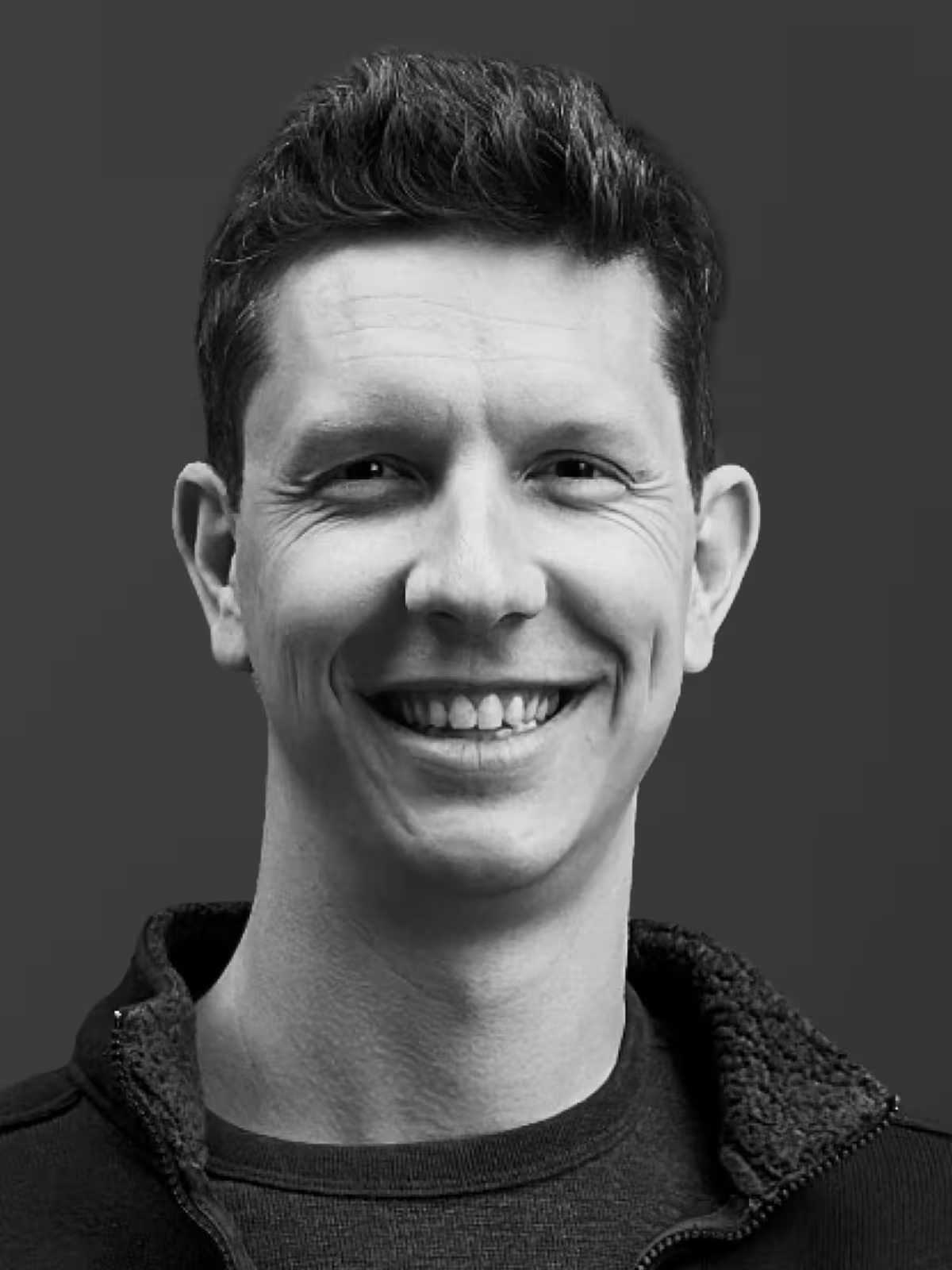
Nick Talken is a chemical engineer who got bored of chemistry. Not the problems - the friction. The endless Excel sheets tracking experiments. The inventory spreadsheets that were always wrong. The formulation data living in twelve different inboxes. The months it took to get from hypothesis to working prototype, not because the science was hard, but because the workflow was broken.
So he built something. First for himself and his team at Molecule Corp, the 3D-materials startup he co-founded with Ken Kisner in 2015. They hired data engineers to create custom software for their lab. The software worked. Henkel noticed - and in 2019 bought the whole company to get the people and the tools inside.
What happened next is the kind of thing that only works if you have a very specific set of skills and a very specific kind of patience. Inside Henkel, Talken scaled that internal platform to cover 2,000+ scientists across the company's global R&D operation. The tool earned a name: Albert. The name is a nod to Einstein - the idea being that the platform doesn't replace scientific genius, it amplifies it.
"The lab is a place where magic can happen when all of the pieces align."- Nick Talken, Co-Founder & CEO, Albert Invent
In 2022, Henkel spun Albert out as a standalone company. Talken left with the team and the technology, co-founding Albert Invent alongside Kisner, CTO Neelesh Vaikhary (20+ years building SaaS platforms), and Zack Kisner as Head of Product. The startup emerged from stealth in 2023 with something most founders spend years trying to achieve: thousands of paying customers on day one.
What Albert Actually Does
Albert Invent describes itself as an operating system for chemists. That's not marketing speak - it's a fairly literal description of what Albert OS does. It sits between the scientist and the data, connecting electronic lab notebooks, inventory management, regulatory compliance databases, and AI inference into a single, coherent interface.
The AI component - Albert Breakthrough, launched in December 2024 - is where the platform gets genuinely unusual. The model has been trained on 15 million molecular structures, making it one of the largest chemistry-specific AI datasets in existence. When a chemist wants to design a new formulation, predict how a molecule will behave, or generate candidate structures that meet certain performance criteria, they can ask Albert. The system can also be fine-tuned on each client's own proprietary experimental data, which matters enormously in an industry where the IP is in the dataset.
The results are not subtle. Some clients have reported compressing development cycles from three months to two days. Albert's AI discovery portal has seen 1,800+ formulas downloaded. The platform is now active in 142+ labs across more than 30 countries - a geographic footprint that outpaces most $50M startups by a wide margin.
"By combining AI with a foundational model of chemistry, we're empowering scientists to solve humanity's greatest challenges - from sustainable materials and new battery technologies to chemical breakthroughs like self-reversible adhesives."- Nick Talken
The Customers Doing the Convincing
Talken didn't build Albert for the startup pitch circuit. He built it for actual chemists at actual chemical companies. The client list reads accordingly: Chemours, Henkel, Diversey, Nouryon, Solenis, 3D Systems, Keystone Industries.
In October 2025, Albert Invent announced a multi-year strategic partnership with Kenvue (NYSE: KVUE) - the consumer health company behind Zyrtec, Neutrogena, and Listerine. The deal covers AI-driven R&D acceleration across Kenvue's product portfolio, which means Talken's platform is now touching some of the most recognized consumer brands on the planet.
None of this happened by writing whitepapers about AI's potential in the $5 trillion chemicals industry. It happened because the software works well enough that the world's largest chemical companies trust it with their most sensitive R&D data. That's a different kind of proof.
The Funding Story
Albert Invent's fundraising timeline is worth reading in sequence. The $7.5M seed in June 2023 came from Index Ventures, Homebrew, and F-Prime Capital - investors who recognized the unusual position of a company emerging from stealth with enterprise customers already in place. Index Ventures wrote the piece "Built by Scientists, for Scientists" to explain why they backed it.
The $22.5M Series A in December 2024, led by Coatue with participation from Index, TCV, F-Prime, and Homebrew, coincided with the launch of Albert Breakthrough. And then, in February 2025, J.P. Morgan Private Capital's Growth Equity Partners led an additional growth investment alongside Coatue and TCV - a signal that the firm sees Albert Invent as something more than a promising startup.
Total funding: over $52 million. The investor roster spans deep-tech specialists, enterprise SaaS funds, and the investment arm of one of the world's largest banks.
The Long Game Inside a Big Company
There's a version of Nick Talken's story that gets told as a straightforward entrepreneurship narrative - chemist builds software, sells company, spins out startup, raises money. That version skips the most interesting part.
For three years inside Henkel, Talken ran a team of engineers building and maintaining software used by thousands of scientists across one of the most demanding R&D organizations in the chemical industry. He wasn't just prototyping. He was operating. The distinction matters, because operating at that scale inside a 145-year-old company is an education you can't get from a startup incubator. He learned what scientists actually need, what breaks at scale, what compliance requirements look like when you're operating across 30 countries, and how to build software that real researchers will adopt.
By the time Albert Invent emerged from stealth, Talken wasn't guessing at product-market fit. He had three years of production data, enterprise customer feedback, and a team that had already solved the hard problems once.
"We ultimately want a platform that helps move towards a future where one doesn't have to wait for years to bring new, safer, and sustainable products to market."- Nick Talken
Expansion, Japan, and What Comes Next
In September 2025, Albert Invent launched a dedicated subsidiary in Tokyo - Albert Invent Japan K.K. - led by Dr. Larry Meixner, former Chief Innovation Officer and CTO of Mitsubishi Chemical Group. Japan is the fourth-largest chemical and materials industry in the world, and the move signals that Talken is thinking about Albert as a genuinely global infrastructure play, not a US-centric SaaS company that happens to have some international customers.
The company has also earned a carbon-negative designation, EcoVadis certification, and Greenly Climate Strategy certification - unusual distinctions for a fast-growing software startup, and consistent with the focus on sustainable chemistry that runs through Albert's product positioning.
The aspiration Talken has stated most clearly: a world where every innovator - not just the ones at Fortune 500 chemical companies - has access to tools, data, and AI that let them do their best scientific work. The platform's current footprint in 30+ countries, across labs in pharmaceutical, coatings, consumer health, advanced materials, and battery research, suggests he's building toward that goal one enterprise deal at a time.
He was trained as a chemist. He operates like a software executive. He thinks like someone who has spent time inside the problem, not pitching a solution to it. That combination is rare, and in the chemicals and materials science industry - a sector that has been notoriously resistant to software adoption - it may be exactly what's required.
What Albert OS Does
Electronic Lab Notebooks
Chemical drawing, structured experiment templates, and real-time data capture built for how chemists actually work.
Albert Breakthrough AI
Trained on 15M molecular structures. Predicts molecular properties, optimizes formulations, generates novel candidates.
Inventory Management
Real-time tracking across labs and locations. No more spreadsheets. No more "we already have that."
Regulatory Compliance
400,000+ chemical substances. Automated SDS generation. Global regulatory intelligence built in.
Data Analytics
Centralized, structured experimental data across teams and geographies - ready for analysis and model training.
Instrument Integration
Connects directly to lab instruments, capturing data at the source and eliminating manual transcription errors.
In the Press
Albert Invent Hopes to Revolutionize the Chemicals Sector With Its AI Platform
Coverage of the $22.5M Series A and the launch of Albert Breakthrough.
Read on TechCrunch →Built by Scientists, for Scientists
Index Ventures explains why they led the seed round and what differentiates Albert Invent.
Read on Index Ventures →Chemistry AI Provider Albert Strikes Deal with Kenvue
American Chemical Society's Chemical & Engineering News covers the Kenvue partnership.
Read on C&EN →Albert Invent Announces Growth Investment Led by J.P. Morgan
Official announcement of J.P. Morgan Private Capital's growth equity investment.
Read on BusinessWire →