A dolphin is an unlikely starting point for a discussion of capital allocation. Yet when Nick Swenson wrote to Air T shareholders in 2024, he reached for Mountain Air Cargo’s early work transporting dolphins for SeaWorld. The business eventually found a different kind of cargo relationship and grew alongside it. His point was about how companies actually begin: somebody sees a need, knows somebody else, and takes a chance. The tidy explanation arrives later.
Swenson is now responsible for a company containing many such explanations. Based in Minneapolis, he is chairman, president and chief executive of Air T, a holding company with businesses across aviation. Its activities extend from cargo flights and deicing equipment to engine parts, software and aircraft leasing. More recently, they have extended to regional passenger service in Australia. For an executive whose earlier career was spent in finance, the portfolio supplies plenty of things that cannot be fixed by changing a spreadsheet.
His recurring concern is how to give capable people enough room to do useful work. He calls them dynamos. The word has the pleasing quality of belonging equally in a workshop and a shareholder letter. It also raises a practical question: what should the person allocating the money do once the people running the business have it?
Before the aircraft, a history degree
Swenson graduated from Middlebury College in 1991 with a degree in history, then earned an MBA at the University of Chicago in 1996. His education puts the humanities before the financial models. It would be convenient to turn that sequence into a theory of his character. His subsequent work offers firmer ground.
He entered corporate finance at Piper Jaffray, where he worked from 1996 to 1999. He then became a research analyst at Värde Partners, a firm specializing in distressed debt. From 2001 to 2009, he was a portfolio manager and partner at Whitebox Advisors. By 2009, he was leading Groveland Capital. The progression moved him through financing companies, examining troubled obligations and taking responsibility for investment portfolios.
His BCCM Advisors biography records recognition from HFM Week in 2007 and connects his Whitebox work to Michael Lewis’s account of the subprime trade in The Big Short. A 2010 interview found him looking at European sovereign debt through the lens of asymmetric opportunities. At that stage, his work concerned securities whose prices and risks might tell different stories.
Air T would change the assignment. A portfolio manager can decide whether a position still belongs in a fund. A holding-company executive also has people, operating commitments and customers to consider. The object being evaluated becomes an organization that has to continue functioning tomorrow morning.
August
August
October
February
The investor moves inside
Swenson joined Air T’s board in August 2012. A year later, he became chairman. The interim president and CEO appointment followed in October 2013, and the permanent appointment in February 2014. These were distinct steps. Over roughly eighteen months, the investor acquired a progressively more direct responsibility for the company’s decisions.
The board’s explanation of his qualifications joins financial and analytical experience with the perspective of a major shareholder. That combination is central to his position. He helps decide where capital goes while also leading the organization that has to make those decisions work.
His history includes shareholder activism. In 2015, Groveland challenged the board at Biglari Holdings. Swenson discussed the campaign publicly, including the recommendations of proxy advisers. It is an earlier example of his willingness to question who controls a company and how that control is exercised. Running Air T brings the same subject back to his own desk.
A holding company gives the desk considerable scope. It can support an existing business, start an adjacent one or purchase something with different needs. Each choice commits more than money. It creates a relationship between the owner and the people expected to turn an investment thesis into ordinary working days.
A little room, backed by capital
Swenson’s public language keeps returning to operating freedom. In 2026, he described the motivation of leaders who have their own ship and can choose its course. The owner’s job, in that telling, includes supplying resources without appropriating every decision. Independence has to be supported before it can be productive.
Crestone Air Partners gives that idea a specific history. Swenson’s July 2026 letter describes a team within Contrail whose interests leaned toward leasing rather than the company’s core engine teardown work. Air T helped give that team a separate business and capital. A difference in specialization became a reason to make space.
By June 2026, Crestone had completed its acquisition of Arena Aviation Capital. Air T owned approximately 83.9 percent of the combined platform. The transaction brought a larger aircraft management operation into the portfolio and made the relationship among its aviation businesses more consequential.
“Our investments don’t come with expiration dates.”
Nick Swenson, June 2026
That is a statement of intended ownership, rather than a guarantee of results. It gives a team permission to consider a longer project. It also leaves the owner responsible for judging whether the project remains sensible as circumstances change.
The portfolio’s services can accompany an aircraft through different stages of use: leasing, maintenance, parts supply, storage and disassembly. Swenson argues that related businesses create opportunities for one another. A retired aircraft still contains useful material. Aviation gives the familiar idea of a second act an unusually literal form.
Australia supplies the practical exam
Air T completed its Rex acquisition in December 2025, entering Australian regional airline operations. The financing arrangement included an A$50 million credit facility funded by an investor partner and access to an additional undrawn A$60 million Commonwealth loan. The Commonwealth remained a secured creditor.
At closing, Air T anticipated bringing the active fleet from approximately 31 aircraft to 45 within two years. That was a plan. The distinction matters in a business where an available aircraft and an owned aircraft are different propositions.
Swenson’s interest concerned an essential service and a familiar industrial problem. Rex connected regional communities, while Air T already had experience in aviation supply chains. The acquisition required coordination among management, creditors, administrators and government. It asked him to combine the financing side of his career with the operating side.
The deal also makes his preference for long-term ownership measurable. There are aircraft to return to service and a network to restore. Passengers experience the outcome through a working flight schedule. The broad investment thesis eventually has to fit into that small, exact promise.
active aircraft
30 scheduled on regular lines of flying
Aircraft availability remained constrained by unscheduled engine removals and outside maintenance turnaround times.
More business, more accounting to untangle
The expanding portfolio has made Air T’s results more complicated. For the fiscal year ended March 2026, revenue reached $327.1 million, while the company reported an operating loss of $11.2 million. The Rex transaction produced a $111.2 million non-cash bargain purchase gain. That accounting gain represented neither cash generated by Rex nor operating income from its business.
The distinction belongs in any account of Swenson’s recent achievements. Buying assets on particular terms can change reported earnings dramatically. It does not settle whether the operating businesses are delivering the intended economics.
The following quarter brought further growth alongside an operating loss. Crestone’s larger scale also required care in description: the combined platform had $3.0 billion actively under management and another $0.6 billion committed under letters of intent. Those are different stages of business, even when they appear together in an announcement.
The work of interpretation is part of Swenson’s job. A growing portfolio needs an explanation that remains useful when an acquisition adds accounting effects, costs and new operating demands. Shareholders have to be able to follow both the ambition and the bill.
The awkward conversation with shareholders
In his July 2025 letter, Swenson acknowledged that Air T could be difficult to understand and said management was making a greater effort to tell its story. A year later, his letter confronted seven years of a flat stock price. He considered possible explanations, including disclosures, liquidity, complexity and the scope of investment activity.
That passage introduces friction into his account of building businesses. Management’s belief that value is accumulating and shareholders’ experience of the share price can diverge. Explaining the portfolio is therefore more than an exercise in public relations. It concerns the relationship between the people committing capital and the people entrusting capital to them.
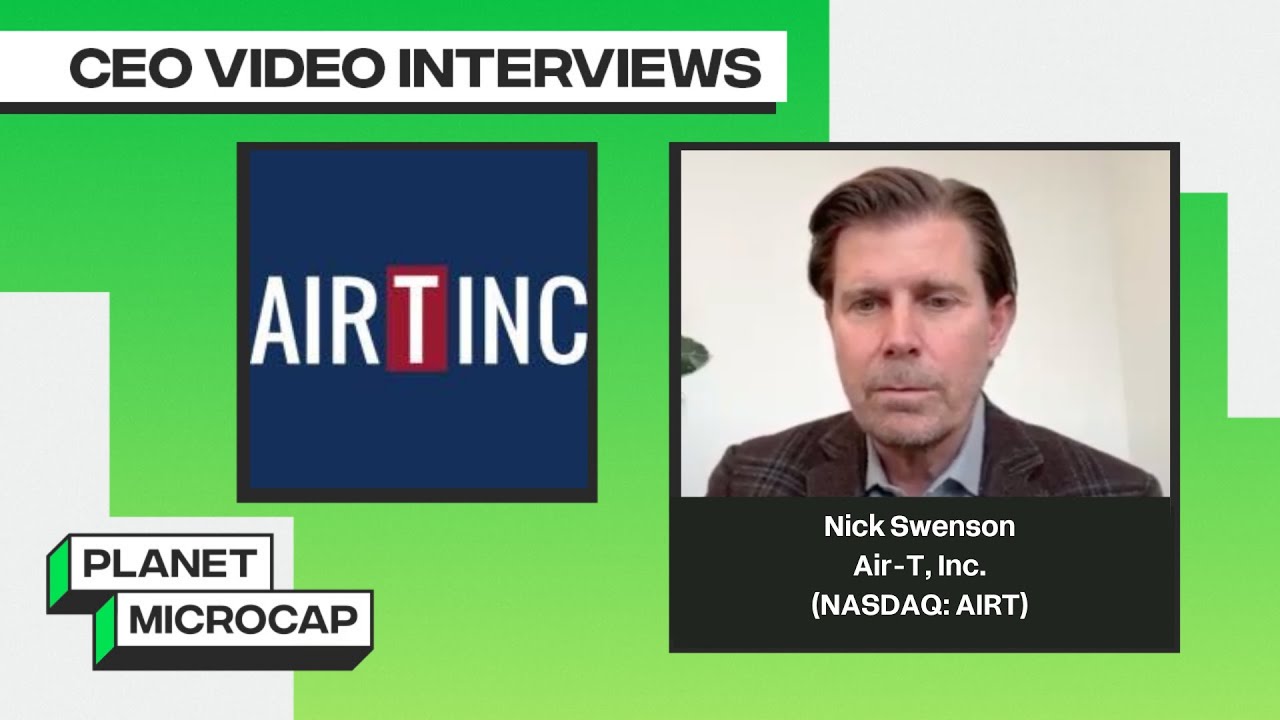
Air T has also opened channels for shareholder questions and made Swenson available in investor presentations. His short Planet MicroCap conversation ahead of the 2025 showcase belongs to that effort. A complex collection of companies still needs an intelligible introduction.
The September 2026 appointment of Stuart Weinroth as Contrail’s CEO returned Swenson to a familiar theme. He praised the business built by Joe and Miriam Kuhn and described providing strong operators with resources and freedom. Leadership succession is another occasion when the principle has to survive contact with an actual decision.
Swenson’s story now rests in these relationships: investor and executive, parent company and operating team, aircraft owner and airline, management and shareholder. He has made room for businesses to develop. The continuing test is what they do with it.
Follow the work
- Air T’s businesses and investor information
- Nick Swenson on LinkedIn · Twitter / X
- Early career biography · BCCM Advisors biography
- Air T’s 2025 leadership appointments and governance
- 2024 shareholder letter · 2025 letter · 2026 letter
- Rex acquisition and financing
- Crestone’s Arena acquisition
- Fiscal 2026 financial results · Fiscal 2027 first-quarter results
- Contrail’s leadership succession
- Swenson’s 2015 shareholder activism
- His 2010 perspective on sovereign credit
- Planet MicroCap video interview