Dominic Wells went to Croatia with a million-dollar business and came home with a problem. Until then, a million dollars in annual sales had seemed a respectable destination. At a 2018 conference, he met someone who said he had sold a company to Microsoft for $300 million. Wells’s response, when asked what he did, was that it hardly mattered.
He tells the story with the embarrassment left in. The people he met were encouraging about his ability to rank websites in Google. Their encouragement mattered as much as their money. His working life had begun to look rather small beside the possibilities around him. The question he brought back was uncomfortable: if business demanded so much effort anyway, why had he chosen such a modest ceiling?
A one-year trip that kept going
There was no investment bank in the original plan. Wells graduated from the University of Sussex in 2006 with a BA (Hons) in Media Practice & Theory. His brother’s marriage to a Taiwanese woman put Taiwan on the map for him. After visiting for the wedding, Wells moved there in 2008 to teach English. He imagined staying a year or two, saving some money and travelling.
The financial crisis made a return to Britain less inviting. Taiwan offered a job and a life he liked. By 2012, he was looking for income online that would let him stay without continuing to teach. Reading Tim Ferriss’s The 4-Hour Workweek helped point him toward the internet economy. Affiliate websites offered a comprehensible proposition: publish useful material, send readers to a retailer, receive a commission when they bought.
One of his early sites, Luxury Shaves, concerned shaving products. Its progress taught him to look past the amount of traffic and examine what readers actually did. Better comparison tables, clearer recommendations and more obvious buying links could change the economics of an existing page. A website was becoming something he could operate, improve and eventually sell.
The customers wanted more than a website
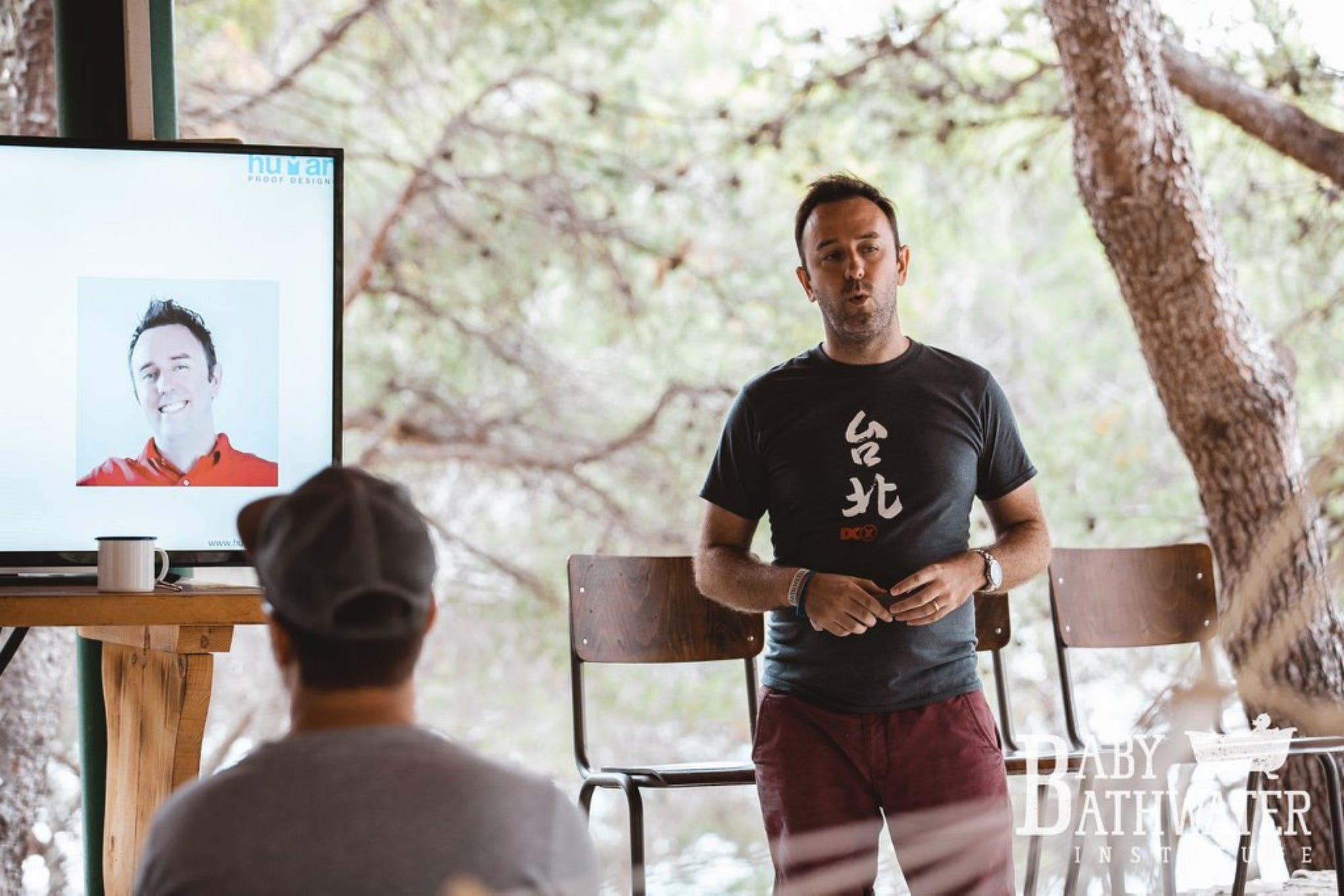
Human Proof Designs began in late 2013. Wells had noticed people buying inexpensive turnkey sites with extravagant income promises. He thought there was room for a more useful product. His early offer cost around $250 and included no content. Customers soon made clear that an empty framework was an unappealing place to begin.
The service grew to include writing, keyword research, search optimization and guidance. Teaching buyers what to do with their sites became part of selling the sites themselves. In 2017, Human Proof Designs recorded $1.1 million in sales. The distinction between sales and money left over was less glamorous. Wells later described promotions on low-margin services that produced impressive revenue months and surprisingly little profit. Arithmetic, it turned out, was unimpressed by a busy order book.
His own development was equally practical. He had once been reluctant to get on the phone with potential customers, even those considering multiple websites. Over time, he learned to make calls, send emails and build relationships. Running an online company still required speaking to people. The browser window had failed to provide the hiding place he initially wanted.
“But I never thought I would be running a public company in 10 years.”
Dominic Wells, reflecting on his first decade in business
The concert with an accounting intermission
By April 2019, Wells was selling Human Proof Designs. He had accepted an offer in February, endured difficult due diligence and signed an agreement on April 1. That evening, he went to an Ed Sheeran concert to celebrate. Partway through the performance, his phone delivered word that the buyer wanted to withdraw.
In Wells’s account, the $700,000 purchase funds had already been released. The disagreement concerned how the business’s financial results were recorded and understood. His spreadsheet and the buyer’s accounting expectations did not line up. A rough March had made matters worse. Further conversations eventually resolved the dispute and the sale went through.
Wells’s lesson was to make a business’s books easy for a buyer to examine. The anecdote gives his later career an unusually apt soundtrack. He had learned to attract customers and earn money; now he was learning how differently another person could interpret the same business. An exit requires two parties to agree on what, exactly, they are buying.
Buying the work, as well as the website
The idea that became Onfolio came from a recurring request. People with money wanted exposure to online businesses but lacked the time or experience to run them. Wells and his team could help buy and operate sites. The early service paired investors with businesses and charged for management. Onfolio LLC’s chief executive role dates to May 2019; he became CEO of Onfolio Holdings in August 2020.
The shift to a holding company changed the unit of ownership. Investors could own part of a portfolio through one company, rather than each depending on a particular website. In a 2020 interview, Wells described an ambition resembling a property investment trust for websites. He also credited Steve Razinski, of IveTriedThat.com, with helping him understand affiliate marketing early on. Years later, they remained friends.
Wells gradually made his buying criteria more demanding. An email list, repeat customers or an engaged community could give a business substance beyond search rankings. Search traffic was useful, but dependence on it created a fragile purchase. His attention moved toward the customer relationships that might survive a change in a platform’s rules.
He has also been explicit that ownership brings work. In his 2022 conversation with Acquiring Minds, he distinguished businesses that earn money relatively passively from the active responsibility of owning them. The distinction fits his career: almost every apparent shortcut has led to another operating problem to solve.
Nasdaq came with a bill
Onfolio’s shares began trading on Nasdaq on August 26, 2022. Its initial public offering closed four days later, raising approximately $13.7 million in gross proceeds before underwriting deductions and other expenses. Wells’s route from small affiliate websites to a listed holding company had taken roughly a decade.
A public company offered access to capital and tradable ownership. It also placed his decisions inside a system of audits, filings and shareholder scrutiny. The company’s present model keeps central operations small and leaves portfolio leaders responsible for their businesses. Capital allocation, shared systems and reporting sit above that operating layer. Wells works with colleagues including Adam Trainor in operations and finance.
That structure has an awkward feature. Subsidiaries can make money while the parent still struggles to cover its own expenses. In January 2026, Wells set out the near-term priority: portfolio cash distributions consistently exceeding parent-company cash costs. That is a stricter test than assembling a growing collection of brands. The collection has to pay for the machinery that holds it together.
His February update described portfolio quarterly operating profit rising from about $50,000 in early 2023 to $575,000 in the third quarter of 2025. He also acknowledged that consolidated accounts showed a net loss. Those measures answer different questions. For Wells, the continuing challenge is converting useful operating businesses into a parent company that can finance its own future.
A new tool kit, an old habit
In March 2026, Wells described renewed progress using AI to build operating systems. He wrote that he did not code, and credited Gael Breton and Mark Webster at Authority Hacker with helping him get up to speed. He saw an advantage in making a workflow once and applying it across several businesses. It was a portfolio version of the improvements he had once made to individual web pages.
By June, Onfolio Labs had introduced SharePulse, an investor relations analytics platform, and Parlance, a managed communications service. Both grew out of tools the team wanted internally. Wells said they were onboarding early clients and cautioned against projecting a material revenue contribution. The builder had reappeared inside the buyer. There was a familiar sequence: encounter a problem, make something useful, discover whether someone else would pay for it.
His interest in learning also has a local expression. In a December 2023 post, he described organizing skillsharing sessions among Taipei entrepreneurs. About 20 people attended a Monday gathering with Jason Long. The scale was a long way from Nasdaq, yet the habit was recognizable: spend time with people who might know something you need to learn.
The larger stage gets less forgiving
The summer of 2026 brought a more difficult test. Onfolio considered a combination with Paramount Helium, a departure from online businesses. Wells explained that the company’s listing could provide a platform for a different kind of transaction. The proposed deal was terminated in July when, in his account, the expected financing looked unlikely to arrive.
August’s results sharpened the need to concentrate on existing operations. Second-quarter revenue was approximately $1.50 million, compared with $3.15 million a year earlier. Wells pointed to slower new sales at Eastern Standard and reduced advertising at Proofread Anywhere. Lower operating expenses had not prevented an operating loss. A public listing had expanded the options available to him; it had also made the disappointments visible.
Company revenue, rounded. This compares the same quarter in consecutive years, not Wells’s personal income.
On August 27, Onfolio announced that it had regained compliance with Nasdaq’s minimum bid price requirement, following a one-for-50 reverse stock split earlier that month. The exchange’s price requirement and the performance of the businesses are separate tests. Clearing the first does not settle the second.
Wells’s stated priorities remain controlling parent costs, restoring cash moving up from the portfolio and pursuing acquisitions that contribute from the start. The Croatia conference enlarged his idea of what a business could become. The years since have supplied the invoices. He is still working on the same question that followed him home: how much useful business can he build with the skills he has, and what must he learn to keep it running?