Nick Callegari grew up helping his father build walls in Florida. Years later, he worked on spacecraft structures at SpaceX. Now he is developing a machine that climbs a wall as it builds it. The route sounds circuitous until you consider the object at its center: a structure that somebody has to trust.
A spacecraft makes that requirement obvious. A house lets us forget it. We expect the walls to hold, the wiring to be where it belongs, and the rooms to feel like somewhere worth living. Then comes the price. Callegari’s company, Verustruct, is working on the construction process behind those expectations. Its wager is that a different machine, designed around the building it must produce, can help make housing less expensive.
There is a pleasing reversal in the idea. Usually, the builder supports the work. In Callegari’s proposed system, the work begins supporting the builder. A wall gets a second job before its first one is finished.
The family business, seen from farther away
Construction was familiar before it became his business. His father worked on walls; relatives worked in trades including electrical installation, plumbing, and glazing. Callegari spent summers alongside his father, getting an early view of the work behind a finished building.
His later engineering career gave him another way to look at that familiar scene. At SpaceX, he saw teams question requirements and work through difficult technical problems. Back in construction, he recognized methods his father had used when Callegari was a child. The contrast helped him ask where he wanted to apply his training.
That question is more interesting than the customary career-change arithmetic. Salary, title, and prestige can all be entered in a spreadsheet. Choosing a problem requires a different calculation. In Callegari’s case, the work of his family and the work of his professional life eventually met in the same place: the walls of a home.
A hoverboard appears in the paperwork
Callegari graduated from Princeton in 2020. His undergraduate engineering record includes a project with Maya Naphade and Dominic Saunders called “Princeton x Hendo: Creating the Next Generation of Hoverboards,” with Arnold listed as adviser. A hoverboard is an agreeable item to find in the backstory of someone who now worries about concrete.
He continued to Berkeley, completing a Master of Engineering in mechanical engineering in 2021. There, coursework also exposed him to market testing. An engineering education can tell you how a device might work; a prospective customer introduces the awkward question of whether anybody wants it.
Callegari has described himself as a first-generation, low-income college student. QuestBridge helped make higher education available to him. Later, while at Yale, he served as a nonprofit board fellow with Groundwork Bridgeport. Those details give his housing ambition a setting beyond the laboratory: opportunity arrived through institutions and people, and he has sought ways to give something back.
An earlier idea refused to become a business
Before Verustruct, Callegari pursued a venture around more efficient mass transit. The idea continued from Princeton into his Berkeley studies, but its economics did not work. He also received feedback that investors wanted more industry experience from someone proposing to lead a hardware company.
He went to SpaceX, where his work included tools and systems for the first commercial spacewalk. Later, at Yale, he returned to entrepreneurship and founded Verustruct in April 2024. The intervening job mattered: an unsuccessful attempt had helped identify what he needed to learn.
At ClimateHaven in New Haven, he asked for a summer’s access to workspace and worked there throughout the season. He ultimately received a year of free space and support. For a hardware founder, a room is part of the experiment. The idea has to occupy a bench before it can occupy a building site.
Why give a house printer such a large frame?
Callegari arrived at Yale’s School of Management in 2023 intending to work on a social venture. Construction became a focus after the Climate Innovation Intensive at Tsai CITY. Looking at existing printers, he recognized the resemblance to machines used for smaller plastic parts and wondered whether housing called for a different starting point.
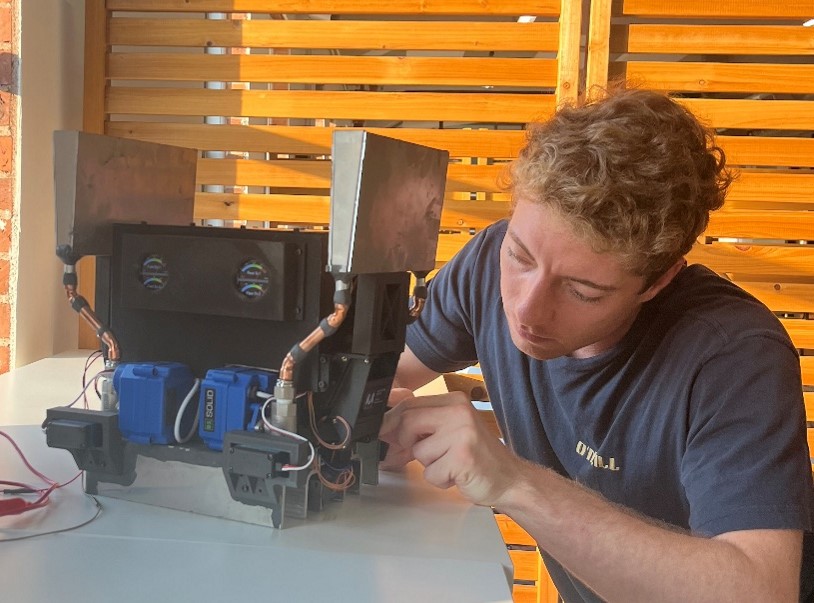
His venture first went by Impact3D. By the summer of 2024, the team had designed, analyzed, and begun manufacturing a small-scale prototype. It was already a design with hundreds of parts, intended to demonstrate printing without an external gantry.
That distinction is the engineering premise of Verustruct. Rather than asking a large frame to carry a printer over the work, the proposed system uses the rising structure. The building becomes part of the equipment arrangement. It is an economical idea to describe, and a demanding one to make reliable.
The wall has more errands to run
The company describes a coordinated system: a wall-laying robot, another for mechanical, electrical, and plumbing work, and a finishing robot. Material arrives through conventional concrete pumping equipment. Software is intended to plan the structure and coordinate what the machines do on site.
This widens the problem beyond depositing material. A useful wall needs pathways for the services that make a house function. A useful building process needs those operations to fit together. Callegari is pursuing that coordination as well as the printing itself.
The patent record listed by Verustruct includes a construction-printer application published in October 2025 and additional pending applications filed in 2026. Those are steps in protecting a design. The practical test remains the same: equipment that performs its work consistently, with a finished structure that can satisfy the requirements of a real building.
A lawyer belongs beside the prototype
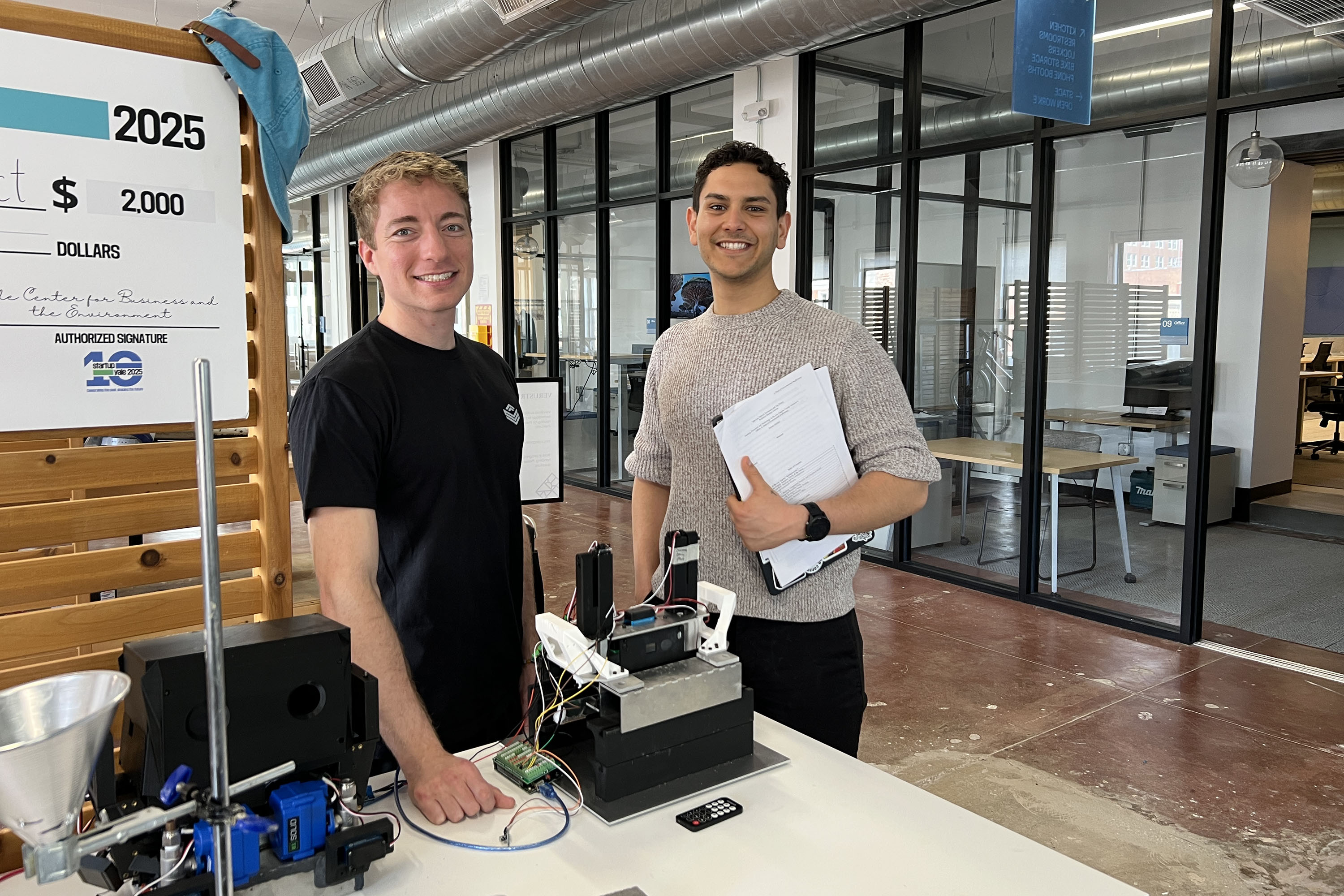
One photograph from Verustruct’s early development shows Callegari beside Yale law student Sam Haddad, with a small printer between them. It captures two kinds of construction. There is the device, and there is the company that will have to own it, finance it, employ people, and make decisions about it.
Yale’s Entrepreneurship & Innovation Clinic helped draft the venture’s founding documents, advised on business strategy, and worked on intellectual property. Callegari credited the collaboration with helping him navigate investor conversations and the organizational work of being a founder.
Verustruct is a public benefit corporation. Its stated purpose includes affordable, sustainable housing. The legal form gives that purpose a place in the business’s structure; the decisions made inside the business will determine how it is carried out. Even a robot needs paperwork. Concrete, at least, has the decency to announce when it is setting.
The money buys more building
On September 24, 2025, Verustruct announced a $2.44 million pre-seed round led by Necessary Ventures and Anorak Ventures, with investors including Boost VC and Mana Ventures. The money followed earlier grants, awards, and university support.
“Closing the round feels like we’ve just qualified to enter the race.”
Nick Callegari, September 2025
The image is apt for a company that still has equipment to develop. A fundraise marks an agreement to continue the work. It cannot perform the work itself. Callegari thanked mentors, advisors, and Yale’s entrepreneurial community in the announcement, describing the support that helped get him to that point.
Verustruct also participated in VentureWell’s 2025 E-Team program, advancing to Propel with Callegari and Konstantinos Markopoulos named as team members. At Climate Week NYC that September, the venture demonstrated its technology at a climate-focused NY Tech Meetup. The idea was becoming something he could put in front of people, rather than simply explain.
What a resident will actually see
Callegari has emphasized smooth surfaces and familiar-looking buildings. A home has neighbors as well as occupants. The appearance of the finished structure can influence whether people welcome it, long before they ask how its walls were made.
He has also discussed wanting to keep savings from being absorbed elsewhere in the building process. That concern connects engineering efficiency to the resident’s bill. A cheaper operation is useful to a housing mission only if the benefit travels far enough.
The company publishes targets of a roughly 50 percent construction-cost reduction, integrated wall systems in under two days, and lower emissions. These are projections. They express what Callegari wants the system to achieve, while leaving the distinction between a development goal and a delivered result visible.
Company targets, not measured results from completed homes.
Back to Southern California, looking ahead
Callegari has announced a move to the Los Angeles area, and his professional profile now lists Torrance. His hiring message sought a mechanical engineer comfortable taking responsibility across design, analysis, assembly, and testing. Those four words describe much of the distance between a promising drawing and field equipment.
Verustruct’s published roadmap targets a full-scale demonstration and Southern California headquarters in 2026, followed by a first accessory dwelling unit and single-family home in 2027. They are plans for the work ahead. His 2026 Forbes 30 Under 30 recognition sits alongside them, rather than standing in for them.
“Housing is a human right,” he wrote when announcing that recognition. It is a short sentence that makes the final accounting unusually demanding. The family construction summers, the engineering education, the spacecraft work, and the company-building all point toward a result someone else must be able to use: a home, with walls that have finished their second job and can get on with their first.