Nick Brien had a phrase ready for his change of occupation: “poacher turned gamekeeper.” After years running businesses that helped advertisers decide where to spend their money, he was now running a business that wanted a share of it. OUTFRONT had the billboards, the transit displays, and the considerable task of persuading agencies to look up from their other screens. Brien knew the people on the opposite side of the table. He had spent much of his career sitting there.
The move became official in stages. A director of OUTFRONT since October 2014, he took over as interim chief executive on February 10, 2025, following Jeremy Male’s retirement announcement. On August 21, the board made the appointment permanent. A seat on a board had become a daily operating job. After more than a decade watching the company, Brien was responsible for changing it.
There is an agreeable irony in an advertising technology executive making the case for going outside. Brien had led Amobee, whose business joined television and digital advertising through software and data. Before that came big agency networks. Then came gaming. His present argument gives all that technological experience a physical address: a station, a street, a place people actually pass through.
He does not propose abandoning technology. He wants outdoor advertising to become easier to plan, buy, and evaluate with it. The ambition is to persuade sophisticated marketers that something encountered in public can earn a serious place in their budgets. A billboard may have excellent posture. It still has to justify the rent.
A London education, then a succession of bigger rooms
Brien’s educational starting point was London. He attended King’s College School, Wimbledon, and graduated in 1982 from the College of Distributive Trades, now part of London College of Communication at University of the Arts London. The institution’s changing name belongs to a different chronology from his own, but the connection has lasted. Decades later, he would return to it as a supporter of students preparing to enter advertising and games design.
His early career included Grey and Leo Burnett. At Burnett he joined the London business as media director in 1992; his subsequent leadership work extended across Leo Burnett Europe, Arc Worldwide, and Starcom MediaVest Group. These were businesses with different specialties, giving him experience of the decisions surrounding an advertisement as well as the advertisement itself. Where it appeared and how it reached people mattered alongside what it said.
At Interpublic, the jobs became larger. He led Universal McCann from 2005 to 2008, then IPG Mediabrands from 2008 to 2010. The latter brought a portfolio of media businesses under his responsibility. In April 2010, he became chief executive of McCann Worldgroup. The progression took a media executive into the leadership of a network associated with the creative side of advertising.
That appointment also supplies a necessary interruption to any smooth account of his career. His McCann tenure ended in November 2012, when Harris Diamond replaced him. A succession of prominent appointments can look inevitable when compressed into a biography. This one was an abrupt stop. Brien’s later jobs followed that departure; they were not the uninterrupted continuation a tidy résumé might suggest.
The recurring problem: making the pieces work together
In March 2015, Hearst appointed Brien chief executive of iCrossing and president of Hearst Magazines Marketing Services. It was a dual role with an obvious practical question attached: how could a digital agency and a publisher’s resources become more useful to advertisers together? Search, content, media, and audience information were all in the room. The work was to turn their proximity into something a client would buy.
Dentsu Aegis Network came next. His appointment as CEO Americas and CEO US was announced in June 2017, with an August 1 start and a New York base. He reported to Jerry Buhlmann. Dentsu was explicitly pursuing its ambition to become a digital economy business. Brien’s responsibilities put him in charge of a large collection of operating businesses serving major advertisers, including Microsoft and General Motors.
By the time Amobee appointed him CEO in July 2021, his recent Dentsu remit was described as 15,000 people across 40 operating units. Those figures explain the scale of his management experience. They also suggest the recurring difficulty in these jobs: a company can own many useful capabilities while clients still struggle to experience them as one useful service.
At Amobee, that question lived inside advertising technology. Television viewing was spread across traditional broadcasts and connected devices. Brien advocated joining the planning and optimization of those channels. Speaking at the Beet Retreat in 2021, he said, “When we’re focusing on unification, it’s because we believe that’s the best way to drive optimization.” His vocabulary was technical; the underlying complaint was familiar. Advertisers had too many pieces to assemble.
- Universal McCannMedia agency leadership
- Hearst / iCrossingPublishing meets digital services
- AmobeeTelevision and digital ad technology
- Enthusiast GamingContent, communities, and creators
- OUTFRONTAdvertising in public space
Selected CEO appointments, shown by start year.
A brief detour through the games people play
In March 2023, Brien became chief executive of Enthusiast Gaming, based in Los Angeles. The business put him closer to gaming audiences, creators, events, and esports. It also offered another collection of properties whose combined appeal needed explaining to advertisers. His appointment paired established agency relationships with a company built around communities that did not organize their entertainment around an agency’s media plan.
He talked about developing a portfolio into a platform and about the possibilities of collaboration with audiences. The tenure was short: the company announced his resignation as CEO and board member on January 8, 2024. Its brevity belongs in the account. Gaming was a chapter in this career, rather than a destination at which he settled.
Seen together, the moves provide a useful way to read his arrival at OUTFRONT. One way to read the pattern is through the recurring task of giving separate assets a common commercial explanation. Agencies offered multiple disciplines; Amobee connected television and digital buying; gaming presented communities, content, and events. At OUTFRONT, a nationwide collection of public advertising spaces became the next business to explain afresh.
The street needs a sales plan
Brien’s early changes at OUTFRONT reached into the sales organization. Jim Norton became chief revenue officer for enterprise, while Mark Bonanni became chief revenue officer for commercial. The company formed two distinct sales organizations, and Brad Alperin joined as head of brand solutions. Those are practical choices about who serves which customers and how the company develops an advertiser’s idea.
The board changed too. When Brien became permanent CEO, OUTFRONT added Michael Barrett, CEO of Magnite, and Nicolle Pangis, Netflix’s advertising vice president for North America. Their experience connected the board to programmatic advertising and the business of selling video. For a company trying to make outdoor inventory easier for agencies to incorporate into broader plans, those were relevant connections.
Brien also talked about the less photogenic work of operating the business. At the September 2025 Citi conference, he said the team had chosen to concentrate on the existing core business rather than pursue major acquisitions that year. He discussed walking away from weak leases and rebuilding the team around transit. The distinction matters: his public case for outdoor creativity arrived with decisions about contracts, staffing, and profitability.
That makes the job more interesting than a rebranding exercise. Calling a medium something new is inexpensive. Changing a sales structure requires people to work differently. Leaving a lease changes the business itself. Brien’s test is whether his familiarity with agency buyers can translate into repeatable demand, while the assets underneath the pitch remain worth operating.
“Trust is the new oil.”
Nick Brien · WOO London, June 2026
The argument moves from attention to action
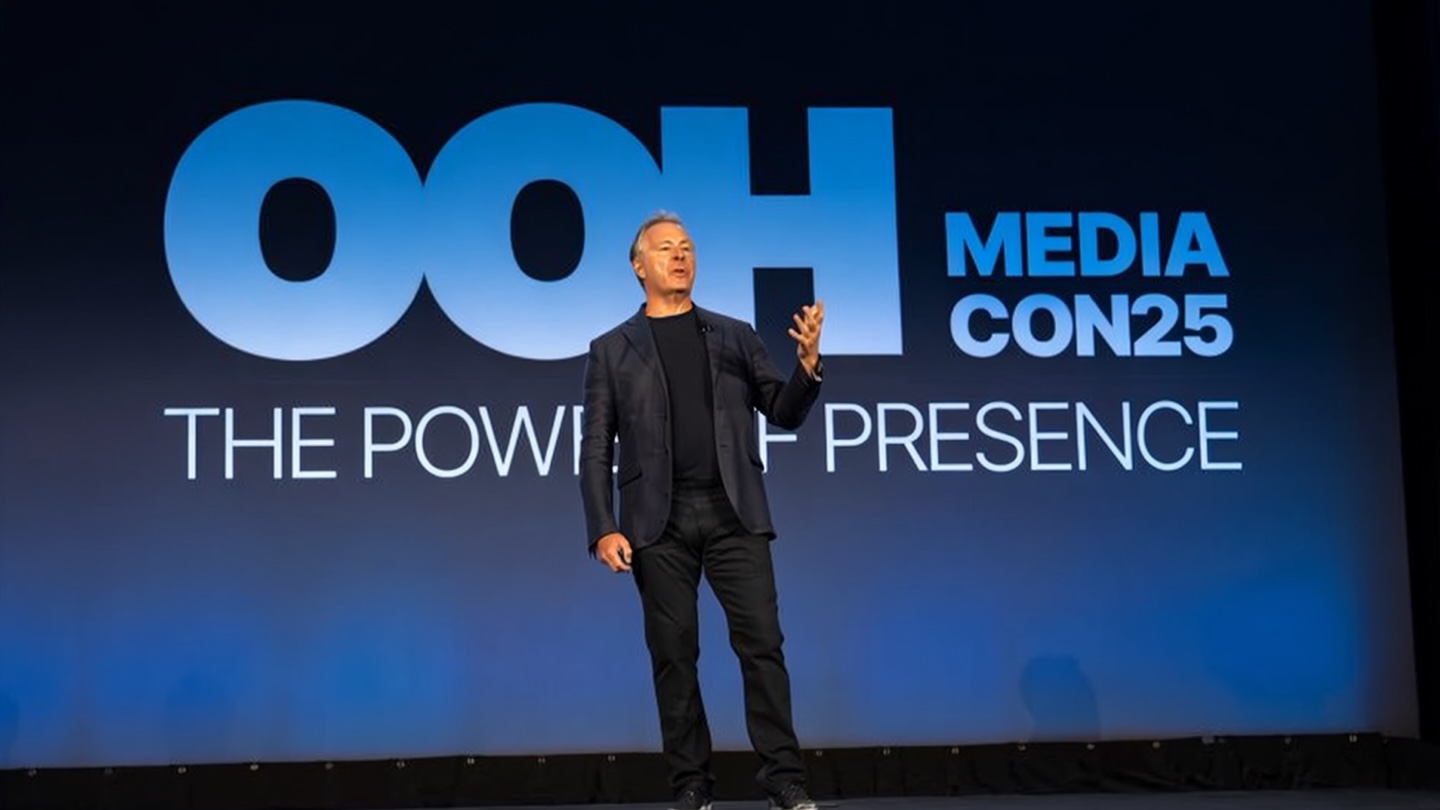
By June 2026, Brien was presenting a broader case at the World Out of Home Organization’s London congress. His argument connected public advertising to trust, participation, and measurable outcomes. He described a shift from an attention economy toward an action economy. The language places a heavier obligation on the seller: an advertisement should do something beyond being counted.
Trust sits at the center of that argument. He contends that shared physical environments offer brands something valuable in a media world divided into personal feeds. That is his proposition, rather than an automatic property of every poster. A public location gives an advertiser an opportunity; the creative work and the audience’s response determine what happens next.
His public appearances have carried the same theme beyond outdoor industry gatherings. At POSSIBLE in 2026, he discussed the move from out-of-home to in-real-life advertising with the New York Stock Exchange’s Kristen Scholer. The terminology broadens the sales conversation from a format to an experience. It also suits an executive whose career has repeatedly crossed the boundaries between creative work, distribution, technology, and commerce.
On October 15, 2026, the OAAA named him chairman of its board, succeeding Scott Wells and serving the remainder of the term through May 2027. That extends his brief from one company to an industry association. His stated priorities include digital modernization, trust, and better measurement. The agency buyer who changed sides now has a role in making the whole medium’s case.
The smaller numbers tell another story
Alongside those large organizations sits a smaller commitment at his former college. Brien launched scholarships for advertising and games design students in 2024. The Brien Family Scholarship listing provides three awards of £5,000 each, supporting students progressing toward their final year. Assessment considers financial need and academic merit, with support contributing to course costs and living expenses.
Advertising and games design. Support for course costs and living expenses, assessed on financial need and academic merit.
The subjects are revealing without requiring a theory about his private life. Advertising and games design correspond to two industries he has worked in. University support turns those professional connections into something usable by people at the beginning. The amounts are modest beside an agency budget, but they meet a different kind of deadline: the cost of finishing a course.
His relationship with STRIVE also predates the OUTFRONT appointment. He co-chaired its Women’s Empowerment Luncheon in 2018, and the organization later selected him as a gala honoree. These commitments add another dimension to a career usually described through corporate titles. They concern access to work and education, rather than the distribution of advertising spend.
Asked about his next chapter after leaving Dentsu, Brien once replied: “Of course it will be exciting. Otherwise, what’s the point?” The remark has survived several changes of business card. At OUTFRONT, the next chapter is unusually visible. Its working surface is the city itself, and its audience has somewhere else to be. That seems a useful discipline for anyone making a living from attention.
Follow the conversation
- OUTFRONTCompany website
- Nick Brien on LinkedInPersonal profile
- The October 2026 OAAA appointmentIndustry news
- The Brien Family ScholarshipEducation
- In conversation with the NYSEWatch · 2m 49s
- From OOH to IRL at POSSIBLEWatch · NYSE interview, May 2026
- Connecting television and digital advertisingWatch / read · Beet.TV, 2021
- The 2025 OUTFRONT appointmentCompany announcement
- A career, in his own wordsMediaPost · January 2020
- The 2026 London presentationWOO · June 2026