On November 18, 2006, Nick Beucher returned to face Tulane wearing a University of Central Florida uniform. Tulane recognised its former kicker. He had scored 45 points for the Green Wave in 2004; now he was handling kickoffs for the visitors. Tulane won 10-9. A single point settled the afternoon, which is the sort of detail a kicker is unlikely to regard as decorative.
Two decades later, Beucher’s name appears in conversations about a different football club, Tottenham Hotspur. He is co-chief executive of Tavistock Group, alongside Josh Levy, and CEO of Tavistock Development Company. His responsibilities reach from Florida real estate to investments overseas. The distance between his old kickoff duties and his place around Tottenham’s ownership group is considerable. Yet sport keeps turning up along the route.
There is another constant: Central Florida. Beucher was born in Orlando, studied at UCF and built a career around a company whose development headquarters are in Lake Nona. His work has become international without losing that local centre of gravity. To understand the executive at the table in London, it helps to start with the teenager doing jobs at a family business in Florida.
Before the boardroom, there was a resort
Beucher began working at 13 in his family’s business. His father, Bud, gave him jobs at the family’s Central Florida golf resort. Hospitality was part of his upbringing before it became part of his professional portfolio. A resort has rather practical ways of introducing a young person to business: people arrive, expect something and eventually decide whether they would come back.
At Lake Highland Preparatory School, his sporting life covered both versions of football. He lettered in soccer for four years as a defender, helping the team reach four playoffs. He also played a year of American football, taking on outside linebacker, kicking and punting duties. That is a busy job description for someone who still has homework.
Tulane’s roster records him as the oldest of four children, born July 9, 1985. He redshirted in 2003, then played his freshman season in 2004. He made 33 of 34 extra points and four of nine field goals. Those numbers have the useful quality of sporting statistics: they preserve the misses as faithfully as the successes. A résumé rarely offers such even-handed accounting.
A freshman season recorded in Tulane’s football archives.
A specialist’s place on the team
At UCF, Beucher joined another kicker, Michael Torres. In a March 2006 spring scrimmage, Beucher made attempts from 30, 37, 42 and 47 yards. His two misses came from 52. Coach George O’Leary praised both kickers. The small progression of distances gives this part of his biography a pleasing specificity. Here, at least, the goal was literally measurable.
An April practice ended with both men attempting 47-yard field goals. Torres missed left; Beucher made his. By August, rain and lightning had pushed the team indoors to Nicholson Fieldhouse, where another practice concluded with the two kickers attempting field goals. These are ordinary scenes from a football programme: repeated work, shared duties, weather interfering with the plan.
Beucher handled UCF’s kickoffs in the 2006 season. It was one specialist role among several, with Torres taking field goals and extra points. The old records give him a place within a team rather than a starring role above it. That distinction makes the sporting chapter more interesting. The future executive had a particular task, and everybody could see when it was his turn.
His university years also produced a different set of qualifications. At UCF he earned undergraduate degrees, an MBA and a master’s in sports business management. The combination put commercial study beside sporting experience. Years later, with Tottenham part of his professional orbit, the sports business degree would look less like a footnote and more like a thread that had remained in view.
The marina before the ribbon
In July 2017, Beucher appeared in coverage of Tavistock’s Pier Sixty-Six property as an asset manager. The company had acquired the Fort Lauderdale hotel and marina from Blackstone the previous December for nearly $163 million. It then closed a $50 million loan and bought an adjacent waterfront parcel, bringing its holdings there to nearly 36 acres.
Beucher supplied a precise clarification: the loan was not for the planned development. It is a modest moment in a large property story, but a revealing professional detail. The transaction, the existing asset and the future scheme were separate matters. Big plans tend to dominate the conversation; somebody still has to keep the financial descriptions straight.
By January 2025, he stood at the resort’s opening celebration as Tavistock Group’s co-CEO. The photograph places him at the left of the central ribbon-cutting line, holding oversized scissors beside development colleagues, hotel executives and city officials. Property has few ceremonies more cheerfully literal. After years of decisions, a ribbon finally gives everyone something uncomplicated to cut.
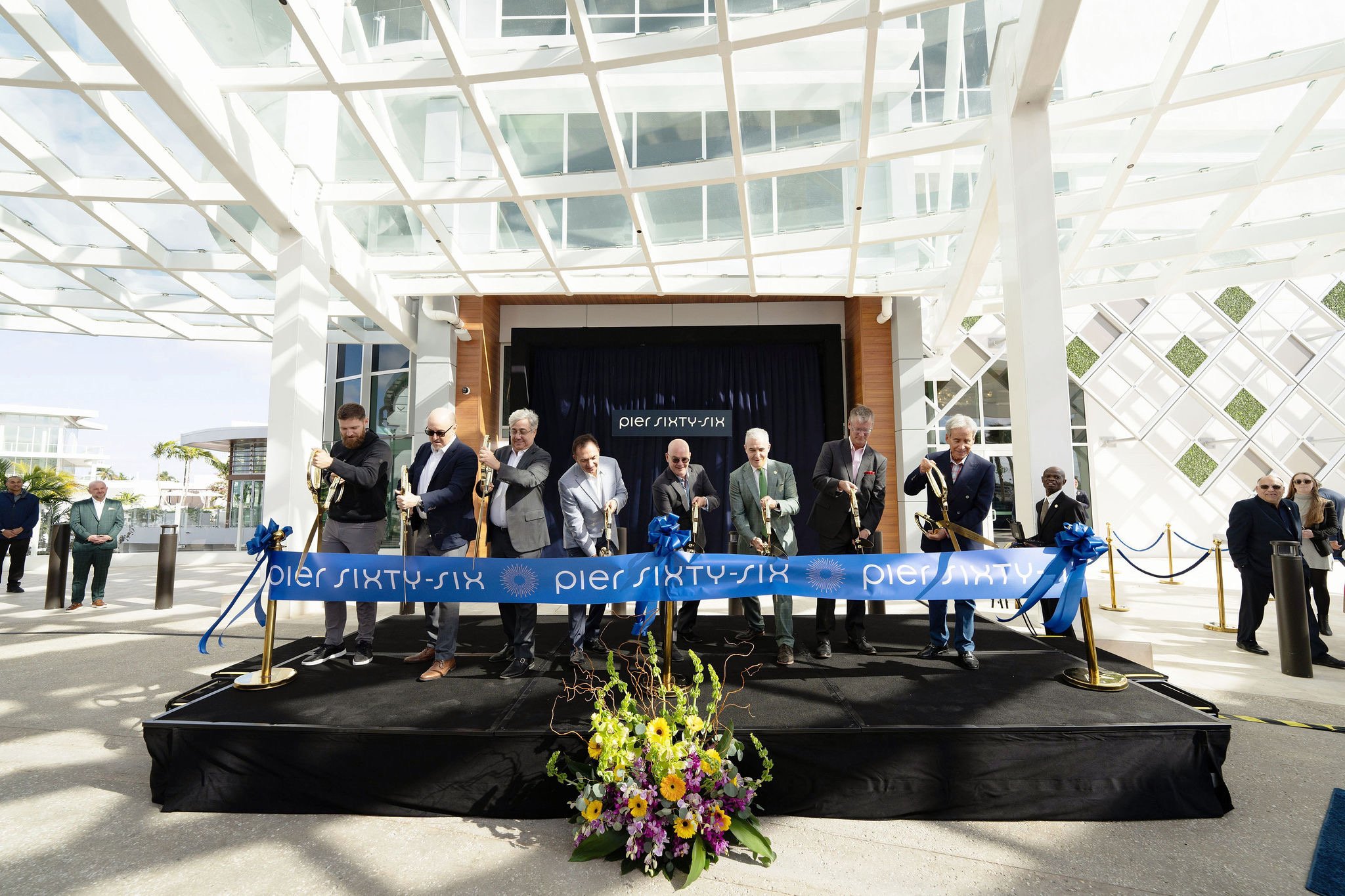
The reopened resort had 325 guest rooms and suites. Its wider redevelopment included a marina promenade and the property’s first residential offerings, comprising 88 condominiums and resort residences. A hotel, a waterfront and homes bring different expectations to the same address. Beucher’s involvement spans the less photogenic asset-management chapter and the day the doors were ready for guests.
The guest is part of the investment
By September 2020, Beucher was president of Tavistock Development. Lake Nona provided another setting for his work, with hospitality woven into a larger community. The Lake Nona Wave Hotel, with 234 rooms, became part of that setting. Its windows were among the technologies Beucher discussed publicly, bringing a development conversation down to something a guest could encounter from inside a room.
In a March 2022 announcement, he called View Smart Windows “a focal point” among the Wave Hotel’s technologies. The product automatically adjusted its tint in response to the sun. A window is an unusually domestic way to talk about innovation. It sits quietly between the room and the world outside, which is probably where most hotel guests would prefer the engineering to stay.
His remarks about CoralTree, the hotel management company, were equally practical. As its Lake Nona responsibilities expanded, Beucher spoke about extending the partnership across Tavistock’s hotels to create a “seamless and exceptional guest experience.” The four additional branded hotels represented 562 rooms. The words concern what happens after construction, when the building becomes somebody else’s weekend, work trip or first impression of a neighbourhood.
“a seamless and exceptional guest experience”
Nick Beucher, on expanding Tavistock’s Lake Nona partnership with CoralTree Hospitality
That operating dimension matters to his story. An investment in hospitality remains visible to its customers in hundreds of small ways. The development executive can approve a building; its daily use supplies another verdict. Beucher’s public remarks place the management relationship alongside the property itself, keeping attention on the people who will actually spend time there.
One Florida base, several kinds of responsibility
Beucher’s current development remit includes Lake Nona, Sunbridge, Infinity Park, Pier Sixty-Six and initiatives in Boston. The projects vary in character: a master-planned Orlando community, a development centred on nature, an industrial district and a waterfront resort. Together they show how much range can sit beneath a single real estate title.
At group level, the map widens further. His responsibilities include teams working on renewable energy in Argentina, sports and lifestyle brands and distribution in Mexico, hospitality through Nexus Luxury Collection, and real estate financing and asset management through 25 Capital. He also sits on Tavistock’s board and executive committee. The co-CEO title shares leadership with Josh Levy; the development title keeps Beucher directly connected to execution.
- OrlandoUCF and Lake Nona: education, football and development.
- Fort LauderdalePier Sixty-Six: an asset-management chapter followed by a resort opening.
- North LondonTottenham: the Lewis family’s interests meet the demands of a football club.
He also joined the Orlando Magic Youth Foundation board, a role noted in his July 2025 company biography. It reconnects the business career with sport and Central Florida through work supporting young residents. The geographical thread remains intact even as the investment map spreads. Orlando is both an early chapter and a continuing professional base.
A seat at a different football table
Beucher is married to Joanna Silverton, granddaughter of Joe Lewis and daughter of Vivienne Lewis. That family connection is part of the explanation for his place around Tottenham. Following Daniel Levy’s departure as executive chairman in September 2025, Beucher became more visible alongside Vivienne and Charles Lewis. His position joins a corporate role at Tavistock with a family relationship to the club’s controlling interests.
On January 19, 2026, then-head coach Thomas Frank described having lunch with Beucher, chief executive Vinai Venkatesham and sporting director Johan Lange. Frank said they talked about life, football and the club’s future. It was a brief glimpse of Beucher inside the conversations surrounding the team, away from the more familiar Florida development setting.
By September 2026, reporting on a further £120 million Lewis family investment identified Beucher and Vivienne Lewis as prominent figures in backing the club. The reported total of family investment over the preceding year reached £320 million. These were family investments, rather than a statement of Beucher’s personal wealth. The scale adds a financial dimension to his sporting connection, with supporters expecting results that capital alone cannot settle.
His path has carried him through places that people visit, inhabit and support. The teenager at a family resort became a college kicker, then a property executive with a place in a global investment firm. Tottenham adds another demanding public audience. Back in 2006, a one-point game supplied a brutally tidy verdict. The work now runs on longer calendars, but the people waiting for the next result have lost none of their impatience.